Odgers-Jewell Kate, Isenring Elisabeth A, Thomas Rae, Reidlinger Dianne P
Faculty of Health Sciences and Medicine, Bond University, Gold Coast, Queensland, Australia.
Centre for Research in Evidence-Based Practice, Bond University, Gold Coast, Queensland, Australia.
PLoS One. 2017 May 16;12(5):e0177688. doi: 10.1371/journal.pone.0177688. eCollection 2017.
The objective of this study was to explore the experiences of individuals who participated in a group-based education program, including their motivators in relation to their diabetes management, and the perceived impact of group interactions on participants' experiences and motivation for self-management. Understanding individuals diagnosed with diabetes experiences of group-based education for the management of type 2 diabetes mellitus may guide the development and facilitation of these programs.
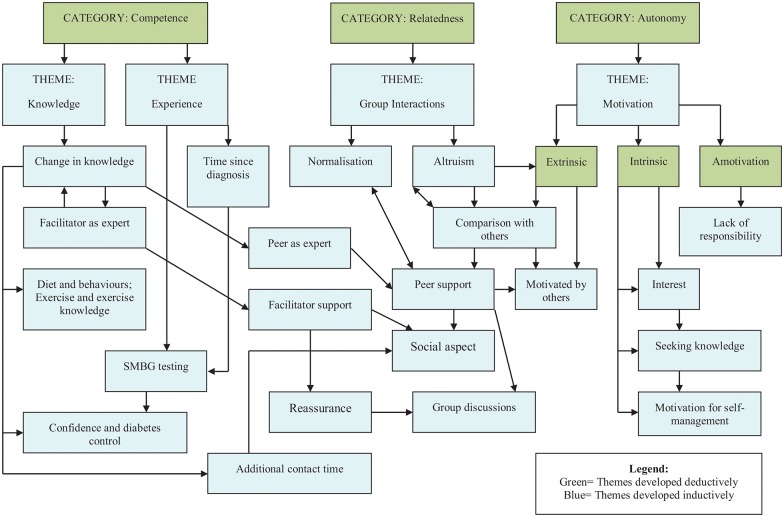
Semi-structured interviews were conducted with all individuals who participated in the intervention. Using thematic analysis underpinned by self-determination theory, we developed themes that explored participants' motivators in relation to diabetes management and the impact of group interactions on their experiences and motivation.
The key themes included knowledge, experience, group interactions and motivation. Participants perceived that the group interactions facilitated further learning and increased motivation, achieved through normalization, peer identification or by talking with, and learning from the experience of others.
The results support the use of patient-centred programs that prioritize group interactions over the didactic presentation of content, which may address relevant psychological needs of people diagnosed with type 2 diabetes mellitus, and improve their motivation and health behaviours. Future group-based education programs may benefit from the use of self-determination theory as a framework for intervention design to enhance participant motivation.
本研究的目的是探究参与基于小组的教育项目的个体的经历,包括他们在糖尿病管理方面的动机,以及小组互动对参与者经历和自我管理动机的感知影响。了解被诊断为糖尿病的个体参与2型糖尿病管理的小组教育经历,可能会为这些项目的开发和实施提供指导。
对所有参与干预的个体进行了半结构化访谈。运用以自我决定理论为基础的主题分析方法,我们确定了一些主题,这些主题探讨了参与者在糖尿病管理方面的动机,以及小组互动对他们的经历和动机产生的影响。
关键主题包括知识、经验、小组互动和动机。参与者认为,通过正常化、同伴认同或与他人交流并从他人的经验中学习,小组互动促进了进一步学习并增强了动机。
研究结果支持使用以患者为中心的项目,这些项目将小组互动置于内容的讲授式呈现之上,这可能满足被诊断为2型糖尿病患者的相关心理需求,并改善他们的动机和健康行为。未来基于小组的教育项目可能会受益于将自我决定理论用作干预设计框架,以增强参与者的动机。