Wang Shuo, Song Jieyun, Yang Yide, Chawla Nitesh V, Ma Jun, Wang Haijun
Institute of Child and Adolescent Health of Peking University, School of Public Health, Peking University Health Science Center, Beijing, China.
Interdisciplinary Center for Network Science and Applications (iCeNSA), University of Notre Dame, Notre Dame, IN, United States of America.
PLoS One. 2017 May 16;12(5):e0177983. doi: 10.1371/journal.pone.0177983. eCollection 2017.
Recent studies indicated that eating behaviors are under genetic influence, and the melanocortin 4 receptor (MC4R) gene polymorphisms can affect the total energy intake and the consumption of fat, protein and carbohydrates. Our study aims at investigating the association of the MC4R polymorphism with appetite and food intake among Chinese children.
A family-based association study was conducted among 151 Chinese trios whose offsprings were overweight/obese children aged 9-15 years. The rs12970134 near MC4R was genotyped, and the Children Eating Behavior Questionnaire (CEBQ) and a self-designed questionnaire measuring food intake were performed. The FBAT and PBAT software packages were used.
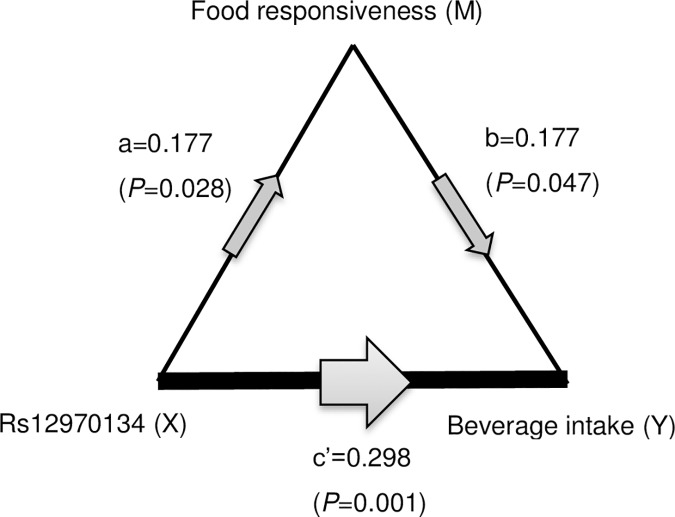
The family-based association analysis showed that there was a significant association between rs12970134 and obesity (Z = 2.449, P = 0.014). After adjusting for age, gender and standardized BMI, rs12970134 was significantly associated with food responsiveness (FR) among children (β'b = 0.077, Pb = 0.028), and with satiety responsiveness (SR) in trios (P = -0.026). The polymorphism was associated with beverage intake (β'b = 0.331, Pb = 0.00016 in children; P = 0.043 in trios), but not significantly associated with vegetable, fruit or meat intake (P>0.050). We further found a significant mediation effect among the rs12970134, FR and beverage intake (b = 0.177, P = 0.047).
Our study is the first to report that rs12970134 near MC4R was associated with appetite and beverage intake, and food responsiveness could mediate the effect of rs12970134 on beverage intake in overweight and obese Chinese children population. Further studies are needed to uncover the genetic basis for eating behaviors, which could lead to develop and implement effective interventional strategies early in life.
近期研究表明,饮食行为受遗传影响,黑皮质素4受体(MC4R)基因多态性可影响总能量摄入以及脂肪、蛋白质和碳水化合物的消耗。我们的研究旨在调查中国儿童中MC4R基因多态性与食欲及食物摄入量之间的关联。
对151个中国三口之家进行了基于家庭的关联研究,这些家庭的后代为9至15岁的超重/肥胖儿童。对MC4R附近的rs12970134进行基因分型,并采用儿童饮食行为问卷(CEBQ)和自行设计的测量食物摄入量的问卷。使用了FBAT和PBAT软件包。
基于家庭的关联分析显示,rs12970134与肥胖之间存在显著关联(Z = 2.449,P = 0.014)。在调整年龄、性别和标准化BMI后,rs12970134与儿童的食物反应性(FR)显著相关(β'b = 0.077,Pb = 0.028),与三口之家的饱腹感反应性(SR)相关(P = -0.026)。该多态性与饮料摄入量相关(儿童中β'b = 0.331,Pb = 0.00016;三口之家中P = 0.043),但与蔬菜、水果或肉类摄入量无显著关联(P>0.050)。我们进一步发现rs12970134、FR和饮料摄入量之间存在显著中介效应(b = 0.177,P = 0.并实施有效的干预策略。
我们的研究首次报告,MC4R附近的rs12970134与食欲和饮料摄入量相关,且食物反应性可介导rs12970134对超重和肥胖中国儿童饮料摄入量的影响。需要进一步研究以揭示饮食行为的遗传基础,这可能有助于在生命早期制定并实施有效的干预策略。