Dai Xingbin, Ji Yanhua, Jiang Pengjun, Sun Xuemei
Department of Hematology, Affiliated Hospital of Nanjing University of Traditional Chinese Medicine, Nanjing, Jiangsu 210029, P.R. China.
School of Life Science and Technology, China Pharmaceutical University, Nanjing, Jiangsu 210009, P.R. China.
Oncol Lett. 2017 May;13(5):2897-2902. doi: 10.3892/ol.2017.5831. Epub 2017 Mar 8.
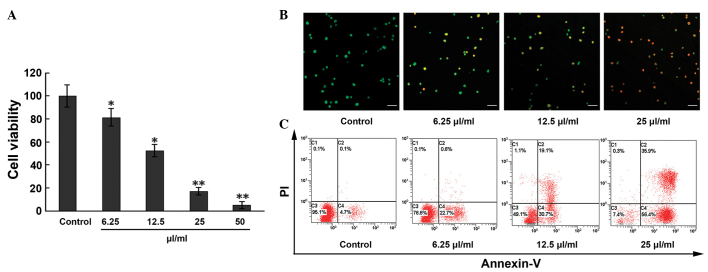
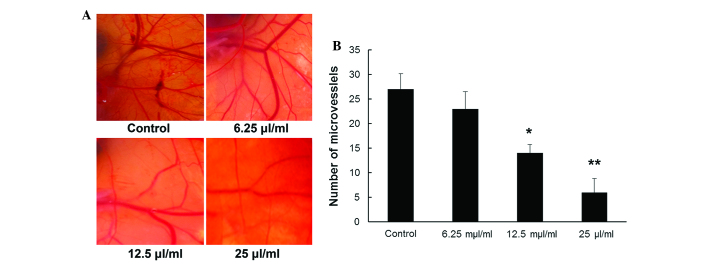
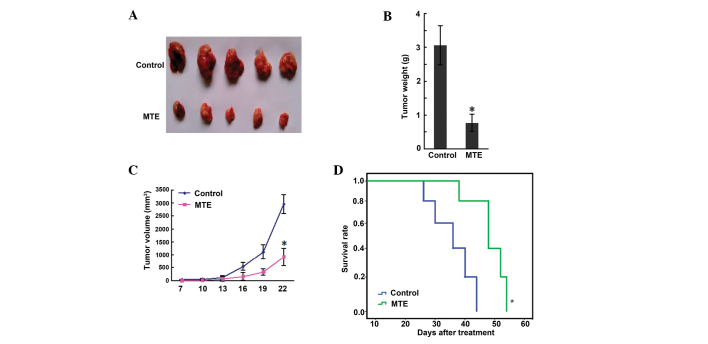
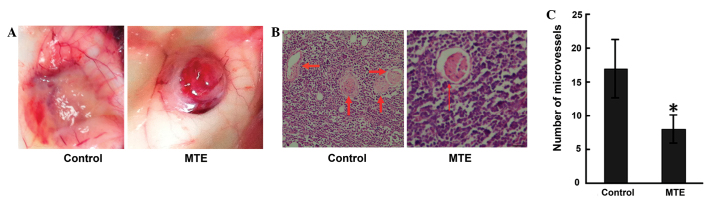
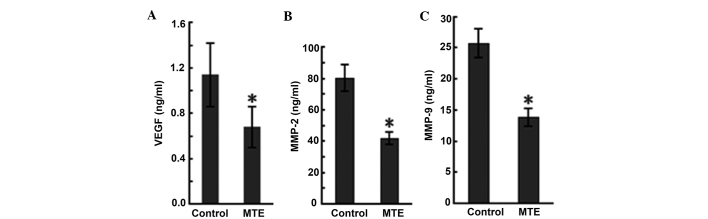
(MT), a traditional Chinese medicine, has been utilized in the treatment of a variety of malignant conditions for decades, but the underlying mechanism remains unclear. Angiogenesis, new blood vessel formation by nearby endothelial cells (ECs) from pre-existing vessels, plays a key role in cancer growth. In the present study, the effects of MT extract (MTE) on EC proliferation and apoptosis , and on A20 mouse lymphoma growth and angiogenesis were investigated. MTE exhibited an anti-proliferative effect on the ECs, with a half maximal inhibitory concentration of 11.91±0.24 µl/ml. Acridine orange/propidium iodide staining indicated that cell apoptosis increased with MTE concentration. Flow cytometry revealed that the EC apoptosis rates induced by 0, 6.25, 12.5 and 25 µl/ml MTE were 4.8, 23.3, 49.8 and 92.3%, respectively. , the volume and weight of the A20 solid tumors were significantly inhibited following administration of 300 µl MTE per day for 14 days (P<0.05). MTE showed extended survivability and a satisfactory security. Subsequent to treatment with MTE, peritumorous angiogenesis was significantly reduced, with lower microvessel density (P<0.05) was quantified by hemotoxylin and eosin staining. Moreover, serum vascular endothelial growth factor, matrix metalloproteinase (MMP)-2 and MMP-9 expression at the protein level in the MTE-treated group, quantified using an ELISA, was significantly lower than that of the control (P<0.05). In a chick chorioallantoic membrane assay, 12.5 and 25 µl/ml MTE distinctly decreased the level of angiogenesis (P<0.05). In conclusion, MTE exhibited potent anti-lymphoma efficacy and this may be associated with its effects against tumor angiogenesis.
中药莪术(MT)已被用于治疗多种恶性疾病数十年,但其潜在机制仍不清楚。血管生成是指由先前存在的血管附近的内皮细胞(ECs)形成新的血管,在癌症生长中起关键作用。在本研究中,研究了莪术提取物(MTE)对EC增殖和凋亡以及对A20小鼠淋巴瘤生长和血管生成的影响。MTE对ECs具有抗增殖作用,半数最大抑制浓度为11.91±0.24微升/毫升。吖啶橙/碘化丙啶染色表明,细胞凋亡随MTE浓度增加而增加。流式细胞术显示,0、6.25、12.5和25微升/毫升MTE诱导的EC凋亡率分别为4.8%、23.3%、49.8%和92.3%。每天给予300微升MTE,持续14天,A20实体瘤的体积和重量受到显著抑制(P<0.05)。MTE显示出延长的生存期和良好的安全性。用MTE治疗后,肿瘤周围血管生成显著减少,苏木精和伊红染色定量显示微血管密度较低(P<0.05)。此外,使用酶联免疫吸附测定法(ELISA)定量,MTE治疗组血清血管内皮生长因子、基质金属蛋白酶(MMP)-2和MMP-9的蛋白水平表达明显低于对照组(P<0.05)。在鸡胚绒毛尿囊膜试验中,12.5和25微升/毫升MTE明显降低了血管生成水平(P<0.05)。总之,MTE表现出强大的抗淋巴瘤功效,这可能与其对肿瘤血管生成的作用有关。