Ng Justin H J, Tachedjian Mary, Wang Lin-Fa, Baker Michelle L
CSIRO Australian Animal Health Laboratory, Health and Biosecurity Business Unit, Geelong, VIC, 3220, Australia.
Faculty of Veterinary Science, University of Sydney, Sydney, NSW, 2006, Australia.
BMC Genomics. 2017 May 18;18(1):388. doi: 10.1186/s12864-017-3760-0.
Bats are an extremely successful group of mammals and possess a variety of unique characteristics, including their ability to co-exist with a diverse range of pathogens. The major histocompatibility complex (MHC) is the most gene dense and polymorphic region of the genome and MHC class II (MHC-II) molecules play a vital role in the presentation of antigens derived from extracellular pathogens and activation of the adaptive immune response. Characterisation of the MHC-II region of bats is crucial for understanding the evolution of the MHC and of the role of pathogens in shaping the immune system.
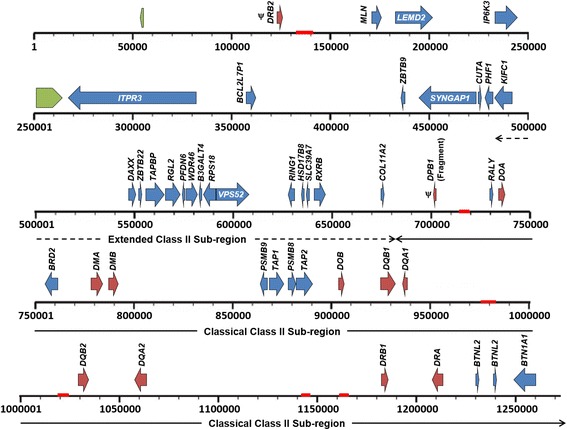
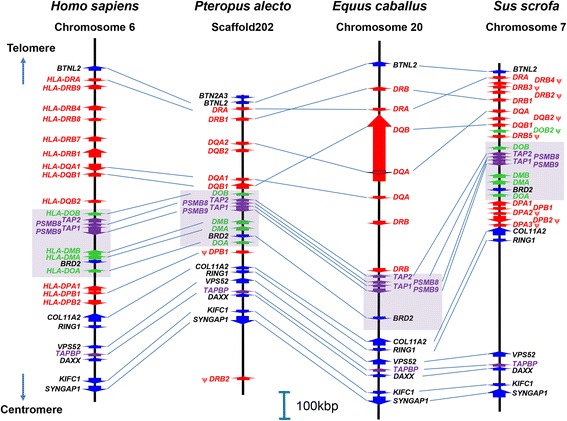
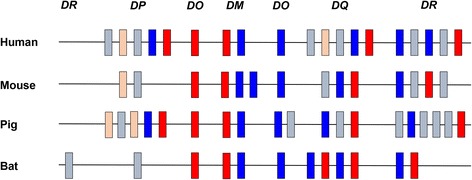
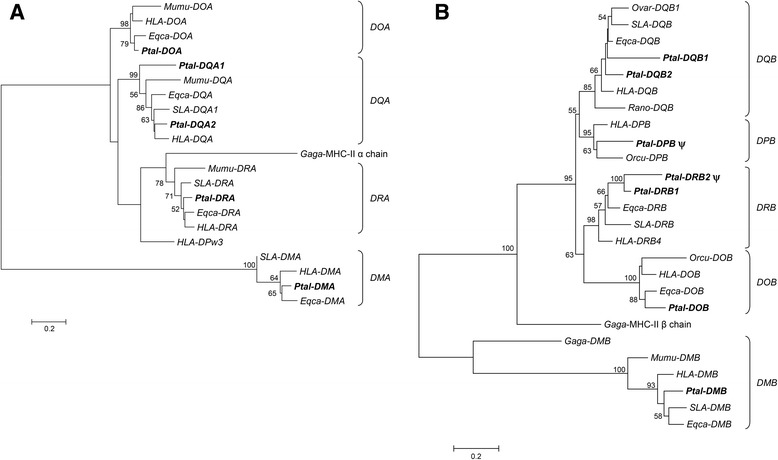
Here we describe the relatively contracted MHC-II region of the Australian black flying-fox (Pteropus alecto), providing the first detailed insight into the MHC-II region of any species of bat. Twelve MHC-II genes, including one locus (DRB2) located outside the class II region, were identified on a single scaffold in the bat genome. The presence of a class II locus outside the MHC-II region is atypical and provides evidence for an ancient class II duplication block. Two non-classical loci, DO and DM and two classical, DQ and DR loci, were identified in P. alecto. A putative classical, DPB pseudogene was also identified. The bat's antigen processing cluster, though contracted, remains highly conserved, thus supporting its importance in antigen presentation and disease resistance.
This detailed characterisation of the bat MHC-II region helps to fill a phylogenetic gap in the evolution of the mammalian class II region and is a stepping stone towards better understanding of the immune responses in bats to viral, bacterial, fungal and parasitic infections.
蝙蝠是一类极其成功的哺乳动物,具有多种独特特征,包括它们与多种病原体共存的能力。主要组织相容性复合体(MHC)是基因组中基因密度最高且多态性最高的区域,MHC II类(MHC-II)分子在呈递源自细胞外病原体的抗原以及激活适应性免疫反应中起着至关重要的作用。对蝙蝠MHC-II区域的表征对于理解MHC的进化以及病原体在塑造免疫系统中的作用至关重要。
在此,我们描述了澳大利亚黑狐蝠(Pteropus alecto)相对收缩的MHC-II区域,首次对任何蝙蝠物种的MHC-II区域提供了详细的见解。在蝙蝠基因组的单个支架上鉴定出了12个MHC-II基因,其中包括一个位于II类区域之外的基因座(DRB2)。在MHC-II区域之外存在一个II类基因座是非典型的,这为古老的II类重复块提供了证据。在黑狐蝠中鉴定出了两个非经典基因座DO和DM以及两个经典基因座DQ和DR。还鉴定出了一个推定的经典DPB假基因。蝙蝠的抗原加工簇虽然收缩,但仍然高度保守,从而支持了其在抗原呈递和抗病性方面的重要性。
对蝙蝠MHC-II区域的这一详细表征有助于填补哺乳动物II类区域进化中的系统发育空白,是朝着更好地理解蝙蝠对病毒、细菌、真菌和寄生虫感染的免疫反应迈出的重要一步。