Ho Jemima, Moyes David L, Tavassoli Mahvash, Naglik Julian R
Mucosal & Salivary Biology Division, Dental Institute, King's College London SE1 1UL, UK.
Centre for Host Microbiome interactions, Mucosal & Salivary Biology Division, Dental Institute, King's College London SE1 1UL, UK.
Trends Microbiol. 2017 Nov;25(11):942-952. doi: 10.1016/j.tim.2017.04.009. Epub 2017 May 15.
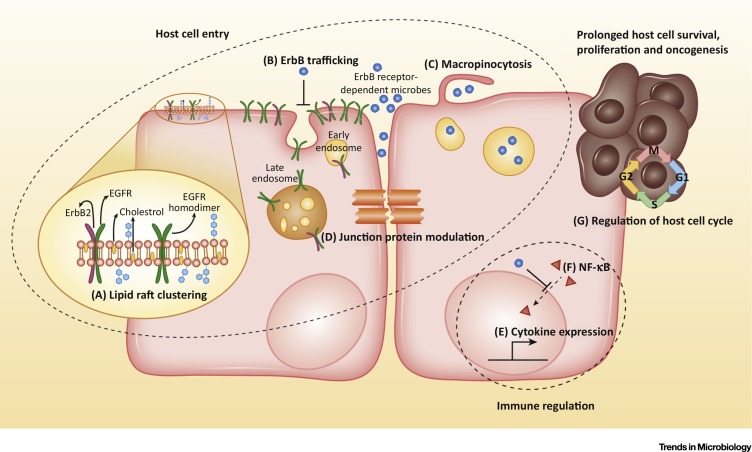
Members of the epidermal growth factor receptor family (ErbB family) possess a wide distribution and diverse functions ranging from cellular growth to migration and apoptosis. Though highly implicated in a variety of cancers, their involvement in infectious disease is less recognised. A growing body of evidence now highlights the importance of the ErbB family in a variety of infections. Their role as growth factor receptors, along with other characteristics, such as surface expression and continuous intracellular trafficking, make this receptor family ideally placed for exploitation by pathogens. Herein, we review our current understanding of the role of the ErbB family in the context of infectious disease, exploring the mechanisms that govern pathogen exploitation of this system.
表皮生长因子受体家族(ErbB家族)成员分布广泛,功能多样,涵盖细胞生长、迁移和凋亡等方面。尽管它们与多种癌症密切相关,但在传染病中的作用却鲜为人知。现在,越来越多的证据凸显了ErbB家族在多种感染中的重要性。它们作为生长因子受体的作用,以及其他特性,如表面表达和持续的细胞内运输,使这个受体家族成为病原体理想的利用对象。在此,我们回顾了目前对ErbB家族在传染病背景下作用的理解,探讨了病原体利用该系统的机制。