Department of Psychiatry, Psychotherapy and Psychosomatics Medical School RWTH Aachen University Aachen Germany.
JARA-Translational Brain MedicineJülichGermany.
Brain Behav. 2017 Apr 5;7(5):e00691. doi: 10.1002/brb3.691. eCollection 2017 May.
Recent research found gender-related differences in resting-state functional connectivity (rs-FC) measured by functional magnetic resonance imaging (fMRI). To the best of our knowledge, there are no studies examining the differences in rs-FC between men, women, and individuals who report a discrepancy between their anatomical sex and their gender identity, i.e. gender dysphoria (GD).
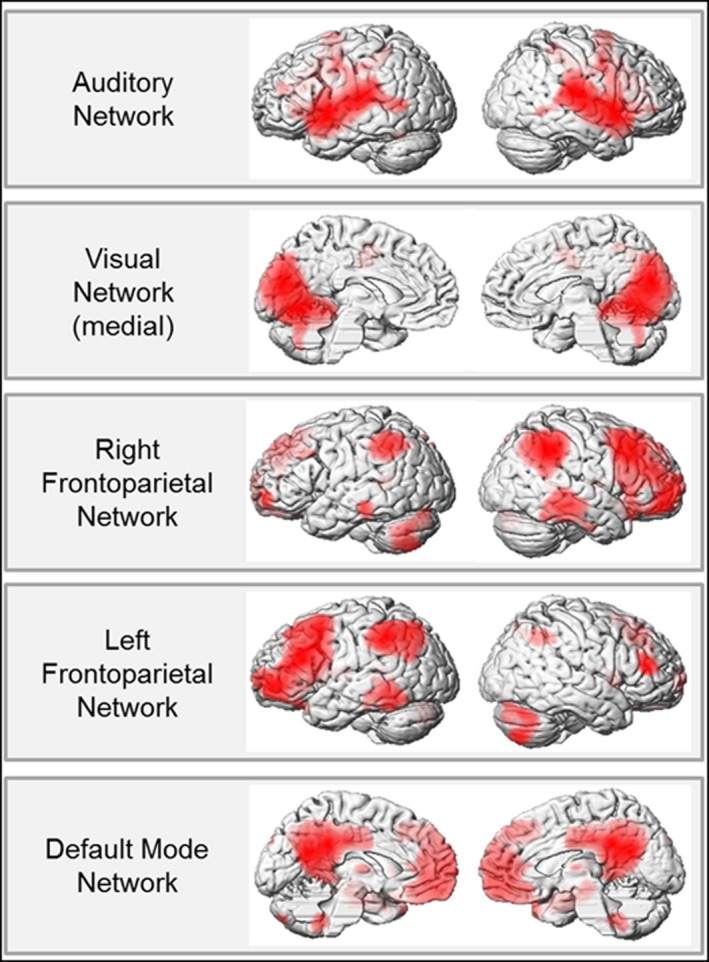
To address this important issue, we present the first fMRI study systematically investigating the differences in typical resting-state networks (RSNs) and hormonal treatment effects in 26 male-to-female GD individuals (MtFs) compared with 19 men and 20 women.
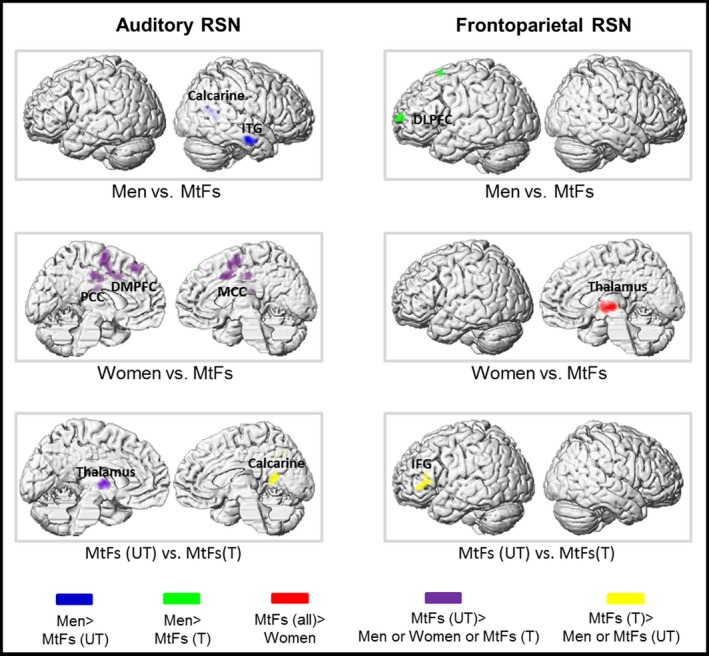
Differences between male and female control groups were found only in the auditory RSN, whereas differences between both control groups and MtFs were found in the auditory and fronto-parietal RSNs, including both primary sensory areas (e.g. calcarine gyrus) and higher order cognitive areas such as the middle and posterior cingulate and dorsomedial prefrontal cortex. Overall, differences in MtFs compared with men and women were more pronounced before cross-sex hormonal treatment. Interestingly, rs-FC between MtFs and women did not differ significantly after treatment. When comparing hormonally untreated and treated MtFs, we found differences in connectivity of the calcarine gyrus and thalamus in the context of the auditory network, as well as the inferior frontal gyrus in context of the fronto-parietal network.
Our results provide first evidence that MtFs exhibit patterns of rs-FC which are different from both their assigned and their aspired gender, indicating an intermediate position between the two sexes. We suggest that the present study constitutes a starting point for future research designed to clarify whether the brains of individuals with GD are more similar to their assigned or their aspired gender.
最近的研究发现,功能磁共振成像(fMRI)测量的静息态功能连接(rs-FC)存在性别相关差异。据我们所知,目前还没有研究检查男性、女性以及报告其解剖性别与其性别认同(即性别焦虑症(GD))不符的个体之间 rs-FC 的差异。
为了解决这个重要问题,我们首次进行 fMRI 研究,系统地比较了 26 名男性到女性 GD 个体(MtFs)与 19 名男性和 20 名女性之间典型静息态网络(RSNs)的差异和激素治疗效果。
仅在听觉 RSN 中发现男性和女性对照组之间的差异,而在听觉和额顶叶 RSN 中发现两组对照组和 MtFs 之间的差异,包括初级感觉区域(例如,楔前回)和更高阶认知区域,如中后扣带和背内侧前额皮质。总体而言,与男性和女性相比,MtFs 之间的差异在接受跨性别激素治疗之前更为明显。有趣的是,治疗后 MtFs 与男性和女性之间的 rs-FC 差异不显著。当比较未接受和接受激素治疗的 MtFs 时,我们发现听觉网络中楔前回和丘脑以及额顶叶网络中额下回的连接存在差异。
我们的研究结果首次提供了证据,表明 MtFs 表现出的 rs-FC 模式与他们的分配性别和期望性别都不同,表明他们处于两性之间的中间位置。我们建议,本研究为未来旨在阐明 GD 个体的大脑更类似于其分配性别还是期望性别提供了一个起点。