Damas O M, Avalos D J, Palacio A M, Gomez L, Quintero M A, Deshpande A R, Sussman D A, McCauley J L, Lopez J, Schwartz S J, Abreu M T
Division of Gastroenterology, Department of Medicine, University of Miami Miller School of Medicine, Miami, FL, USA.
Department of Medicine, University of Miami/JFK Medical Center GME Consortium, West Palm Beach, FL, USA.
Aliment Pharmacol Ther. 2017 Aug;46(3):303-309. doi: 10.1111/apt.14145. Epub 2017 May 19.
Despite a rising incidence of inflammatory bowel disease (IBD) in Hispanics in the United States, there are no studies examining the relationship between immigrant generation and IBD onset among Hispanics.
To determine whether age of IBD diagnosis, time from immigration to IBD diagnosis and IBD phenotype, differed across immigration periods in South Florida Cuban immigrants.
This was a cohort of consecutively identified Cuban-born adults who developed IBD in the United States and were followed in gastroenterology (GI) clinic. We divided time cohorts of immigration by historical relevance: before 1980, 1980-1994 and 1995-to-present. We examined differences across time cohorts in diagnosis age, time from immigration to IBD diagnosis, and IBD phenotype (ie, IBD type, disease location).
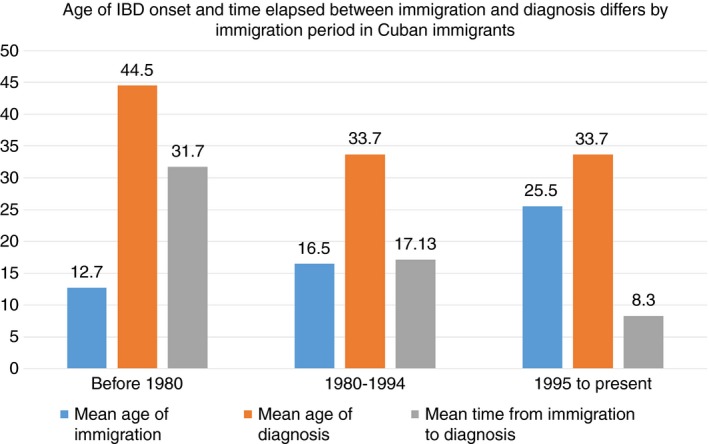
A total of 130 Cuban patients with IBD were included. Age of IBD diagnosis was older in Cubans arriving before 1980 than in those arriving between 1980-1994 or after 1995 (44.7 vs 33.79 and 33.71, respectively, P<.0001). Time between immigration and diagnosis was shorter in patients arriving to the US after 1980 (31.77 years, Standard deviation (SD) 12.83 (<1980) vs 17.13 years, SD 8.55 (1980-1994) and 8.30 years, SD 4.72 (1995-to-present). IBD phenotype, including type of IBD, disease location and surgeries, did not differ significantly across time cohorts.
Our study describes changing patterns of IBD onset following immigration in Cubans, suggesting that environmental changes either in the United States, Cuba or both are resulting in faster IBD onset in younger immigrant generations. These studies can inform the search for environmental triggers that may result in IBD.
尽管美国西班牙裔人群中炎症性肠病(IBD)的发病率不断上升,但尚无研究探讨移民代次与西班牙裔IBD发病之间的关系。
确定南佛罗里达古巴移民在不同移民时期的IBD诊断年龄、从移民到IBD诊断的时间以及IBD表型是否存在差异。
这是一组连续确诊的在美国患IBD的古巴出生成年人,他们在胃肠病学(GI)诊所接受随访。我们根据历史相关性将移民时间队列分为:1980年以前、1980 - 1994年和1995年至今。我们研究了不同时间队列在诊断年龄、从移民到IBD诊断的时间以及IBD表型(即IBD类型、疾病部位)方面的差异。
共纳入130例患IBD的古巴患者。1980年以前抵达的古巴人IBD诊断年龄比1980 - 1994年或1995年以后抵达的人更大(分别为44.7岁、33.79岁和33.71岁,P <.0001)。1980年以后抵达美国的患者从移民到诊断的时间更短(1980年以前为31.77年,标准差(SD)12.83;(1980 - 1994年为17.13年,SD 8.55;1995年至今为8.30年,SD 4.72)。IBD表型,包括IBD类型、疾病部位和手术情况,在不同时间队列之间没有显著差异。
我们的研究描述了古巴移民后IBD发病模式的变化,表明美国、古巴或两者的环境变化导致年轻移民代次中IBD发病更快。这些研究可为寻找可能导致IBD的环境触发因素提供参考。