International Center for Materials Nanoarchitectonics (MANA), National Institute for Materials Science (NIMS), 1-1 Namiki, Tsukuba, Ibaraki 305-0044, Japan.
Faculty of Science and Engineering, Waseda University, 3-4-1 Okubo, Shinjuku, Tokyo 169-8555, Japan.
Nat Commun. 2017 May 19;8:15581. doi: 10.1038/ncomms15581.
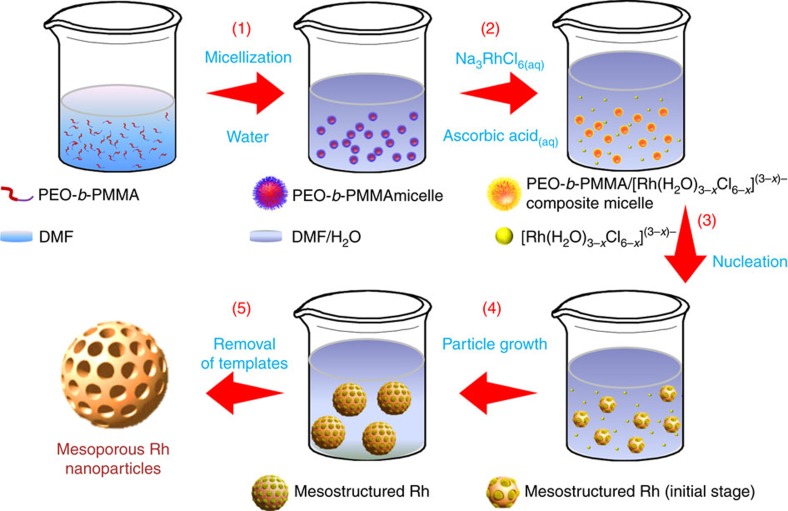
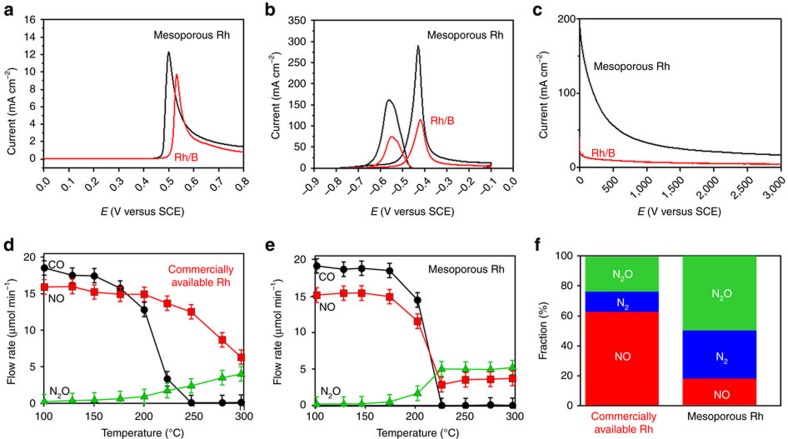
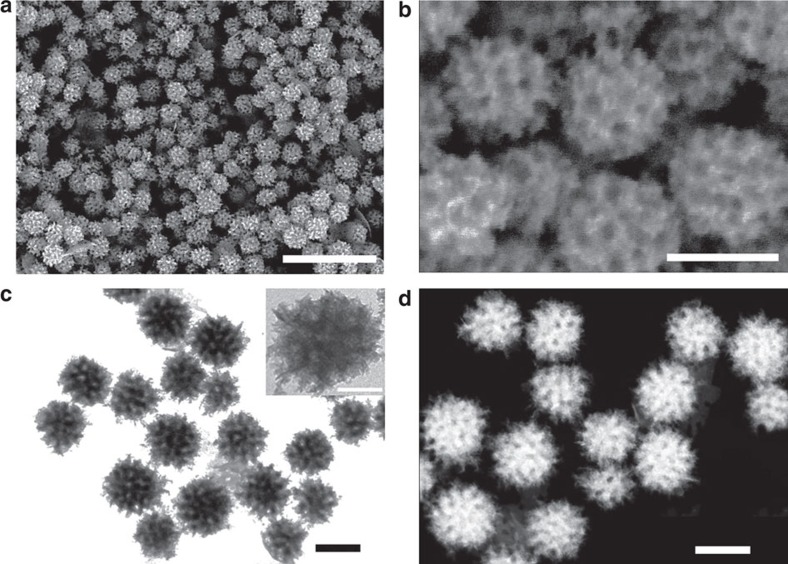
Mesoporous noble metals are an emerging class of cutting-edge nanostructured catalysts due to their abundant exposed active sites and highly accessible surfaces. Although various noble metal (e.g. Pt, Pd and Au) structures have been synthesized by hard- and soft-templating methods, mesoporous rhodium (Rh) nanoparticles have never been generated via chemical reduction, in part due to the relatively high surface energy of rhodium (Rh) metal. Here we describe a simple, scalable route to generate mesoporous Rh by chemical reduction on polymeric micelle templates [poly(ethylene oxide)-b-poly(methyl methacrylate) (PEO-b-PMMA)]. The mesoporous Rh nanoparticles exhibited a ∼2.6 times enhancement for the electrocatalytic oxidation of methanol compared to commercially available Rh catalyst. Surprisingly, the high surface area mesoporous structure of the Rh catalyst was thermally stable up to 400 °C. The combination of high surface area and thermal stability also enables superior catalytic activity for the remediation of nitric oxide (NO) in lean-burn exhaust containing high concentrations of O.
介孔贵金属由于其丰富的暴露活性位和高可及表面,是一类新兴的前沿纳米结构催化剂。尽管已经通过硬模板和软模板法合成了各种贵金属(例如 Pt、Pd 和 Au)结构,但从未通过化学还原法生成介孔铑(Rh)纳米颗粒,部分原因是铑(Rh)金属的表面能相对较高。在这里,我们描述了一种在聚合物胶束模板[聚(氧化乙烯)-b-聚(甲基丙烯酸甲酯)(PEO-b-PMMA)]上通过化学还原生成介孔 Rh 的简单、可扩展的方法。与市售 Rh 催化剂相比,介孔 Rh 纳米颗粒对甲醇的电催化氧化表现出约 2.6 倍的增强。令人惊讶的是,Rh 催化剂的高表面积介孔结构在高达 400°C 的温度下热稳定。高表面积和热稳定性的结合还使该 Rh 催化剂在含有高浓度 O 的贫燃废气中修复一氧化氮(NO)的催化活性更优。