Department of Materials, ‡Institute of Biomedical Engineering, and §Department of Bioengineering, Imperial College London , Exhibition Road, London, SW7 2AZ, U.K.
J Am Chem Soc. 2017 May 31;139(21):7250-7255. doi: 10.1021/jacs.7b00528. Epub 2017 May 19.
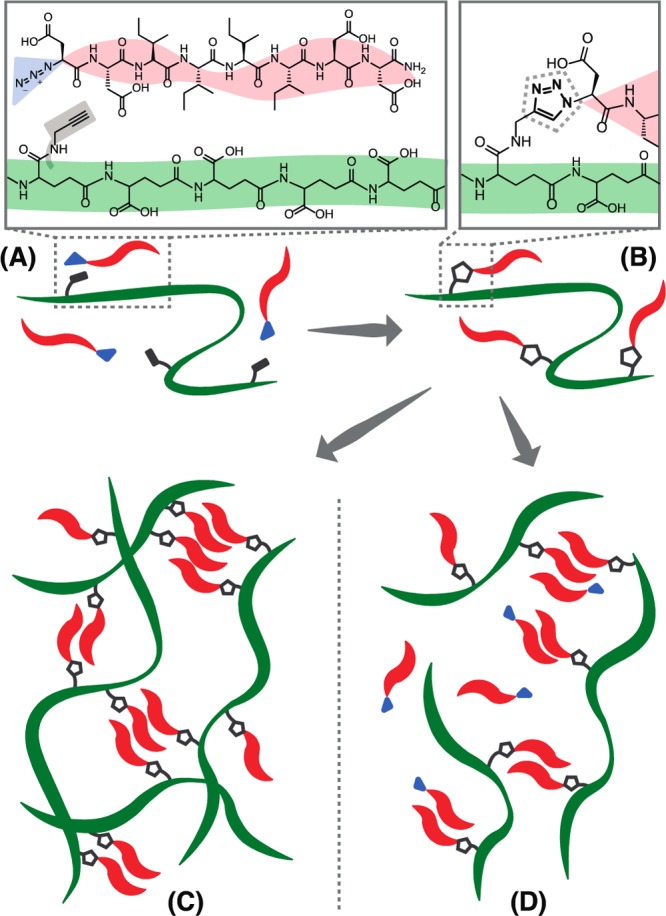
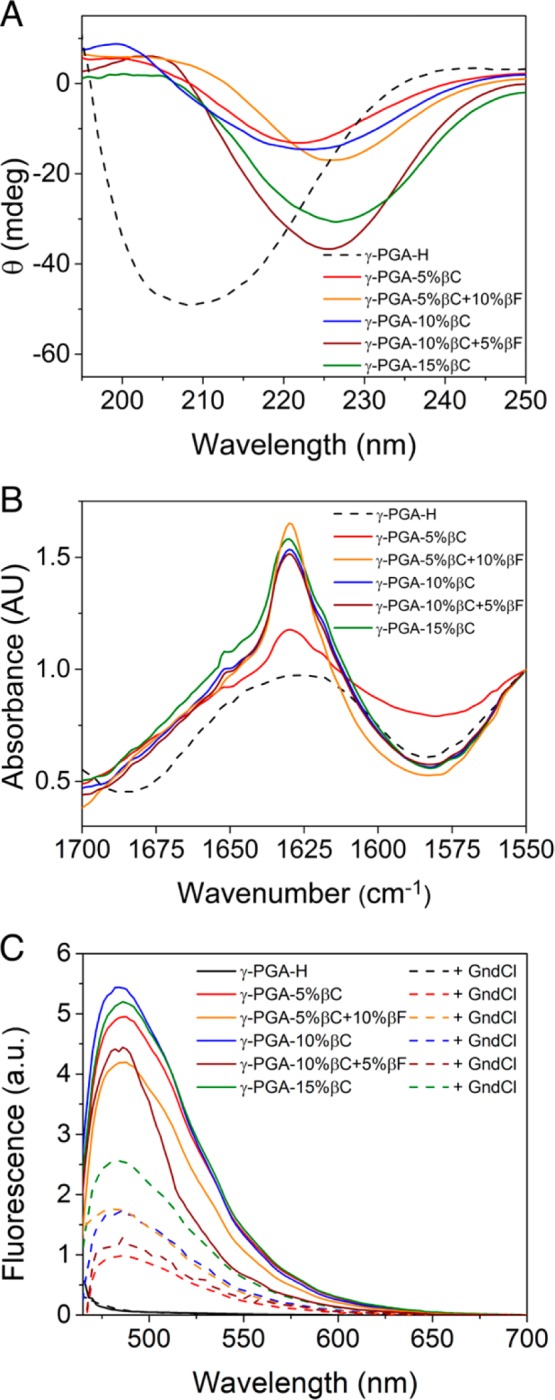
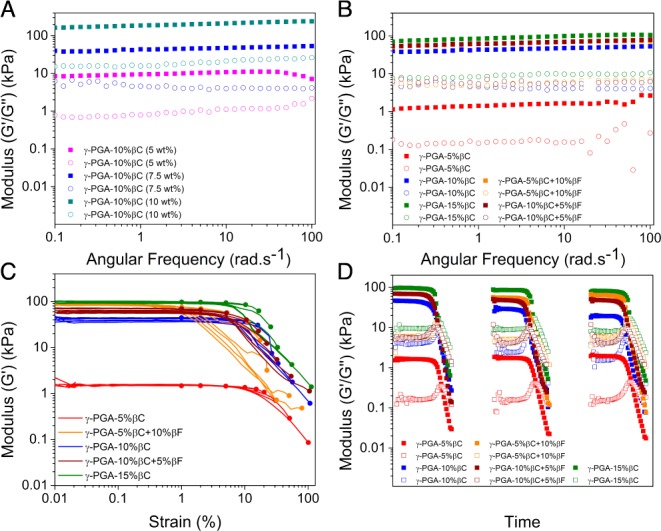
Self-assembled biomaterials are an important class of materials that can be injected and formed in situ. However, they often are not able to meet the mechanical properties necessary for many biological applications, losing mechanical properties at low strains. We synthesized hybrid hydrogels consisting of a poly(γ-glutamic acid) polymer network physically cross-linked via grafted self-assembling β-sheet peptides to provide non-covalent cross-linking through β-sheet assembly, reinforced with a polymer backbone to improve strain stability. By altering the β-sheet peptide graft density and concentration, we can tailor the mechanical properties of the hydrogels over an order of magnitude range of 10-200 kPa, which is in the region of many soft tissues. Also, due to the ability of the non-covalent β-sheet cross-links to reassemble, the hydrogels can self-heal after being strained to failure, in most cases recovering all of their original storage moduli. Using a combination of spectroscopic techniques, we were able to probe the secondary structure of the materials and verify the presence of β-sheets within the hybrid hydrogels. Since the polymer backbone requires less than a 15% functionalization of its repeating units with β-sheet peptides to form a hydrogel, it can easily be modified further to incorporate specific biological epitopes. This self-healing polymer-β-sheet peptide hybrid hydrogel with tailorable mechanical properties is a promising platform for future tissue-engineering scaffolds and biomedical applications.
自组装生物材料是一类重要的材料,可以进行注射和原位成型。然而,它们通常无法满足许多生物应用所需的机械性能,在低应变时失去机械性能。我们合成了由聚(γ-谷氨酸)聚合物网络组成的杂化水凝胶,该聚合物网络通过接枝的自组装β-折叠肽物理交联,通过β-折叠组装提供非共价交联,并用聚合物主链增强以提高应变稳定性。通过改变β-折叠肽接枝密度和浓度,我们可以在 10-200kPa 的数量级范围内调整水凝胶的机械性能,这在许多软组织的范围内。此外,由于非共价β-折叠交联能够重新组装,水凝胶在应变至失效后可以自修复,在大多数情况下可以恢复其原始储能模量的全部。我们使用一系列光谱技术来探测材料的二级结构,并验证杂化水凝胶中β-折叠的存在。由于聚合物主链只需不到其重复单元的 15%用β-折叠肽官能化即可形成水凝胶,因此可以很容易地进一步修饰以引入特定的生物表位。这种具有可调节机械性能的自修复聚合物-β-折叠肽杂化水凝胶是未来组织工程支架和生物医学应用的有前途的平台。