Vieux Florent, Maillot Matthieu, Constant Florence, Drewnowski Adam
MS-Nutrition, Faculté de Médecine La Timone, Marseille, France.
Nestlé Waters M.T, 12 boulevard Garibaldi, 92130, Issy-les-Moulineaux, France.
BMC Public Health. 2017 May 19;17(1):479. doi: 10.1186/s12889-017-4400-y.
The UK government has announced a tax on sugar-sweetened beverages. The aim of this study was to assess consumption patterns for plain drinking water relative to sugary beverages among UK children.
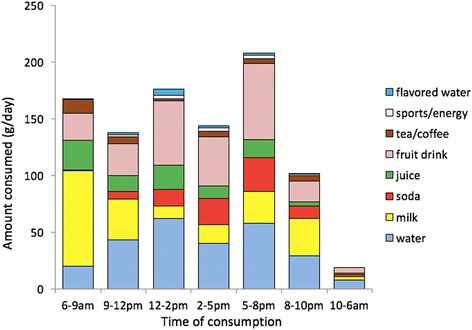
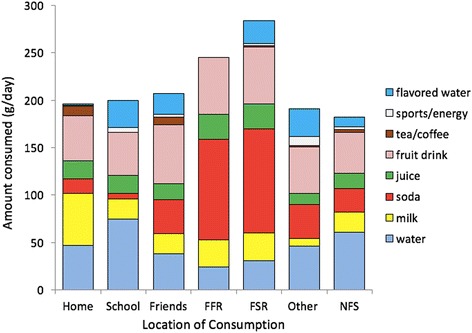
Dietary intake data for 845 children aged 4-13 years came from the nationally representative cross-sectional National Diet and Nutrition Survey, 2008-2011. Beverage categories were drinking water (tap or bottled), milk, 100% fruit juices, soda, fruit drinks, tea, coffee, sports drinks, flavored waters, and liquid supplements. Consumption patterns were examined by age group, gender, household incomes, time and location of consumption, region and seasonality. Total water consumption from drinking water, beverages, and foods, and the water-to-calorie ratios (L/kcal) were compared to the EFSA (European Food Safety Authority) adequate intake standards.
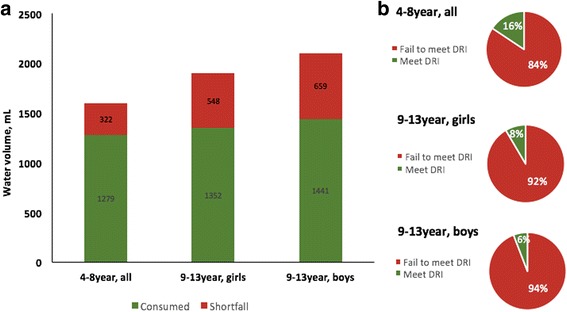
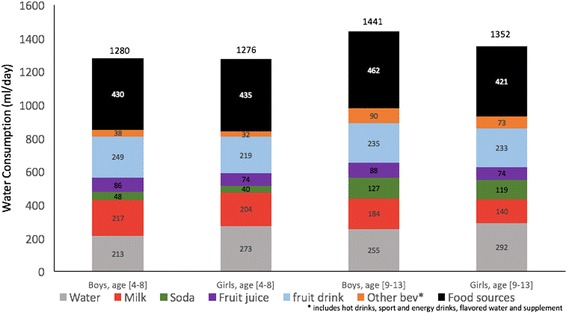
Total water intake (1338 ml/d) came from plain water (19%), beverages (48%), and food moisture (33%). Plain drinking water provided 258 g/d (241 g/d for children aged 4-8 years; 274 g/d for 9-13 years), mostly (83.8%) from tap. Water and beverages supplied 901 g /d of water. Tap water consumption increased with income and was highest in the South of England. The consumption of bottled water, soda, tea and coffee increased with age, whereas milk consumption declined. About 88.7% of children did not meet EFSA adequate intake standards. The daily water shortfall ranged from 322 ml/d to 659 ml/d. Water-to-calorie ratio was 0.845 L/1000 kcal short of desirable levels of 1.0-1.5 L/1000 kcal.
Total water intake were at 74.8% of EFSA reference values. Drinking water consumption among children in the UK was well below US and French estimates.
英国政府已宣布对含糖饮料征税。本研究的目的是评估英国儿童中相对于含糖饮料而言的普通饮用水消费模式。
845名4至13岁儿童的饮食摄入数据来自具有全国代表性的2008 - 2011年横断面全国饮食与营养调查。饮料类别包括饮用水(自来水或瓶装水)、牛奶、100%果汁、汽水、果汁饮料、茶、咖啡、运动饮料、调味水和液体补充剂。按年龄组、性别、家庭收入、消费时间和地点、地区以及季节性对消费模式进行了研究。将饮用水、饮料和食物中的总水摄入量以及水与卡路里的比率(升/千卡)与欧洲食品安全局(EFSA)的充足摄入量标准进行了比较。
总水摄入量(1338毫升/天)来自普通水(19%)、饮料(48%)和食物水分(33%)。普通饮用水提供258克/天(4至8岁儿童为241克/天;9至13岁为274克/天),大部分(83.8%)来自自来水。水和饮料提供了901克/天的水。自来水消费量随收入增加而增加,在英格兰南部最高。瓶装水、汽水、茶和咖啡的消费量随年龄增长而增加,而牛奶消费量下降。约88.7%的儿童未达到EFSA充足摄入量标准。每日水缺口在322毫升/天至659毫升/天之间。水与卡路里的比率比理想水平1.0 - 1.5升/1000千卡低0.845升/1000千卡。
总水摄入量为EFSA参考值的74.8%。英国儿童的饮用水消费量远低于美国和法国的估计值。