• 文献检索
  • 文档翻译
  • 深度研究
  • 学术资讯
  • Suppr Zotero 插件Zotero 插件
  • 邀请有礼
  • 套餐&价格
  • 历史记录
应用&插件
Suppr Zotero 插件Zotero 插件浏览器插件Mac 客户端Windows 客户端微信小程序
定价
高级版会员购买积分包购买API积分包
服务
文献检索文档翻译深度研究API 文档MCP 服务
关于我们
关于 Suppr公司介绍联系我们用户协议隐私条款
关注我们

Suppr 超能文献

核心技术专利:CN118964589B侵权必究
粤ICP备2023148730 号-1Suppr @ 2026

文献检索

告别复杂PubMed语法,用中文像聊天一样搜索,搜遍4000万医学文献。AI智能推荐,让科研检索更轻松。

立即免费搜索

文件翻译

保留排版,准确专业,支持PDF/Word/PPT等文件格式,支持 12+语言互译。

免费翻译文档

深度研究

AI帮你快速写综述,25分钟生成高质量综述,智能提取关键信息,辅助科研写作。

立即免费体验

英国成年人 24/7 随时都在喝饮料:与总水分摄入和能量摄入有关。

Beverage consumption habits "24/7" among British adults: association with total water intake and energy intake.

机构信息

Sig-Nurture Ltd., Guildford, Surrey Gu1 2TF, UK.

出版信息

Nutr J. 2013 Jan 10;12:9. doi: 10.1186/1475-2891-12-9.

DOI:10.1186/1475-2891-12-9
PMID:23305461
原文链接:https://pmc.ncbi.nlm.nih.gov/articles/PMC3575376/
Abstract

BACKGROUND

Various recommendations exist for total water intake (TWI), yet it is seldom reported in dietary surveys. Few studies have examined how real-life consumption patterns, including beverage type, variety and timing relate to TWI and energy intake (EI).

METHODS

We analysed weighed dietary records from the National Diet and Nutrition Survey of 1724 British adults aged 19-64 years (2000/2001) to investigate beverage consumption patterns over 24 hrs and 7 days and associations with TWI and EI. TWI was calculated from the nutrient composition of each item of food and drink and compared with reference values.

RESULTS

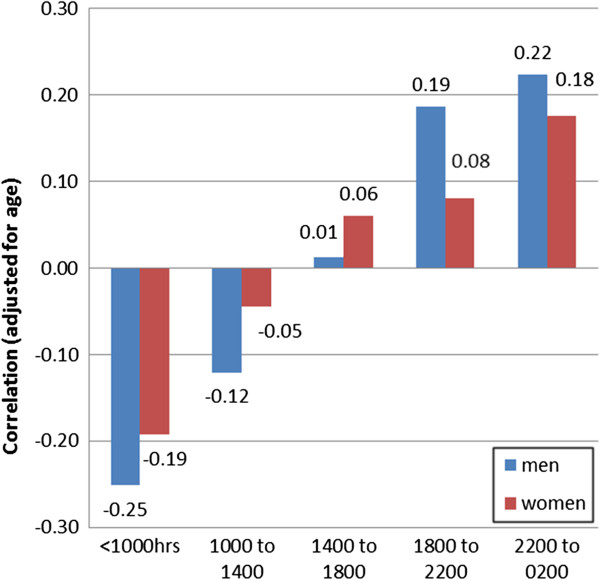
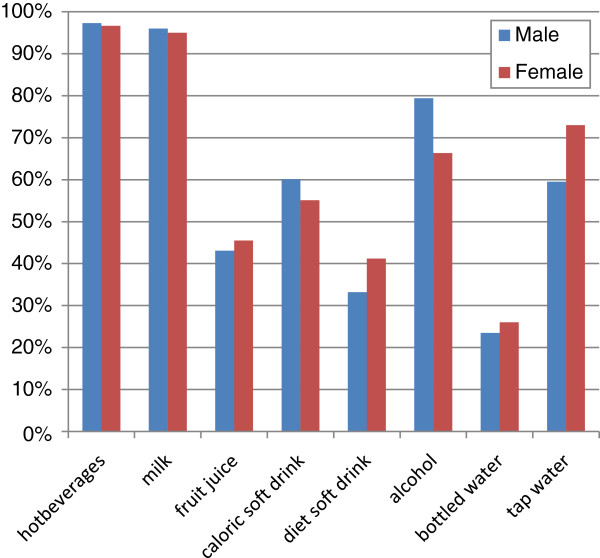
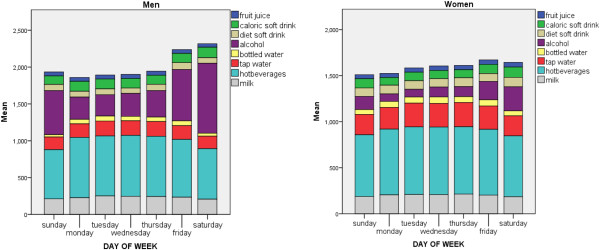
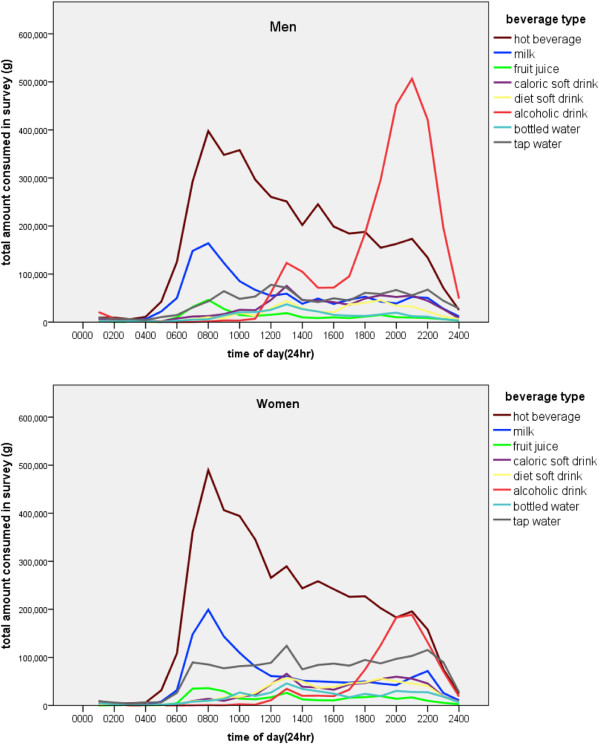
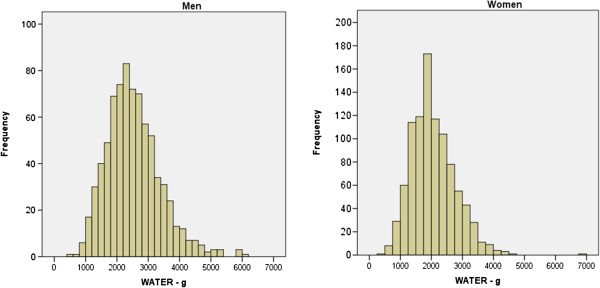
Mean TWI was 2.53 L (SD 0.86) for men and 2.03 L (SD 0.71) for women, close to the European Food Safety Authority "adequate Intake" (AI) of 2.5 L and 2 L, respectively. However, for 33% of men and 23% of women TWI was below AI and TWI:EI ratio was <1 g/kcal. Beverages accounted for 75% of TWI. Beverage variety was correlated with TWI (r 0.34) and more weakly with EI (r 0.16). Beverage consumption peaked at 0800 hrs (mainly hot beverages/ milk) and 2100 hrs (mainly alcohol). Total beverage consumption was higher at weekends, especially among men. Overall, beverages supplied 16% of EI (men 17%, women 14%), alcoholic drinks contributed 9% (men) and 5% (women), milk 5-6%, caloric soft drinks 2%, and fruit juice 1%.In multi-variable regression (adjusted for sex, age, body weight, smoking, dieting, activity level and mis-reporting), replacing 100 g of caloric beverages (milk, fruit juice, caloric soft drinks and alcohol) with 100 g non-caloric drinks (diet soft drinks, hot beverages and water) was associated with a reduction in EI of 15 kcal, or 34 kcal if food energy were unchanged. Using within-person data (deviations from 7-day mean) each 100 g change in caloric beverages was associated with 29 kcal change in EI or 35 kcal if food energy were constant. By comparison the calculated energy content of caloric drinks consumed was 47 kcal/100 g.

CONCLUSIONS

TWI and beverage consumption are closely related, and some individuals appeared to have low TWI. Compensation for energy from beverages may occur but is partial. A better understanding of interactions between drinking and eating habits and their impact on water and energy balance would give a firmer basis to dietary recommendations.

摘要

背景

有各种各样的关于总饮水量(TWI)的建议,但在饮食调查中很少有报道。很少有研究探讨现实生活中的消费模式,包括饮料类型、种类和时间,与 TWI 和能量摄入(EI)之间的关系。

方法

我们分析了 1724 名年龄在 19-64 岁的英国成年人的全国饮食与营养调查的称重饮食记录,以调查 24 小时和 7 天内的饮料消费模式,并研究其与 TWI 和 EI 的关系。TWI 是根据每种食物和饮料的营养成分计算出来的,并与参考值进行了比较。

结果

男性的平均 TWI 为 2.53 升(SD 0.86),女性为 2.03 升(SD 0.71),接近欧洲食品安全局(EFSA)分别为 2.5 升和 2 升的“适宜摄入量”(AI)。然而,33%的男性和 23%的女性的 TWI 低于 AI,且 TWI:EI 比值<1g/kcal。饮料占 TWI 的 75%。饮料种类与 TWI(r 0.34)呈正相关,与 EI(r 0.16)的相关性较弱。饮料消费高峰出现在 0800 小时(主要是热饮/牛奶)和 2100 小时(主要是酒精)。周末的总饮料消费更高,尤其是男性。总的来说,饮料提供了 16%的 EI(男性 17%,女性 14%),酒精饮料占 9%(男性)和 5%(女性),牛奶占 5-6%,含热量软饮料占 2%,果汁占 1%。在多变量回归(按性别、年龄、体重、吸烟、节食、活动水平和报告错误调整)中,用 100 克无热量饮料(无糖软饮料、热饮和水)代替 100 克含热量饮料(牛奶、果汁、含热量软饮料和酒精)与 EI 减少 15 卡路里相关,如果食物能量不变,则减少 34 卡路里。如果使用个体内数据(7 天平均值的偏差),则每 100 克含热量饮料的变化与 EI 变化 29 卡路里相关,如果食物能量不变,则与 EI 变化 35 卡路里相关。相比之下,计算出的含热量饮料的能量含量为每 100 克 47 卡路里。

结论

TWI 和饮料消费密切相关,一些人似乎 TWI 较低。可能会从饮料中补偿能量,但这种补偿是部分的。更好地了解饮食和饮食习惯之间的相互作用及其对水和能量平衡的影响,将为饮食建议提供更坚实的基础。
https://cdn.ncbi.nlm.nih.gov/pmc/blobs/344d/3575376/ac20352eb52d/1475-2891-12-9-5.jpg
https://cdn.ncbi.nlm.nih.gov/pmc/blobs/344d/3575376/b7d7e6fc4e71/1475-2891-12-9-1.jpg
https://cdn.ncbi.nlm.nih.gov/pmc/blobs/344d/3575376/1c9cec9dd419/1475-2891-12-9-2.jpg
https://cdn.ncbi.nlm.nih.gov/pmc/blobs/344d/3575376/7ae4bfd13f75/1475-2891-12-9-3.jpg
https://cdn.ncbi.nlm.nih.gov/pmc/blobs/344d/3575376/3a92afb9262a/1475-2891-12-9-4.jpg
https://cdn.ncbi.nlm.nih.gov/pmc/blobs/344d/3575376/ac20352eb52d/1475-2891-12-9-5.jpg
https://cdn.ncbi.nlm.nih.gov/pmc/blobs/344d/3575376/b7d7e6fc4e71/1475-2891-12-9-1.jpg
https://cdn.ncbi.nlm.nih.gov/pmc/blobs/344d/3575376/1c9cec9dd419/1475-2891-12-9-2.jpg
https://cdn.ncbi.nlm.nih.gov/pmc/blobs/344d/3575376/7ae4bfd13f75/1475-2891-12-9-3.jpg
https://cdn.ncbi.nlm.nih.gov/pmc/blobs/344d/3575376/3a92afb9262a/1475-2891-12-9-4.jpg
https://cdn.ncbi.nlm.nih.gov/pmc/blobs/344d/3575376/ac20352eb52d/1475-2891-12-9-5.jpg

相似文献

1
Beverage consumption habits "24/7" among British adults: association with total water intake and energy intake.英国成年人 24/7 随时都在喝饮料:与总水分摄入和能量摄入有关。
Nutr J. 2013 Jan 10;12:9. doi: 10.1186/1475-2891-12-9.
2
Characteristics of Beverage Consumption Habits among a Large Sample of French Adults: Associations with Total Water and Energy Intakes.大量法国成年人样本的饮料消费习惯特征:与总水摄入量和能量摄入量的关联
Nutrients. 2016 Oct 11;8(10):627. doi: 10.3390/nu8100627.
3
Beverage Consumption among Adults in the Balearic Islands: Association with Total Water and Energy Intake.巴利阿里群岛成年人的饮料消费:与总水和能量摄入的关联。
Nutrients. 2018 Aug 23;10(9):1149. doi: 10.3390/nu10091149.
4
Beverage Consumption Habits and Association with Total Water and Energy Intakes in the Spanish Population: Findings of the ANIBES Study.西班牙人群的饮料消费习惯及其与总水摄入量和能量摄入量的关联:ANIBES研究结果
Nutrients. 2016 Apr 20;8(4):232. doi: 10.3390/nu8040232.
5
Beverage intake among preschool children and its effect on weight status.学龄前儿童的饮料摄入量及其对体重状况的影响。
Pediatrics. 2006 Oct;118(4):e1010-8. doi: 10.1542/peds.2005-2348.
6
Water and beverage consumption among adults in the United States: cross-sectional study using data from NHANES 2005-2010.美国成年人的水和饮料消费:使用 NHANES 2005-2010 数据的横断面研究。
BMC Public Health. 2013 Nov 12;13:1068. doi: 10.1186/1471-2458-13-1068.
7
Beverage Consumption Habits in Italian Population: Association with Total Water Intake and Energy Intake.意大利人群的饮料消费习惯:与总水摄入量和能量摄入量的关联。
Nutrients. 2016 Oct 26;8(11):674. doi: 10.3390/nu8110674.
8
Changes in beverage consumption in Canada.加拿大饮料消费的变化。
Health Rep. 2019 Jul 17;30(7):20-30. doi: 10.25318/82-003-x201900700003-eng.
9
Water and beverage consumption patterns among 4 to 13-year-old children in the United Kingdom.英国4至13岁儿童的水及饮料消费模式。
BMC Public Health. 2017 May 19;17(1):479. doi: 10.1186/s12889-017-4400-y.
10
Beverage consumption and energy intake among Canadians: analyses of 2004 and 2015 national dietary intake data.加拿大的饮料消费和能量摄入:2004 年和 2015 年全国饮食摄入数据的分析。
Nutr J. 2019 Oct 18;18(1):60. doi: 10.1186/s12937-019-0488-5.

引用本文的文献

1
Patterns of Beverage Consumption Among Saudi Residents and Associated Demographic Factors: A Nationwide Survey.沙特居民的饮料消费模式及相关人口统计学因素:一项全国性调查。
Nutrients. 2025 Jun 30;17(13):2182. doi: 10.3390/nu17132182.
2
Potential impact of alcohol calorie labelling on the attitudes and drinking behaviour of hazardous and low-risk drinkers in England: a national survey.酒精卡路里标签对英国危险和低风险饮酒者态度和饮酒行为的潜在影响:一项全国性调查。
BMJ Open. 2024 Sep 18;14(8):e087491. doi: 10.1136/bmjopen-2024-087491.
3
Qualitative analysis of UK women's attitudes to calorie-based alcohol marketing and alcohol calorie labelling.

本文引用的文献

1
Diet-obesity associations in children: approaches to counteract attenuation caused by misreporting.儿童饮食-肥胖关联:应对归因性偏误导致的衰减效应的方法。
Public Health Nutr. 2013 Feb;16(2):256-66. doi: 10.1017/S1368980012004491. Epub 2012 Oct 9.
2
Beverage consumption, appetite, and energy intake: what did you expect?饮料消费、食欲和能量摄入:你期望得到什么?
Am J Clin Nutr. 2012 Mar;95(3):587-93. doi: 10.3945/ajcn.111.025437. Epub 2012 Jan 18.
3
Patterns and trends of beverage consumption among children and adults in Great Britain, 1986-2009.
英国女性对基于卡路里的酒精营销和酒精卡路里标签的态度的定性分析。
Health Promot Int. 2024 Feb 1;39(1). doi: 10.1093/heapro/daae006.
4
Gender Differences in Body Satisfaction Perception: The Role of Nutritional Habits, Psychological Traits, and Physical Activity in a Strength-Training Population.性别在身体满意度感知上的差异:营养习惯、心理特征和体育活动在力量训练人群中的作用。
Nutrients. 2023 Dec 28;16(1):104. doi: 10.3390/nu16010104.
5
Representational shifts: increasing motivation for bottled water through simulation-enhancing advertisements.代表性转变:通过模拟增强广告提高对瓶装水的购买动机。
BMC Public Health. 2023 Nov 9;23(1):2209. doi: 10.1186/s12889-023-17109-1.
6
Fluid intake at work in foresters working in different thermal conditions.在不同热环境下工作的林务员在工作时的液体摄入量。
Sci Rep. 2023 Sep 23;13(1):15870. doi: 10.1038/s41598-023-41652-x.
7
Energy labelling of alcoholic drinks: An important or inconsequential obesity policy?酒精饮料的能量标签:一项重要的还是无关紧要的肥胖政策?
Obes Sci Pract. 2022 Sep 23;9(2):75-86. doi: 10.1002/osp4.638. eCollection 2023 Apr.
8
Estrogen to Progesterone Ratio and Fluid Regulatory Responses to Varying Degrees and Methods of Dehydration.雌激素与孕酮比值以及对不同程度和脱水方法的液体调节反应。
Front Sports Act Living. 2021 Oct 14;3:722305. doi: 10.3389/fspor.2021.722305. eCollection 2021.
9
Adult diet in England: Where is more support needed to achieve dietary recommendations?英格兰成年人的饮食:在哪些方面需要更多支持以实现饮食建议?
PLoS One. 2021 Jun 23;16(6):e0252877. doi: 10.1371/journal.pone.0252877. eCollection 2021.
10
Hydration status, body composition, and anxiety status in aeronautical military personnel from Spain: a cross-sectional study.西班牙航空军事人员的水合状态、身体成分和焦虑状态:一项横断面研究。
Mil Med Res. 2021 Jun 2;8(1):35. doi: 10.1186/s40779-021-00327-2.
英国儿童和成人饮料消费的模式和趋势,1986-2009 年。
Br J Nutr. 2012 Aug;108(3):536-51. doi: 10.1017/S0007114511006465. Epub 2011 Dec 20.
4
Demographic, socioeconomic and nutritional determinants of daily versus non-daily sugar-sweetened and artificially sweetened beverage consumption.每日与非每日摄入含糖和人工甜味饮料的人口学、社会经济和营养决定因素。
Eur J Clin Nutr. 2012 Feb;66(2):150-5. doi: 10.1038/ejcn.2011.138. Epub 2011 Aug 10.
5
To what extent have sweetened beverages contributed to the obesity epidemic?含糖饮料在多大程度上导致了肥胖流行?
Public Health Nutr. 2011 Mar;14(3):499-509. doi: 10.1017/S1368980010002375. Epub 2010 Sep 23.
6
Water, hydration, and health.水、水合作用与健康。
Nutr Rev. 2010 Aug;68(8):439-58. doi: 10.1111/j.1753-4887.2010.00304.x.
7
Nutritively sweetened beverage consumption and body weight: a systematic review and meta-analysis of randomized experiments.营养性甜味饮料摄入与体重:随机对照试验的系统评价和荟萃分析。
Obes Rev. 2011 May;12(5):346-65. doi: 10.1111/j.1467-789X.2010.00755.x.
8
Sugar-sweetened beverages and risk of obesity and type 2 diabetes: epidemiologic evidence.含糖饮料与肥胖和 2 型糖尿病风险:流行病学证据。
Physiol Behav. 2010 Apr 26;100(1):47-54. doi: 10.1016/j.physbeh.2010.01.036. Epub 2010 Feb 6.
9
Patterns of beverage use across the lifecycle.生命周期内的饮料使用模式。
Physiol Behav. 2010 Apr 26;100(1):4-9. doi: 10.1016/j.physbeh.2009.12.022. Epub 2010 Jan 4.
10
Water as an essential nutrient: the physiological basis of hydration.水作为一种必需营养素:水合作用的生理学基础。
Eur J Clin Nutr. 2010 Feb;64(2):115-23. doi: 10.1038/ejcn.2009.111. Epub 2009 Sep 2.