Senterre Christelle, Dramaix Michèle, Thiébaut Isabelle
Research Centre of Epidemiology, Biostatistics and Clinical Research, School of Public Health, Université Libre de Bruxelles, Route de Lennik, 808 Brussels, Belgium.
BMC Public Health. 2014 Jun 26;14:651. doi: 10.1186/1471-2458-14-651.
In childhood, inadequate fluid intakes can lead on the short term, to reduced physical and cognitive performances. However, few data are available on the fluid intake among schoolchildren in Belgium. The main aim of this study is to evaluate total fluid intake provided by different types of beverages in a sample of Belgian schoolchildren, in order to assess the percentage of individuals complying with the European Food Safety Authority recommendations for total fluid intake. A secondary aim was to characterize the study population in terms of determinants of the total fluid intake requirements.
A child friendly "fluids and liquid food" diary was used to prospectively record the volume and frequency of beverage consumption over 7 days from 1045 schoolchildren. This diary also recorded the practice of physical activity. An adequate fluid intake was defined as an intake ≥ 75% of the age-specific adequate intake recommended by the EFSA.
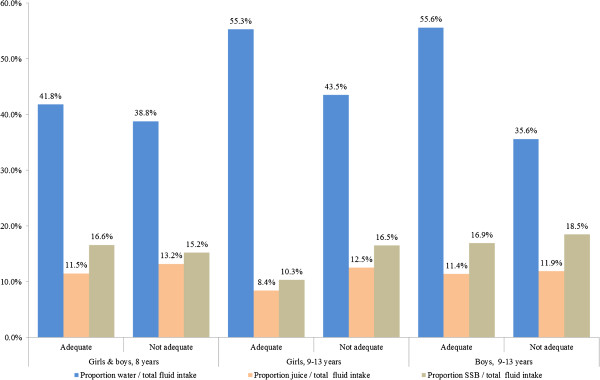
The median (P25-P75) of habitual daily fluid intake was 864 (608-1104) ml/day, with 355 (194-579) coming from drinking water. This habitual daily fluid intake varied significantly among the three investigated EFSA groups (girls and boys aged from 8 years, girls from 9 to 13 and boys from 9 to 13), except for the drinking water (P = 0.906). The highest medians of fruit juice, sugar-sweetened beverages and milk and derivatives were found among boys of 9-13. Only 9.5% of the children had an adequate fluid intake, with a value of 19.2% among the 8 years old girls and boys, 7.0% among girls of 9-13 and 8.4% among boys of 9-13. In the whole sample, 27.7% of the children declared to drink less than 3-4x/day, 56% drunk water less than 2x/day and 7.7% drunk no water at all. Every day, 27.1% and 34.1% of the children drank respectively one fruit juice and one sugar-sweetened beverage.
Belgian schoolchildren have an inadequate total fluid intake. Given the potential health consequences, interventions involving parents and school environment to promote water consumption seem pertinent.
在儿童时期,液体摄入量不足短期内会导致身体和认知能力下降。然而,关于比利时学童液体摄入量的数据较少。本研究的主要目的是评估比利时学童样本中不同类型饮料提供的总液体摄入量,以评估符合欧洲食品安全局总液体摄入量建议的个体百分比。次要目的是根据总液体摄入需求的决定因素对研究人群进行特征描述。
使用一份适合儿童的“液体和流质食物”日记前瞻性记录1045名学童7天内饮料消费的量和频率。该日记还记录了体育活动情况。充足的液体摄入量定义为摄入量≥欧洲食品安全局推荐的特定年龄充足摄入量的75%。
习惯性每日液体摄入量的中位数(第25-75百分位数)为864(608-1104)毫升/天,其中355(194-579)毫升来自饮用水。除饮用水外,在欧洲食品安全局调查的三个组(8岁的女孩和男孩、9至13岁的女孩、9至13岁的男孩)中,这种习惯性每日液体摄入量差异显著(P = 0.906)。9至13岁男孩的果汁、含糖饮料以及牛奶及其制品的中位数最高。只有9.5%的儿童液体摄入量充足,8岁女孩和男孩中这一比例为19.2%,9至13岁女孩中为7.0%,9至13岁男孩中为8.4%。在整个样本中,27.7%的儿童宣称每天喝水少于3-4次,56%的儿童每天喝水少于2次,7.7%的儿童根本不喝水。每天,分别有27.1%和34.1%的儿童喝一杯果汁和一杯含糖饮料。
比利时学童的总液体摄入量不足。鉴于可能的健康后果,涉及家长和学校环境以促进饮水的干预措施似乎是恰当的。