Ballestri Stefano, Nascimbeni Fabio, Baldelli Enrica, Marrazzo Alessandra, Romagnoli Dante, Lonardo Amedeo
Azienda USL di Modena, Pavullo Hospital, Pavullo nel Frignano, Italy.
Ospedale Civile di Baggiovara, Azienda Ospedaliero-Universitaria di Modena, Modena, Italy.
Adv Ther. 2017 Jun;34(6):1291-1326. doi: 10.1007/s12325-017-0556-1. Epub 2017 May 19.
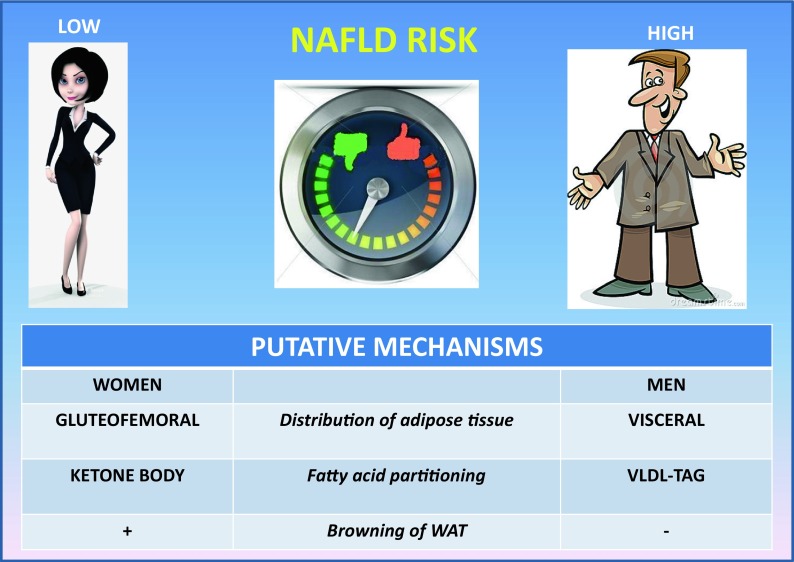
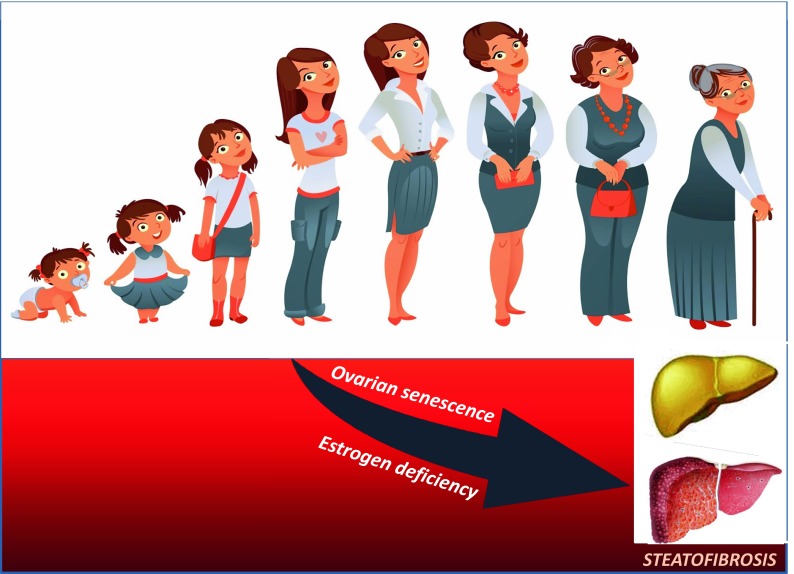
Nonalcoholic fatty liver disease (NAFLD) spans steatosis through nonalcoholic steatohepatis, cirrhosis, and hepatocellular carcinoma (HCC) associated with striking systemic features and excess cardiovascular and liver-related mortality. The pathogenesis of NAFLD is complex and multifactorial. Endocrine derangements are closely linked with dysmetabolic traits. For example, in animal and human studies, female sex is protected from dysmetabolism thanks to young individuals' ability to partition fatty acids towards ketone body production rather than very low density lipoprotein (VLDL)-triacylglycerol, and to sex-specific browning of white adipose tissue. Ovarian senescence facilitates both the development of massive hepatic steatosis and the fibrotic progression of liver disease in an experimental overfed zebrafish model. Consistently, estrogen deficiency, by potentiating hepatic inflammatory changes, hastens the progression of disease in a dietary model of nonalcoholic steatohepatitis (NASH) developing in ovariectomized mice fed a high-fat diet. In humans, NAFLD more often affects men; and premenopausal women are equally protected from developing NAFLD as they are from cardiovascular disease. It would be expected that early menarche, definitely associated with estrogen activation, would produce protection against the risk of NAFLD. Nevertheless, it has been suggested that early menarche may confer an increased risk of NAFLD in adulthood, excess adiposity being the primary culprit of this association. Fertile age may be associated with more severe hepatocyte injury and inflammation, but also with a decreased risk of liver fibrosis compared to men and postmenopausal status. Later in life, ovarian senescence is strongly associated with severe steatosis and fibrosing NASH, which may occur in postmenopausal women. Estrogen deficiency is deemed to be responsible for these findings via the development of postmenopausal metabolic syndrome. Estrogen supplementation may at least theoretically protect from NAFLD development and progression, as suggested by some studies exploring the effect of hormonal replacement therapy on postmenopausal women, but the variable impact of different sex hormones in NAFLD (i.e., the pro-inflammatory effect of progesterone) should be carefully considered.
非酒精性脂肪性肝病(NAFLD)涵盖从肝脂肪变性到非酒精性脂肪性肝炎、肝硬化以及肝细胞癌(HCC)的一系列病变,伴有显著的全身特征以及心血管疾病和肝脏相关死亡率的增加。NAFLD的发病机制复杂且具有多因素性。内分泌紊乱与代谢异常特征密切相关。例如,在动物和人体研究中,由于年轻个体能够将脂肪酸导向酮体生成而非极低密度脂蛋白(VLDL)-三酰甘油的生成,以及白色脂肪组织的性别特异性褐变,女性在代谢异常方面受到保护。在实验性过度喂养的斑马鱼模型中,卵巢衰老促进了大量肝脏脂肪变性的发展以及肝脏疾病的纤维化进程。同样,在高脂饮食喂养的去卵巢小鼠发生非酒精性脂肪性肝炎(NASH)的饮食模型中,雌激素缺乏通过增强肝脏炎症变化加速了疾病进展。在人类中,NAFLD更常影响男性;绝经前女性与预防心血管疾病一样,同样受到保护而不易发生NAFLD。可以预期,肯定与雌激素激活相关的初潮提前会对NAFLD风险产生保护作用。然而,有人提出初潮提前可能会增加成年后患NAFLD的风险,肥胖是这种关联的主要罪魁祸首。育龄期可能与更严重的肝细胞损伤和炎症相关,但与男性及绝经后状态相比,肝纤维化风险降低。在生命后期,卵巢衰老与严重脂肪变性和纤维化性NASH密切相关,这可能发生在绝经后女性中。雌激素缺乏被认为是通过绝经后代谢综合征的发展导致这些结果的。一些研究探讨了激素替代疗法对绝经后女性的影响,提示雌激素补充至少在理论上可预防NAFLD的发生和进展,但应仔细考虑不同性激素在NAFLD中的可变影响(即孕酮的促炎作用)。