Department of Earth and Space Sciences/Astrobiology Program, University of Washington, Seattle, Washington 98195-1310, USA.
Nat Commun. 2017 May 22;8:15423. doi: 10.1038/ncomms15423.
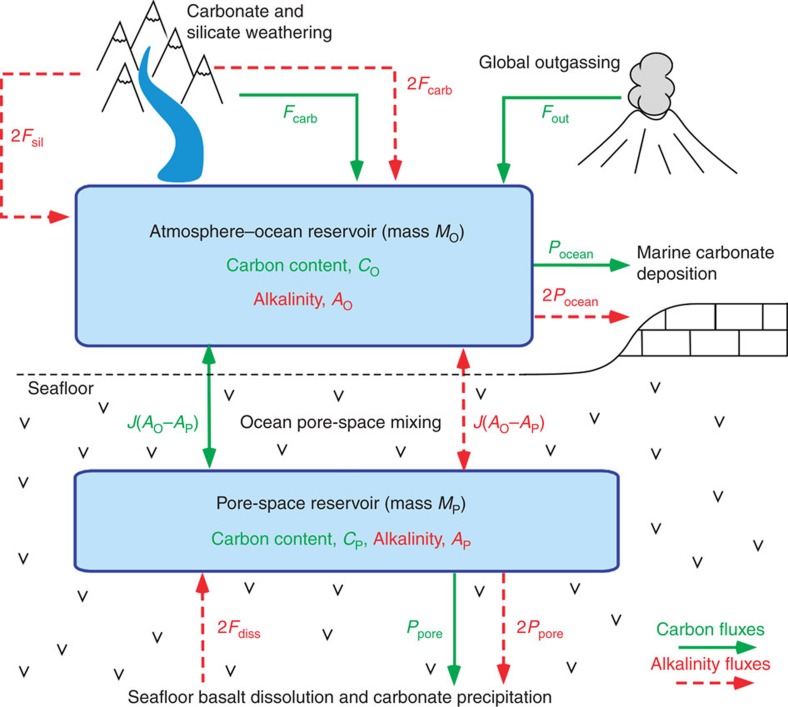
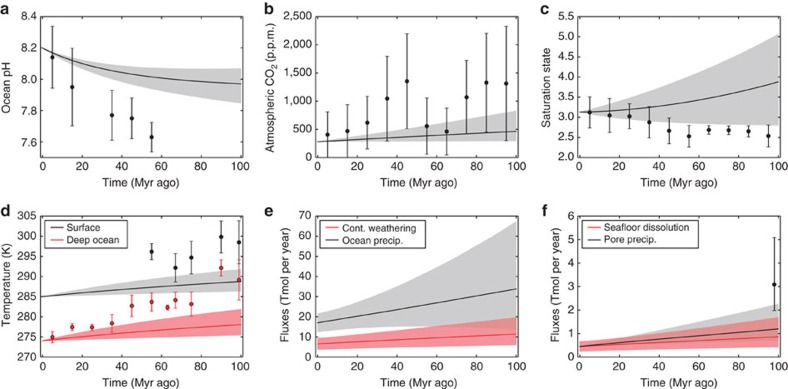
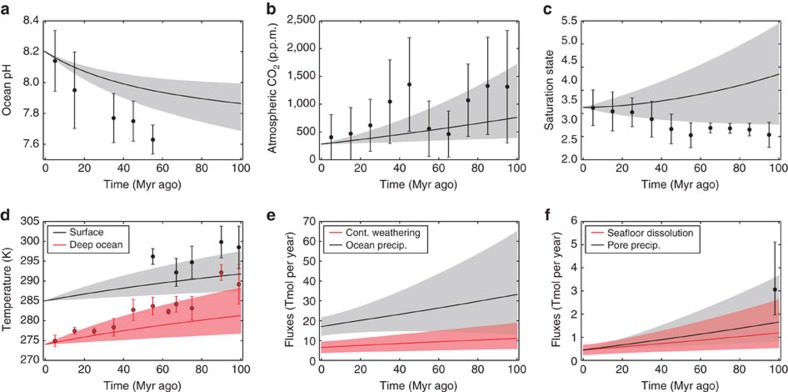
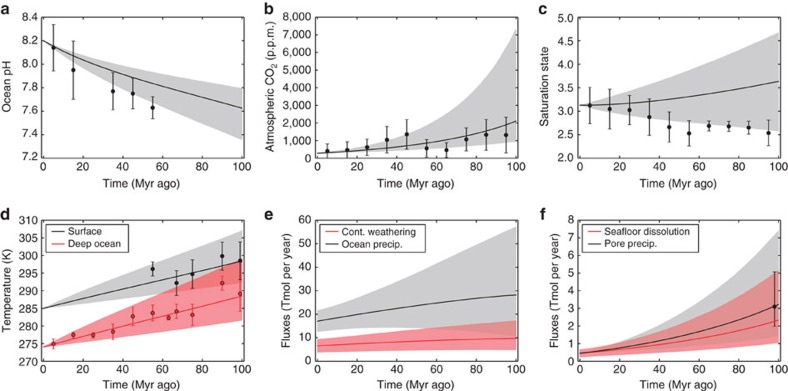
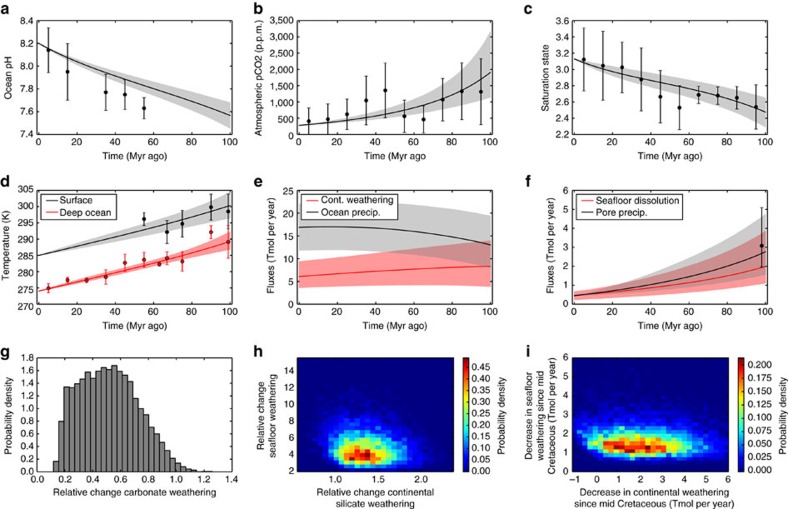
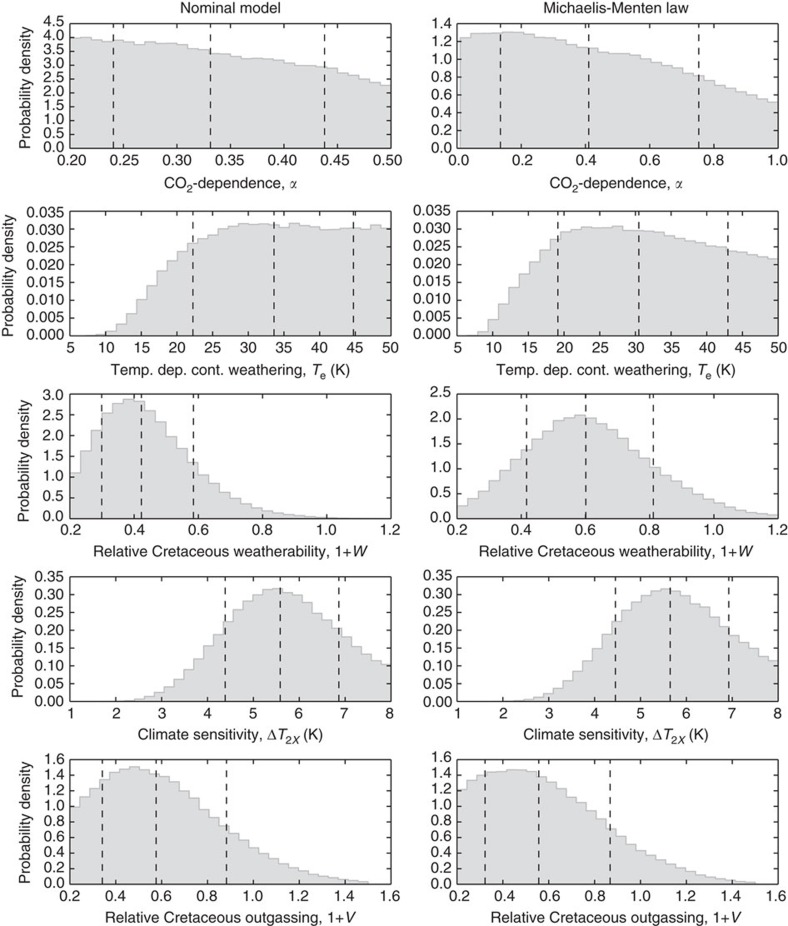
The relative influences of tectonics, continental weathering and seafloor weathering in controlling the geological carbon cycle are unknown. Here we develop a new carbon cycle model that explicitly captures the kinetics of seafloor weathering to investigate carbon fluxes and the evolution of atmospheric CO and ocean pH since 100 Myr ago. We compare model outputs to proxy data, and rigorously constrain model parameters using Bayesian inverse methods. Assuming our forward model is an accurate representation of the carbon cycle, to fit proxies the temperature dependence of continental weathering must be weaker than commonly assumed. We find that 15-31 °C (1σ) surface warming is required to double the continental weathering flux, versus 3-10 °C in previous work. In addition, continental weatherability has increased 1.7-3.3 times since 100 Myr ago, demanding explanation by uplift and sea-level changes. The average Earth system climate sensitivity is K (1σ) per CO doubling, which is notably higher than fast-feedback estimates. These conclusions are robust to assumptions about outgassing, modern fluxes and seafloor weathering kinetics.
构造作用、大陆风化和海底风化对控制地质碳循环的相对影响尚不清楚。在这里,我们开发了一种新的碳循环模型,该模型明确捕捉了海底风化的动力学,以研究自 1 亿年前以来的碳通量和大气 CO 和海洋 pH 的演化。我们将模型输出与代理数据进行比较,并使用贝叶斯反演方法严格约束模型参数。假设我们的正向模型是碳循环的准确表示,为了拟合代理,大陆风化的温度依赖性必须比通常假设的弱。我们发现,要使大陆风化通量增加一倍,需要 15-31°C(1σ)的地表变暖,而在之前的工作中为 3-10°C。此外,自 1 亿年前以来,大陆风化能力增加了 1.7-3.3 倍,这需要通过抬升和海平面变化来解释。地球系统平均气候敏感性为每 CO 加倍 K(1σ),明显高于快速反馈估计值。这些结论对于关于排气、现代通量和海底风化动力学的假设是稳健的。