Department of Earth and Space Sciences, University of Washington, Seattle, WA 98195;
Virtual Planetary Laboratory Team, NASA Astrobiology Institute, Seattle, WA 98195.
Proc Natl Acad Sci U S A. 2018 Apr 17;115(16):4105-4110. doi: 10.1073/pnas.1721296115. Epub 2018 Apr 2.
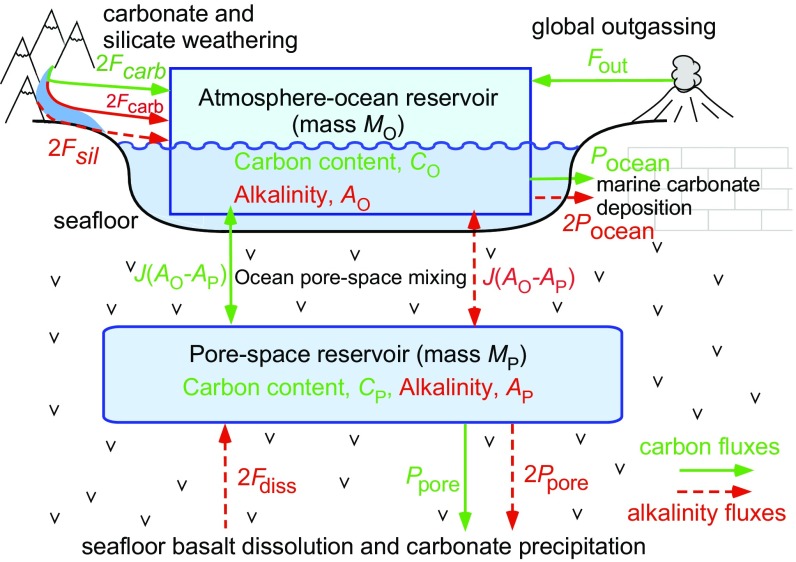
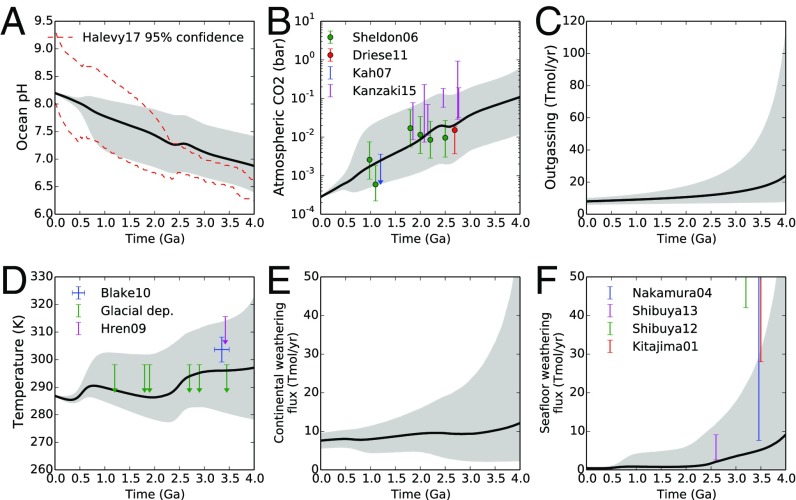
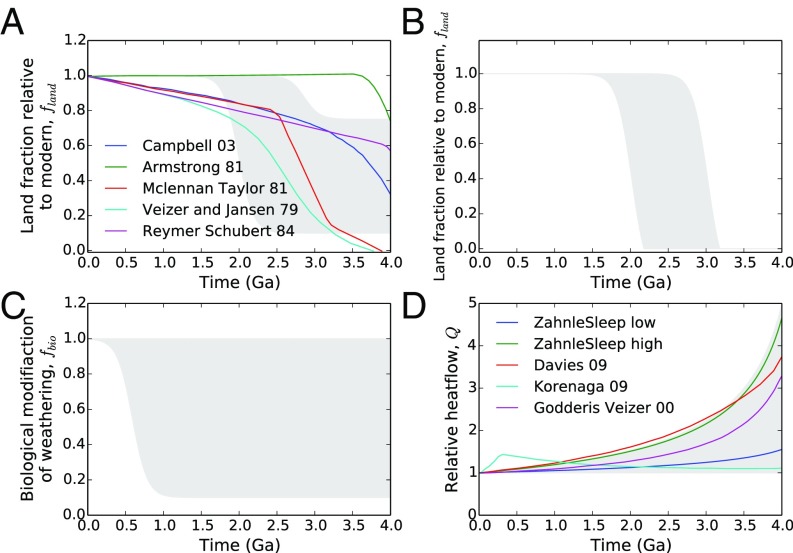
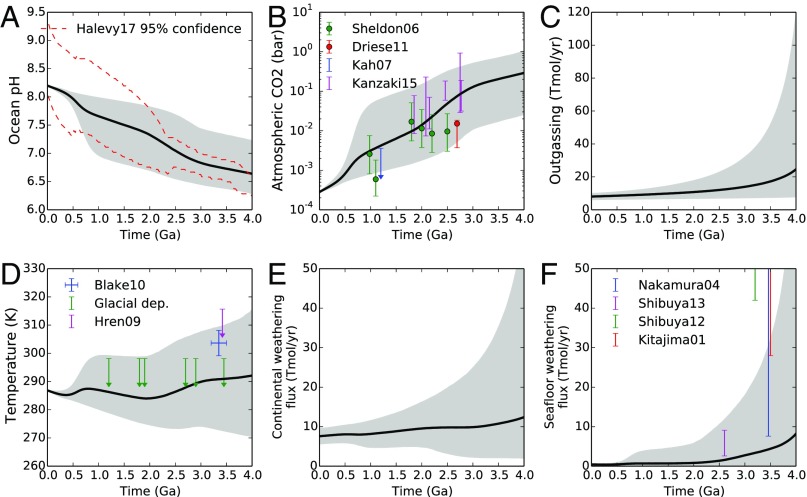
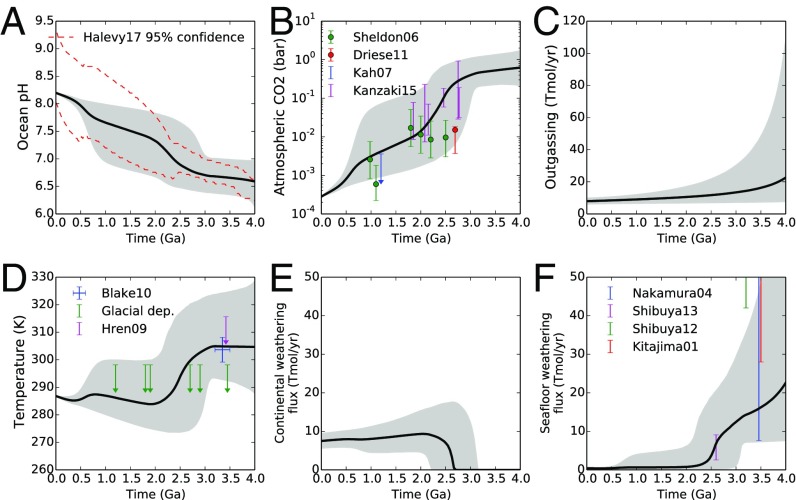
The early Earth's environment is controversial. Climatic estimates range from hot to glacial, and inferred marine pH spans strongly alkaline to acidic. Better understanding of early climate and ocean chemistry would improve our knowledge of the origin of life and its coevolution with the environment. Here, we use a geological carbon cycle model with ocean chemistry to calculate self-consistent histories of climate and ocean pH. Our carbon cycle model includes an empirically justified temperature and pH dependence of seafloor weathering, allowing the relative importance of continental and seafloor weathering to be evaluated. We find that the Archean climate was likely temperate (0-50 °C) due to the combined negative feedbacks of continental and seafloor weathering. Ocean pH evolves monotonically from [Formula: see text] (2σ) at 4.0 Ga to [Formula: see text] (2σ) at the Archean-Proterozoic boundary, and to [Formula: see text] (2σ) at the Proterozoic-Phanerozoic boundary. This evolution is driven by the secular decline of pCO, which in turn is a consequence of increasing solar luminosity, but is moderated by carbonate alkalinity delivered from continental and seafloor weathering. Archean seafloor weathering may have been a comparable carbon sink to continental weathering, but is less dominant than previously assumed, and would not have induced global glaciation. We show how these conclusions are robust to a wide range of scenarios for continental growth, internal heat flow evolution and outgassing history, greenhouse gas abundances, and changes in the biotic enhancement of weathering.
早期地球的环境颇具争议。气候估计范围从炎热到寒冷,推断的海洋 pH 值跨度从强碱性到酸性。更好地了解早期气候和海洋化学将有助于我们了解生命的起源及其与环境的共同进化。在这里,我们使用具有海洋化学的地质碳循环模型来计算气候和海洋 pH 值的一致历史。我们的碳循环模型包括对海底风化的温度和 pH 值依赖性的经验验证,从而可以评估大陆风化和海底风化的相对重要性。我们发现,由于大陆风化和海底风化的综合负反馈,太古代气候可能是温带的(0-50°C)。海洋 pH 值从 40 亿年前的[Formula: see text](2σ)单调演化到太古代-元古代边界的[Formula: see text](2σ),再到元古代-显生宙边界的[Formula: see text](2σ)。这种演化是由 pCO 的长期下降驱动的,而 pCO 的下降又是太阳光度增加的结果,但受到来自大陆和海底风化的碳酸盐碱度的调节。太古代海底风化可能与大陆风化一样是一个相当大的碳汇,但不如先前假设的那样重要,并且不会引起全球冰川作用。我们展示了这些结论如何在大陆增长、内部热流演化和排气历史、温室气体丰度以及风化的生物增强变化的广泛情景下保持稳健。