Wang Haiyan, Sheng Weizhong
Department of Nuclear Medicine, Shanghai East Hospital, Tongji University School of Medicine, Shanghai, 200120, China.
Department of General Surgery, Zhongshan Hospital, Fudan University, Shanghai, 200032, China.
Nanoscale Res Lett. 2017 Dec;12(1):365. doi: 10.1186/s11671-017-2140-7. Epub 2017 May 19.
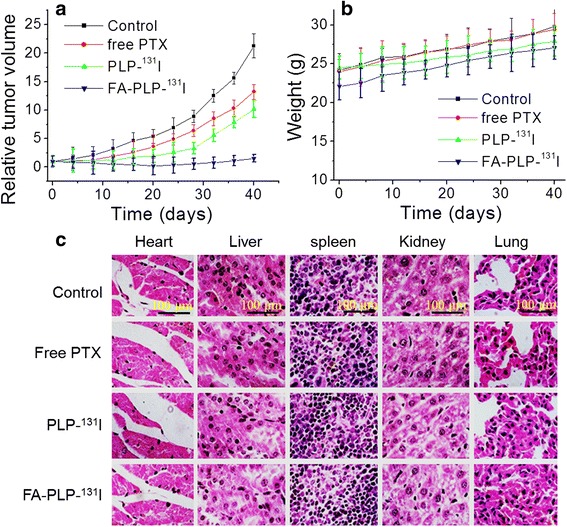
Herein, folic acid (FA) conjugated Poly(d,l-lactide-co-glycolide) (PLGA)-lipid composites (FA-PL) were developed as nanocarriers for the targeted delivery of insoluble anti-cancer drug paclitaxel (PTX), resulting FA-PLP nanoparticles. Furthermore, I, as a radioactive tracer, was used to label FA-PLP nanoparticles (FA-PLP-I) to evaluate their cell uptake activity, in vivo blood circulation, and biodistribution. The FA-PLP-I nanoparticles had a spherical morphology with great stability, a narrow size distribution (165.6 and 181.2 nm), and -22.1 mV in average zeta potential. Confocal laser scanning microscopy indicated that the targeting molecule FA promotes PLP-I uptake by melanoma B16F10 cells, which was further confirmed by the cell incorporation rate via I activity detection as measured by a gamma counter. FA-PLP-I without PTX (FA-PL-I) shows minor cytotoxicity, good biocompatibility, while FA-PLP-I was demonstrated to have efficient cell viability suppression compared to free PTX and PLP-I. Following intravenous injection, the blood circulation half-life of free PTX (t = 5.4 ± 0.23 h) was prolonged to 18.5 ± 0.5 h by FA-PLP-I. Through FA targeting, the tumor uptake of FA-PLP-I was approximately 4.41- and 12.8-fold higher compared to that of PLP-I and free PTX-I, respectively. Moreover, following 40 days of treatment, FA-PLP-I showed an improved tumor inhibition effect compared to free PTX and PLP-I, with no relapse and no remarkable systemic in vivo toxicity. The results demonstrate that the I-labeled PLGA-lipid nanoparticle can be simultaneously applied for targeted drug delivery and reliable tracking of drugs in vivo.
在此,叶酸(FA)偶联的聚(d,l-丙交酯-共-乙交酯)(PLGA)-脂质复合材料(FA-PL)被开发为用于靶向递送不溶性抗癌药物紫杉醇(PTX)的纳米载体,从而得到FA-PLP纳米颗粒。此外,将放射性示踪剂碘(I)用于标记FA-PLP纳米颗粒(FA-PLP-I),以评估其细胞摄取活性、体内血液循环和生物分布。FA-PLP-I纳米颗粒呈球形,具有良好的稳定性、窄尺寸分布(165.6和181.2纳米)以及平均ζ电位为-22.1毫伏。共聚焦激光扫描显微镜表明,靶向分子FA促进黑色素瘤B16F10细胞对PLP-I的摄取,通过伽马计数器测量的I活性检测细胞掺入率进一步证实了这一点。不含PTX的FA-PLP-I(FA-PL-I)显示出轻微的细胞毒性、良好的生物相容性,而与游离PTX和PLP-I相比,FA-PLP-I被证明具有有效的细胞活力抑制作用。静脉注射后,FA-PLP-I将游离PTX的血液循环半衰期(t = 5.4±0.23小时)延长至18.5±0.5小时。通过FA靶向,FA-PLP-I的肿瘤摄取分别比PLP-I和游离PTX-I高约4.41倍和12.8倍。此外,经过40天的治疗,与游离PTX和PLP-I相比,FA-PLP-I显示出改善的肿瘤抑制效果,没有复发且没有明显的体内全身毒性。结果表明,I标记的PLGA-脂质纳米颗粒可同时用于体内靶向药物递送和可靠的药物追踪。