Mahy Mary, Brown Tim, Stover John, Walker Neff, Stanecki Karen, Kirungi Wilford, Garcia-Calleja Txema, Ghys Peter D
a Strategic Information and Evaluation Department , UNAIDS , Geneva , Switzerland.
b East-West Center , Honolulu , HI , USA.
Glob Health Action. 2017 Jan-Dec;10(sup1):1291169. doi: 10.1080/16549716.2017.1291169.
The development of global HIV estimates has been critical for understanding, advocating for and funding the HIV response. The process of generating HIV estimates has been cited as the gold standard for public health estimates.
This paper provides important lessons from an international scientific collaboration and provides a useful model for those producing public health estimates in other fields.
Through the compilation and review of published journal articles, United Nations reports, other documents and personal experience we compiled historical information about the estimates and identified potential lessons for other public health estimation efforts.
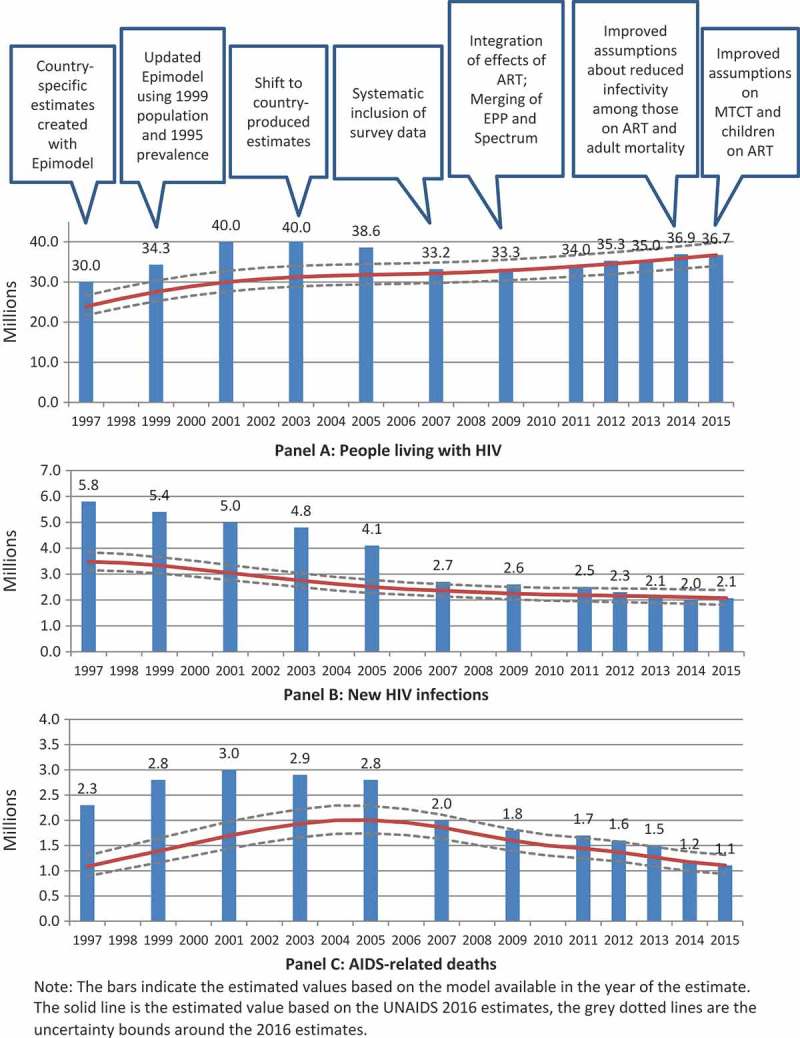
Through the development of core partnerships with country teams, implementers, demographers, mathematicians, epidemiologists and international organizations, UNAIDS has led a process to develop the capacity of country teams to produce internationally comparable HIV estimates. The guidance provided by these experts has led to refinements in the estimated numbers of people living with HIV, new HIV infections and AIDS-related deaths over the past 20 years. A number of important updates to the methods since 1997 resulted in fluctuations in the estimated levels, trends and impact of HIV. The largest correction occurred between the 2005 and 2007 rounds with the additions of household survey data into the models. In 2001 the UNAIDS models at that time estimated there were 40 million people living with HIV. In 2016, improved models estimate there were 30 million (27.6-32.7 million) people living with HIV in 2001.
Country ownership of the estimation tools has allowed for additional uses of the results than had the results been produced by researchers or a team in Geneva. Guidance from a reference group and input from country teams have led to critical improvements in the models over time. Those changes have improved countries' and stakeholders' understanding of the HIV epidemic.
全球艾滋病病毒(HIV)估计数的制定对于了解、倡导和资助艾滋病应对工作至关重要。HIV估计数的生成过程被视为公共卫生估计的黄金标准。
本文提供了来自一项国际科学合作的重要经验教训,并为其他领域进行公共卫生估计的人员提供了一个有用的模式。
通过汇编和审查已发表的期刊文章、联合国报告、其他文件以及个人经验,我们收集了有关估计数的历史信息,并确定了对其他公共卫生估计工作的潜在经验教训。
通过与国家团队、实施者、人口统计学家、数学家、流行病学家和国际组织建立核心伙伴关系,联合国艾滋病规划署(UNAIDS)引领了一个提升国家团队能力的过程,使其能够生成具有国际可比性的HIV估计数。这些专家提供的指导使过去20年中HIV感染者、新感染HIV人数以及与艾滋病相关死亡人数的估计得到了完善。自1997年以来,方法的一些重要更新导致了HIV估计水平、趋势和影响的波动。最大的修正发生在2005年至2007年期间,当时将家庭调查数据纳入了模型。2001年,UNAIDS当时的模型估计有4000万HIV感染者。2016年,改进后的模型估计2001年有3000万(2760万至3270万)HIV感染者。
与估计结果由日内瓦的研究人员或团队得出相比,国家对估计工具的自主掌控使得结果有了更多的用途。随着时间的推移,一个参考小组的指导和国家团队的投入使模型得到了关键改进。这些变化增进了各国和利益相关者对艾滋病流行情况的了解。