Erasmus School of Health Policy and Management, Erasmus University, Rotterdam, Netherlands.
School of Public Health, Imperial College, London, United Kingdom.
JMIR Public Health Surveill. 2021 Aug 16;7(8):e29309. doi: 10.2196/29309.
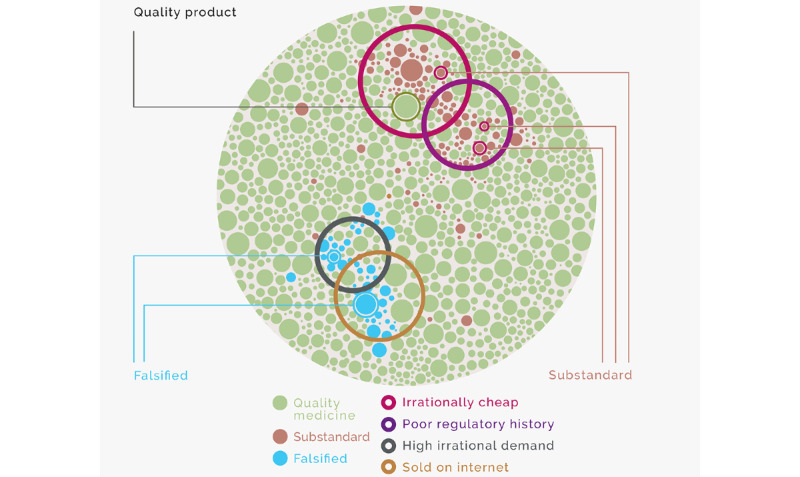
The World Health Organization and others warn that substandard and falsified medicines harm health and waste money, especially in low- and middle-income countries. However, no country has measured the market-wide extent of the problem, and no standardized methods exist to estimate the prevalence of either substandard or falsified medicines. This is, in part, because the task seems overwhelming; medicine markets are huge and diverse, and testing medicines is expensive. Many countries do operate some form of postmarket surveillance of medicine, but their methods and goals differ. There is currently no clear guidance on which surveillance method is most appropriate to meet specific public health goals. In this viewpoint, we aimed to discuss the utility of both case finding and risk-based sentinel surveillance for substandard and falsified medicines, linking each to specific public health goals. We posit that choosing the system most appropriate to the goal, as well as implementing it with a clear understanding of the factors driving the production and sale of substandard and falsified medicines, will allow for surveillance resources to be concentrated most efficiently. We adapted principles used for disease outbreak responses to suggest a case-finding system that uses secondary data to flag poor-quality medicines, proposing risk-based indicators that differ for substandard and falsified medicines. This system potentially offers a cost-effective way of identifying "cases" for market withdrawal, enhanced oversight, or another immediate response. We further proposed a risk-based sentinel surveillance system that concentrates resources on measuring the prevalence of substandard and falsified medicines in the risk clusters where they are most likely to be found. The sentinel surveillance system provides base data for a transparent, spreadsheet-based model for estimating the national prevalence of substandard and falsified medicines. The methods we proposed are based on ongoing work in Indonesia, a large and diverse middle-income country currently aiming to achieve universal health coverage. Both the case finding and the sentinel surveillance system are designed to be adaptable to other resource-constrained settings.
世界卫生组织(WHO)和其他组织警告称,劣药和假药危害健康并造成浪费,尤其是在中低收入国家。然而,尚无任何国家全面衡量这一问题的严重程度,也没有标准化方法可以评估劣药和假药的流行程度。部分原因是因为这项任务似乎艰巨得难以完成:药品市场庞大且复杂,药品检测费用高昂。许多国家的确对药品进行某种形式的上市后监测,但各国的方法和目标存在差异。目前,尚无明确的指导意见来确定哪种监测方法最适合实现特定的公共卫生目标。在本观点文章中,我们旨在讨论劣药和假药的病例发现监测和基于风险的哨点监测的实用性,将每种方法与具体的公共卫生目标联系起来。我们认为,选择最适合目标的系统,并在充分了解劣药和假药的生产和销售驱动因素的情况下实施该系统,将使监测资源能够得到最有效的集中。我们借鉴用于疾病暴发应对的原则,提出了一种病例发现系统,该系统利用二手数据来标记劣质药品,并为劣药和假药提出了不同的基于风险的指标。该系统有可能提供一种具有成本效益的方法,用于识别需要进行市场撤市、加强监督或其他紧急应对的“病例”。我们进一步提出了一种基于风险的哨点监测系统,该系统将资源集中用于测量最有可能发现劣药和假药的风险集群中的这些药品的流行程度。该哨点监测系统为透明、基于电子表格的模型提供了基础数据,可用于估计全国范围内劣药和假药的流行程度。我们提出的方法基于印度尼西亚正在进行的工作,印度尼西亚是一个中等收入大国,目前正在努力实现全民健康覆盖。病例发现和哨点监测系统均旨在适应其他资源有限的环境。