Sherk Vanessa D, Jackman Matthew R, Giles Erin D, Higgins Janine A, Foright Rebecca M, Presby David M, Johnson Ginger C, Houck Julie A, Houser Jordan L, Oljira Robera, MacLean Paul S
Division of Endocrinology, Metabolism, and Diabetes, Department of Medicine, University of Colorado Anschutz Medical Campus, Aurora, Colorado.
Department of Nutrition & Food Science, Texas A&M University, College Station, Texas.
Physiol Rep. 2017 May;5(10):e13272. doi: 10.14814/phy2.13272.
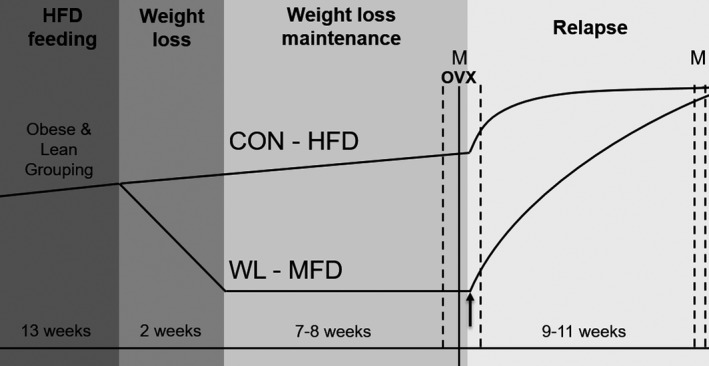
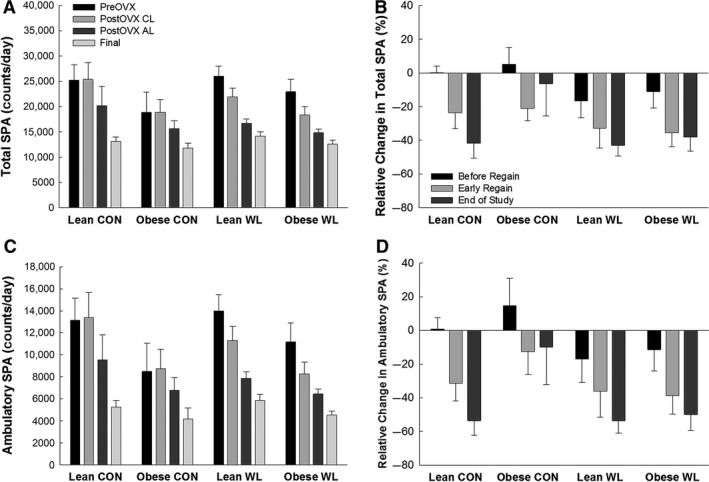
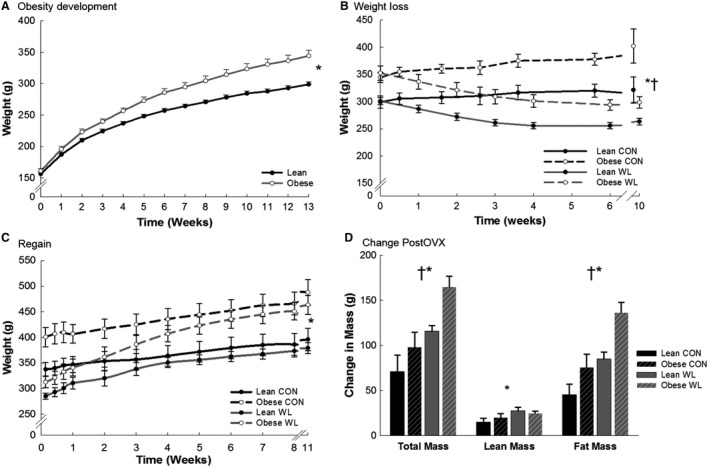
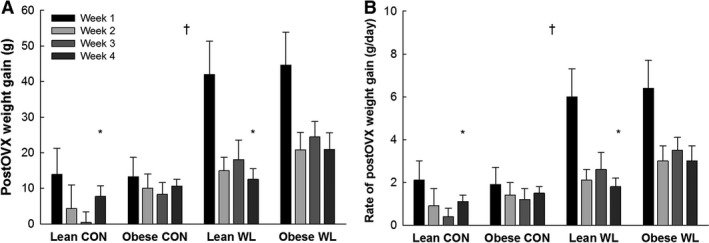
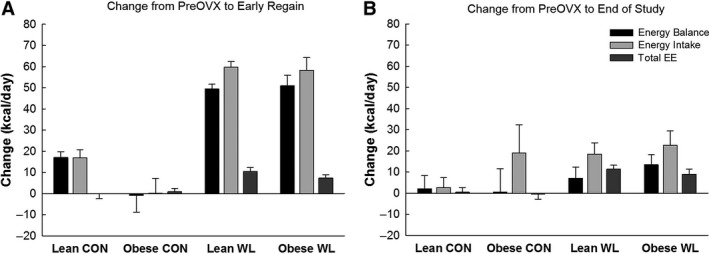
Both the history of obesity and weight loss may change how menopause affects metabolic health. The purpose was to determine whether obesity and/or weight loss status alters energy balance (EB) and subsequent weight gain after the loss of ovarian function. Female lean and obese Wistar rats were randomized to 15% weight loss (WL) or ad libitum fed controls (CON). After the weight loss period, WL rats were kept in EB at the reduced weight for 8 weeks prior to ovariectomy (OVX). After OVX, all rats were allowed to eat ad libitum until weight plateaued. Energy intake (EI), spontaneous physical activity, and total energy expenditure (TEE) were measured with indirect calorimetry before OVX, immediately after OVX, and after weight plateau. Changes in energy intake (EI), TEE, and weight gain immediately after OVX were similar between lean and obese rats. However, obese rats gained more total weight and fat mass than lean rats over the full regain period. Post-OVX, EI increased more ( ≤ 0.03) in WL rats (58.9 ± 3.5 kcal/d) than CON rats (8.5 ± 5.2 kcal/d), and EI partially normalized (change from preOVX: 20.5 ± 4.2 vs. 1.5 ± 4.9 kcal/day) by the end of the study. As a result, WL rats gained weight (week 1:44 ± 20 vs. 7 ± 25 g) more rapidly (mean = 44 ± 20 vs. 7 ± 25 g/week; < 0.001) than CON Prior obesity did not affect changes in EB or weight regain following OVX, whereas a history of weight loss prior to OVX augmented disruptions in EB after OVX, resulting in more rapid weight regain.
肥胖史和减肥经历都可能改变更年期对代谢健康的影响。本研究的目的是确定肥胖和/或减肥状态是否会改变能量平衡(EB)以及卵巢功能丧失后的后续体重增加情况。将雌性瘦型和肥胖型Wistar大鼠随机分为减重15%(WL)组或自由采食对照组(CON)。在减肥期结束后,WL组大鼠在卵巢切除(OVX)前,以减轻后的体重维持能量平衡8周。OVX后,所有大鼠自由进食,直至体重稳定。在OVX前、OVX后即刻以及体重稳定后,采用间接测热法测量能量摄入(EI)、自发身体活动和总能量消耗(TEE)。瘦型和肥胖型大鼠在OVX后即刻的能量摄入(EI)、TEE和体重增加变化相似。然而,在整个体重恢复期间,肥胖型大鼠比瘦型大鼠增加的总体重和脂肪量更多。OVX后,WL组大鼠(58.9±3.5千卡/天)的EI增加幅度大于CON组大鼠(8.5±5.2千卡/天)(P≤0.03),并且到研究结束时,EI部分恢复正常(与OVX前相比的变化:20.5±4.2 vs. 1.5±4.9千卡/天)。结果,WL组大鼠体重增加更快(第1周:44±20 vs. 7±25克)(平均值=44±20 vs. 7±25克/周;P<0.001)。既往肥胖不影响OVX后EB的变化或体重恢复,而OVX前的减肥史会加剧OVX后EB的紊乱,导致体重恢复更快。