Mason Julia G, Rudd Murray A, Crowder Larry B
Julia G. Mason (
Bioscience. 2017 May 1;67(5):418-428. doi: 10.1093/biosci/biw172. Epub 2017 Feb 1.
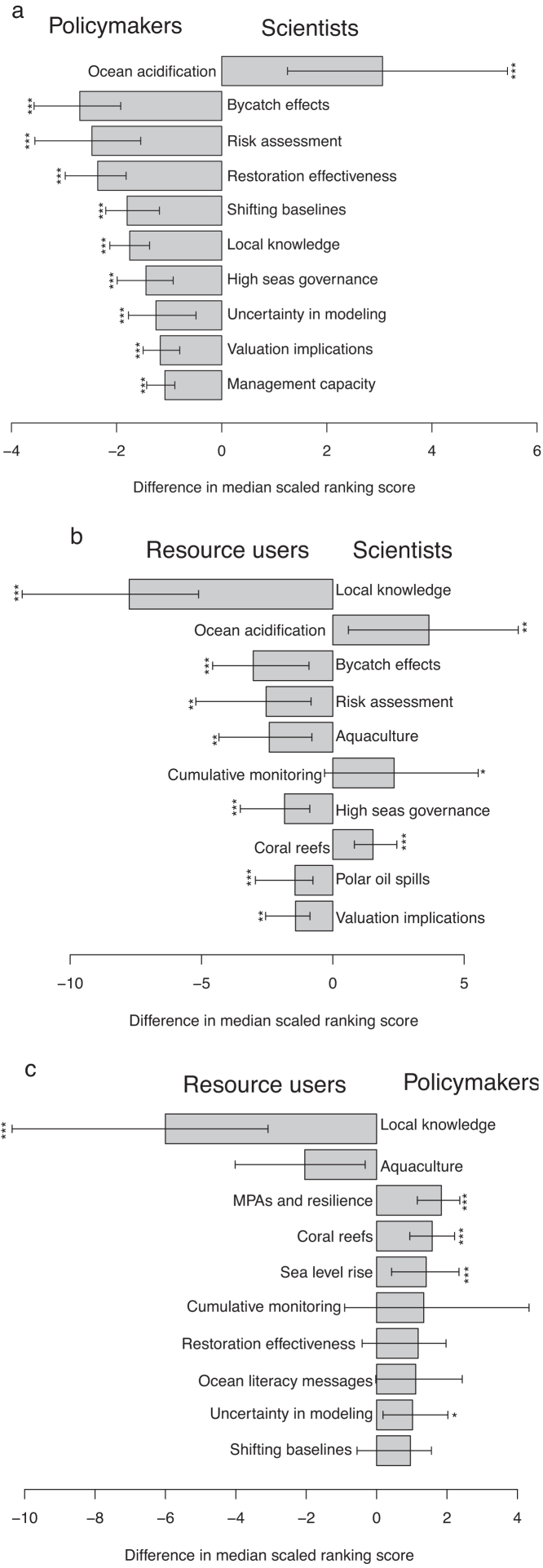
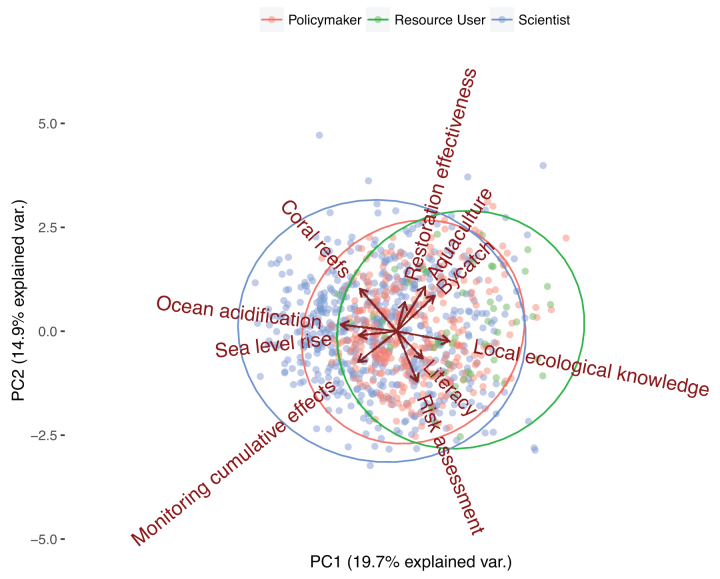
Understanding and solving complex ocean conservation problems requires cooperation not just among scientific disciplines but also across sectors. A recently published survey that probed research priorities of marine scientists, when provided to ocean stakeholders, revealed some agreement on priorities but also illuminated key differences. Ocean acidification, cumulative impacts, bycatch effects, and restoration effectiveness were in the top 10 priorities for scientists and stakeholder groups. Significant priority differences were that scientists favored research questions about ocean acidification and marine protected areas; policymakers prioritized questions about habitat restoration, bycatch, and precaution; and fisheries sector resource users called for the inclusion of local ecological knowledge in policymaking. These results quantitatively demonstrate how different stakeholder groups approach ocean issues and highlight the need to incorporate other types of knowledge in the codesign of solutions-oriented research, which may facilitate cross-sectoral collaboration.
理解和解决复杂的海洋保护问题不仅需要跨科学学科的合作,还需要跨部门的合作。最近发表的一项对海洋科学家研究重点进行调查的研究,在提供给海洋利益相关者时,揭示了在优先事项上的一些共识,但也凸显了关键差异。海洋酸化、累积影响、副渔获物影响和恢复效果在科学家和利益相关者群体的前10大优先事项中。显著的优先事项差异在于,科学家们倾向于关于海洋酸化和海洋保护区的研究问题;政策制定者将栖息地恢复、副渔获物和预防问题列为优先事项;渔业部门的资源使用者呼吁在政策制定中纳入当地生态知识。这些结果定量地展示了不同利益相关者群体处理海洋问题的方式,并强调了在以解决方案为导向的研究的共同设计中纳入其他类型知识的必要性,这可能有助于跨部门合作。