Gelli Chiara, Tarocchi Mirko, Abenavoli Ludovico, Di Renzo Laura, Galli Andrea, De Lorenzo Antonino
Chiara Gelli, Laura Di Renzo, Antonino De Lorenzo, Division of Clinical Nutrition and Nutrigenomics, Department of Biomedicine and Prevention, University of Rome "Tor Vergata", 0133 Rome, Italy.
World J Gastroenterol. 2017 May 7;23(17):3150-3162. doi: 10.3748/wjg.v23.i17.3150.
To determine the clinical effectiveness of nutritional counseling on reduction of non-alcoholic fatty liver disease (NAFLD) severity, weight loss, metabolic and anthropometric indexes and liver enzymes.
Forty-six adults with NAFLD received a 6-mo clinical and a dietary intervention (based on Mediterranean diet) carried out respectively by a gastroenterologist and a nutritionist with counseling license. The counseling process consisted of monthly meeting (about 45 min each). The effect of the treatment was evaluated monitoring liver enzymes, metabolic parameters, cardiovascular risk indexes, NAFLD severity [assessed by ultrasound (US)] and related indexes. All parameters were assessed at baseline. Biochemistry was also assessed at mid- and end-interventions and US was repeated at end-intervention.
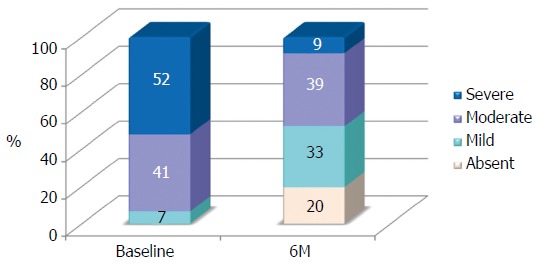
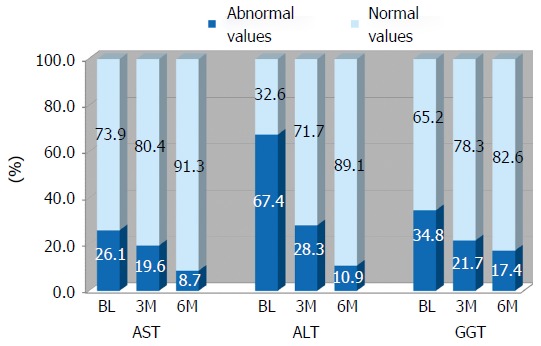
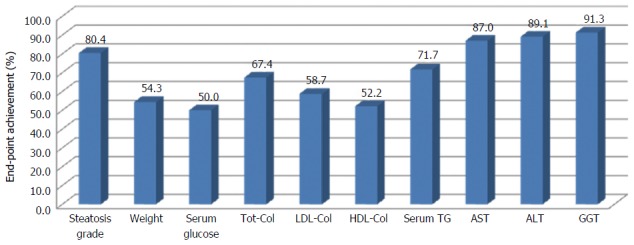
The percentage of patients with steatosis grade equal or higher than 2 was reduced from 93% to 48% and steatosis regressed in 9 patients (20%). At the end of the treatment the end-point concerning the weight (., a 7% weight reduction or achievement/maintenance of normal weight) was accomplished by 25 out of 46 patients (., 54.3%). As far as the liver enzymes is concerned, all three liver enzymes significantly decrease during the treatment the normalization was particularly evident for the ALT enzyme (altered values reduced from 67% down to 11%). Several parameters, ., BMI, waist circumference, waist-to-hip ratio, AST, ALT, GGT, HDL, serum glucose, Tot-Chol/HDL, LDL/HDL, TG/HDL, AIP, HOMA, FLI, Kotronen index, VAI, NAFLD liver fat score and LAP, showed a significant improvement ( < 0.01) between baseline and end-treatment.
Outcomes of this study further strengthen the hypothesis that MedDiet and more active lifestyle can be considered a safe therapeutic approach for reducing risk and severity of NAFLD and related disease states. The proposed approach may be proposed as a valid and recommended approach for improving the clinical profile of NAFLD patients.
确定营养咨询在降低非酒精性脂肪性肝病(NAFLD)严重程度、减轻体重、改善代谢和人体测量指标以及降低肝酶方面的临床效果。
46名患有NAFLD的成年人接受了为期6个月的临床和饮食干预(基于地中海饮食),分别由一名胃肠病学家和一名持有咨询执照的营养师进行。咨询过程包括每月一次的会面(每次约45分钟)。通过监测肝酶、代谢参数、心血管风险指标、NAFLD严重程度[通过超声(US)评估]及相关指标来评估治疗效果。所有参数均在基线时进行评估。在干预中期和结束时还进行了生化评估,在干预结束时重复进行超声检查。
脂肪变性等级等于或高于2级的患者百分比从93%降至48%,9名患者(20%)的脂肪变性有所消退。治疗结束时,46名患者中有25名(即54.3%)达到了体重终点(即体重减轻7%或达到/维持正常体重)。就肝酶而言,在治疗期间所有三种肝酶均显著降低,谷丙转氨酶(ALT)酶的正常化尤为明显(异常值从67%降至11%)。几个参数,如体重指数(BMI)、腰围、腰臀比、谷草转氨酶(AST)、ALT、γ-谷氨酰转肽酶(GGT)、高密度脂蛋白(HDL)、血糖、总胆固醇/HDL、低密度脂蛋白/HDL、甘油三酯/HDL、动脉硬化指数(AIP)、稳态模型评估胰岛素抵抗指数(HOMA)、脂肪肝指数(FLI)、科特罗宁指数、内脏脂肪指数(VAI)、NAFLD肝脏脂肪评分和脂质蓄积产物(LAP),在基线和治疗结束之间显示出显著改善(P<0.01)。
本研究结果进一步强化了以下假设,即地中海饮食和更积极的生活方式可被视为降低NAFLD风险和严重程度以及相关疾病状态的安全治疗方法。所提出的方法可作为改善NAFLD患者临床状况的有效且推荐的方法。