Read Mark N, Holmes Andrew J
The School of Environmental and Life Sciences, The Charles Perkins Centre, The University of Sydney, Sydney, NSW, Australia.
Front Immunol. 2017 May 8;8:538. doi: 10.3389/fimmu.2017.00538. eCollection 2017.
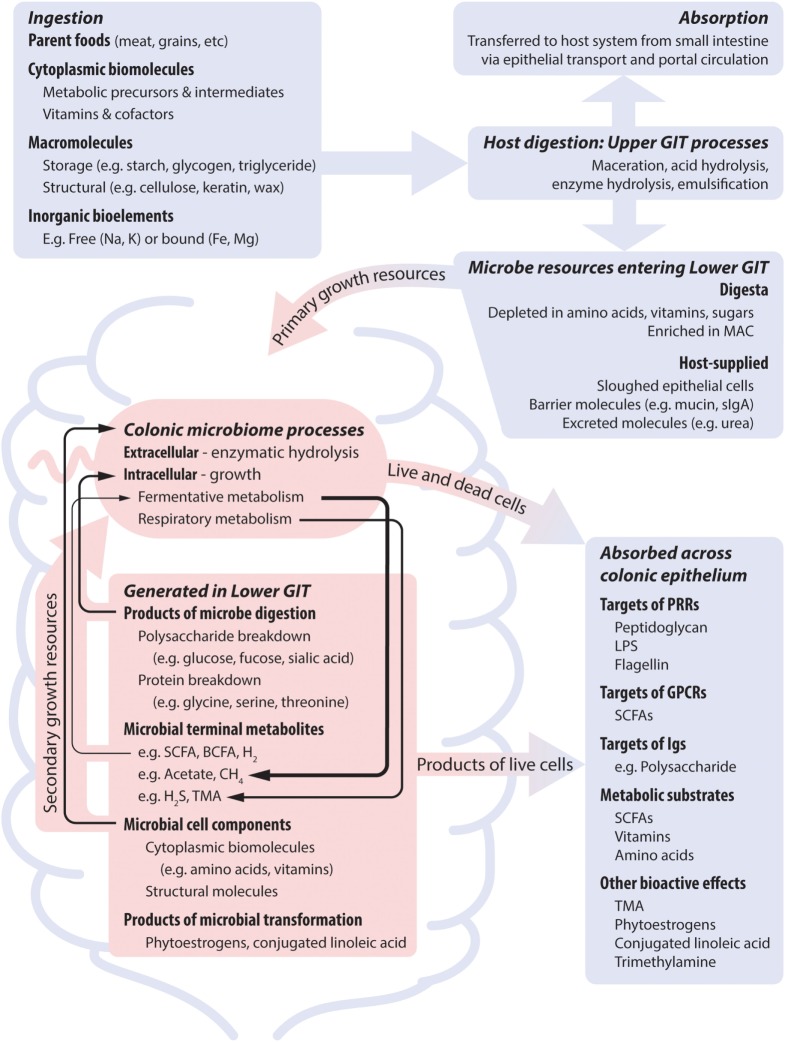
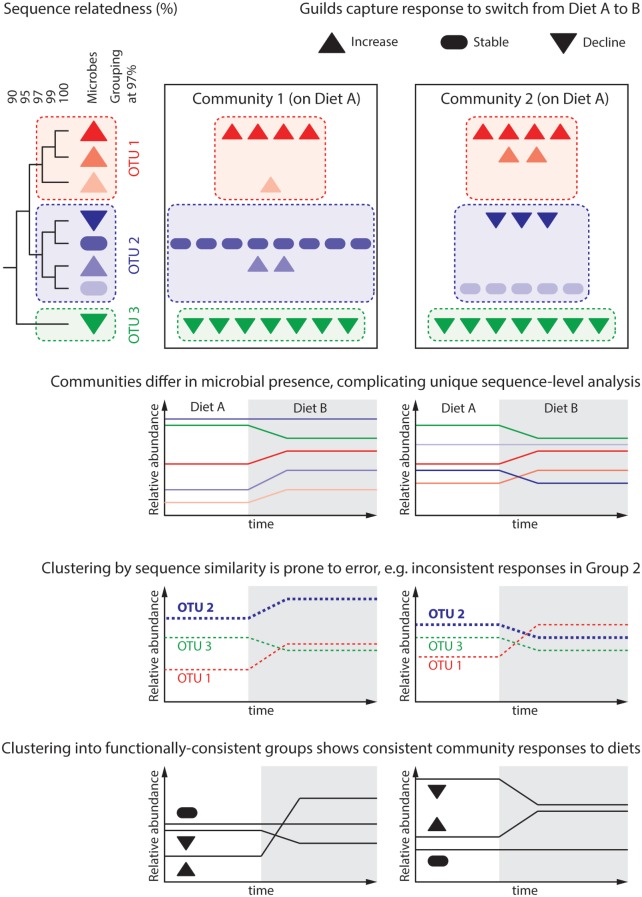
Over the last 20 years, a sizeable body of research has linked the microbiome and host diet to a remarkable diversity of diseases. Yet, unifying principles of microbiome assembly or function, at levels required to rationally manipulate a specific individual's microbiome to their benefit, have not emerged. A key driver of both community composition and activity is the host diet, but diet-microbiome interactions cannot be characterized without consideration of host-diet interactions such as appetite and digestion. This becomes even more complex if health outcomes are to be explored, as microbes engage in multiple interactions and feedback pathways with the host. Here, we review these interactions and set forth the need to build conceptual models of the diet-microbiome-host axes that draw out the key principles governing this system's dynamics. We highlight how "units of response," characterizations of similarly behaving microbes, do not correlate consistently with microbial sequence relatedness, raising a challenge for relating high-throughput data sets to conceptual models. Furthermore, they are question-specific; responses to resource environment may be captured at higher taxonomic levels, but capturing microbial products that depend on networks of different interacting populations, such as short-chain fatty acid production through anaerobic fermentation, can require consideration of the entire community. We posit that integrative approaches to teasing apart diet-microbe-host interactions will help bridge between experimental data sets and conceptual models and will be of value in formulating predictive models.
在过去20年里,大量研究将微生物组和宿主饮食与种类繁多的疾病联系起来。然而,尚未出现能在合理调控特定个体微生物组以使其受益所需水平上统一微生物组组装或功能的原则。群落组成和活性的一个关键驱动因素是宿主饮食,但如果不考虑诸如食欲和消化等宿主-饮食相互作用,就无法描述饮食与微生物组之间的相互作用。如果要探究健康结果,情况会变得更加复杂,因为微生物与宿主存在多种相互作用和反馈途径。在此,我们综述这些相互作用,并阐述构建饮食-微生物组-宿主轴概念模型的必要性,该模型应提炼出支配这一系统动态变化的关键原则。我们强调,“反应单元”(即行为相似的微生物的特征)与微生物序列相关性并不始终一致,这给将高通量数据集与概念模型关联起来带来了挑战。此外,它们是针对具体问题的;对资源环境的反应可能在较高分类水平上得以体现,但要捕捉依赖不同相互作用种群网络的微生物产物,比如通过厌氧发酵产生短链脂肪酸,可能需要考虑整个群落。我们认为,剖析饮食-微生物-宿主相互作用的综合方法将有助于在实验数据集和概念模型之间架起桥梁,并在构建预测模型方面具有价值。