Oh Ju Hee, Lee Na Kyung
Department of Medical Science, College of Medical Sciences, Soonchunhyang University, Asan 31538, Korea.
Department of Biomedical Laboratory Science, College of Medical Sciences, Soonchunhyang University, Asan 31538, Korea.
Mol Cells. 2017 May 31;40(5):371-377. doi: 10.14348/molcells.2017.0025. Epub 2017 May 22.
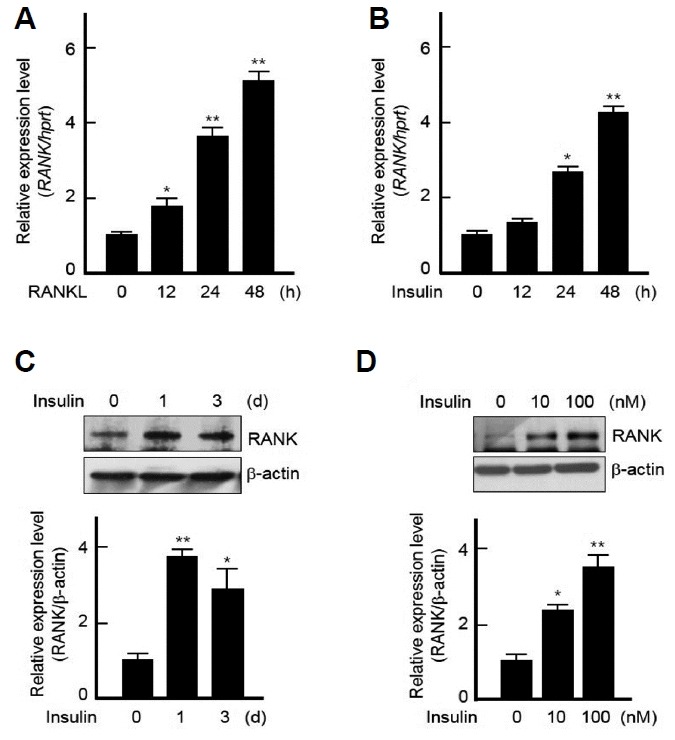
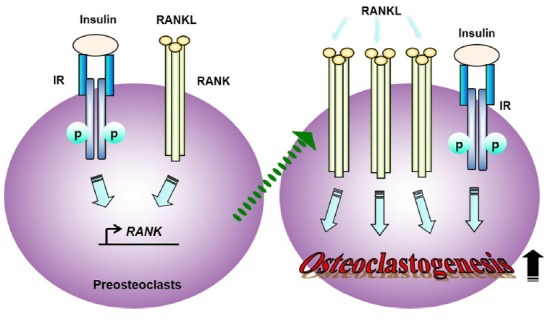
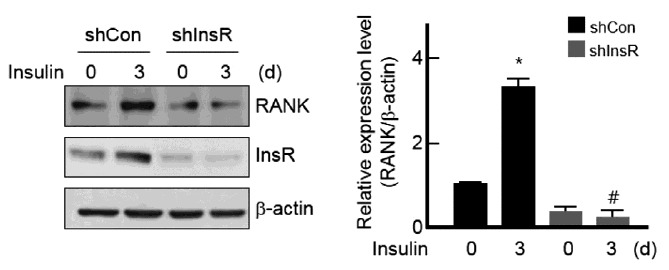
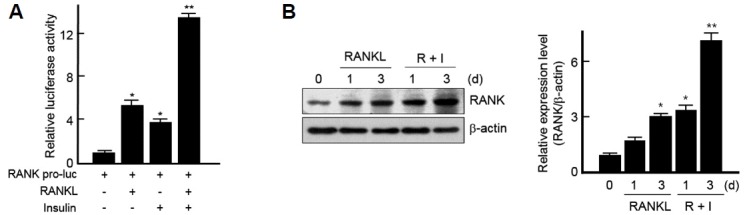
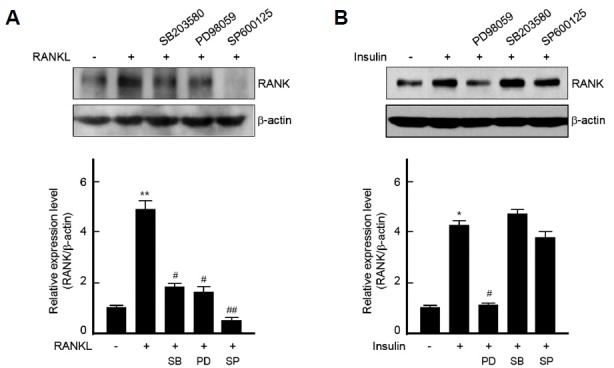
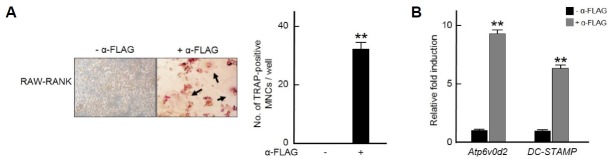
Despite the importance of the receptor activator of nuclear factor (NF)-kappaB ligand (RANKL)-RANK signaling mechanisms on osteoclast differentiation, little has been studied on how RANK expression is regulated or what regulates its expression during osteoclastogenesis. We show here that insulin signaling increases RANK expression, thus enhancing osteoclast differentiation by RANKL. Insulin stimulation induced RANK gene expression in time- and dose-dependent manners and insulin receptor shRNA completely abolished RANK expression induced by insulin in bone marrow-derived monocyte/macrophage cells (BMMs). Moreover, the addition of insulin in the presence of RANKL promoted RANK expression. The ability of insulin to regulate RANK expression depends on extracellular signal-regulated kinase 1/2 (ERK1/2) since only PD98059, an ERK1/2 inhibitor, specifically inhibited its expression by insulin. However, the RANK expression by RANKL was blocked by all three mitogen-activated protein (MAP) kinases inhibitors. The activation of RANK increased differentiation of BMMs into tartrate-resistant acid phosphatase-positive (TRAP) osteoclasts as well as the expression of dendritic cell-specific transmembrane protein (DC-STAMP) and d2 isoform of vacuolar (H) ATPase (v-ATPase) Vo domain (Atp6v0d2), genes critical for osteoclastic cell-cell fusion. Collectively, these results suggest that insulin induces RANK expression via ERK1/2, which contributes to the enhancement of osteoclast differentiation.
尽管核因子(NF)-κB 受体激活剂配体(RANKL)-RANK 信号传导机制在破骨细胞分化中具有重要作用,但关于 RANK 表达如何被调控以及在破骨细胞生成过程中是什么调控其表达的研究却很少。我们在此表明,胰岛素信号传导增加 RANK 表达,从而通过 RANKL 增强破骨细胞分化。胰岛素刺激以时间和剂量依赖性方式诱导 RANK 基因表达,并且胰岛素受体短发夹 RNA(shRNA)完全消除了胰岛素在骨髓来源的单核细胞/巨噬细胞(BMM)中诱导的 RANK 表达。此外,在存在 RANKL 的情况下添加胰岛素可促进 RANK 表达。胰岛素调节 RANK 表达的能力取决于细胞外信号调节激酶 1/2(ERK1/2),因为只有 ERK1/2 抑制剂 PD98059 能特异性抑制胰岛素诱导的其表达。然而,RANKL 诱导的 RANK 表达被所有三种丝裂原活化蛋白(MAP)激酶抑制剂阻断。RANK 的激活增加了 BMM 向抗酒石酸酸性磷酸酶阳性(TRAP)破骨细胞的分化以及树突状细胞特异性跨膜蛋白(DC-STAMP)和液泡(H)ATP 酶(v-ATPase)Vo 结构域的 d2 亚型(Atp6v0d2)的表达,这些基因对于破骨细胞的细胞间融合至关重要。总的来说,这些结果表明胰岛素通过 ERK1/2 诱导 RANK 表达,这有助于增强破骨细胞分化。