a School of Food Science, Washington State University , Pullman , WA , USA.
b Department of Kinesiology and Community Health , University of Illinois , Urbana-Champaign , IL , USA.
Nutr Neurosci. 2018 Nov;21(9):632-640. doi: 10.1080/1028415X.2017.1329976. Epub 2017 May 23.
Macular pigment optical density (MPOD) - a non-invasive indicator of retinal xanthophylls and correlate of brain lutein - has been associated with superior cognitive function among adult populations. Given that lutein accumulation in the brain occurs in early life, it is possible that the cognitive implications of greater MPOD may be evident in childhood.
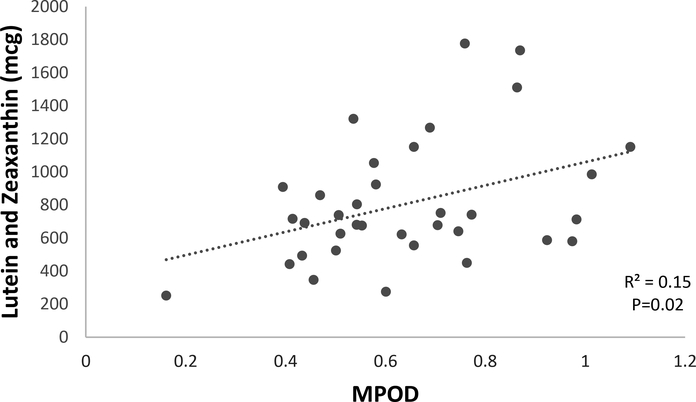
Participants aged 8-9 years (n = 56) completed MPOD measurements via heterochromatic flicker photometry. Academic performance was assessed using the Kaufman Test of Academic and Educational Achievement II (KTEA). Habitual dietary intake of L and Z was measured among a subsample of participants (n = 35) using averaged 3-day food records. Stepwise hierarchical regression models were developed to determine the relationship between MPOD and academic achievement tests, following the adjustment of key covariates including sex, aerobic fitness, body composition, and intelligence quotient (IQ).
The regression analyses revealed that MPOD improved the model, beyond the covariates, for overall academic achievement (ΔR = 0.10, P < 0.01), mathematics (ΔR = 0.07, P = 0.02), and written language composite standard scores (ΔR = 0.15, P < 0.01).
This is the first study to demonstrate that retinal L and Z, measured as MPOD, is positively related to academic achievement in children, even after accounting for the robust effects of IQ and other demographic factors. These findings extend the positive associations observed between MPOD and cognitive abilities to a pediatric population. Trail registration: The Fitness Improves Thinking in Kids 2 (FITKids2) trial was registered at www.clinicaltrials.gov as NCT01619826.
黄斑色素光学密度(MPOD)是视网膜叶黄素的非侵入性指标,也是大脑中叶黄素的相关指标,与成年人群的认知功能较高有关。鉴于叶黄素在生命早期就在大脑中积累,因此,较高的 MPOD 对认知的影响可能在儿童时期就表现出来。
8-9 岁的参与者(n=56)通过异色素闪烁光度法完成 MPOD 测量。使用 Kaufman 学术和教育成就测试第二版(KTEA)评估学业成绩。在一个子样本(n=35)中,通过平均 3 天的食物记录来测量 L 和 Z 的习惯性饮食摄入。在调整了关键协变量(包括性别、有氧健身、身体成分和智商(IQ))之后,采用逐步分层回归模型来确定 MPOD 与学业成绩测试之间的关系。
回归分析表明,MPOD 提高了模型,超出了协变量,对总体学业成绩(ΔR=0.10,P<0.01)、数学(ΔR=0.07,P=0.02)和书面语言综合标准分数(ΔR=0.15,P<0.01)都有改善。
这是第一项研究表明,视网膜中的 L 和 Z,以 MPOD 衡量,与儿童的学业成绩呈正相关,即使在考虑到 IQ 和其他人口统计学因素的强大影响之后也是如此。这些发现将 MPOD 与认知能力之间的积极关联扩展到了儿科人群。试验注册:健身提高儿童思维能力 2 号(FITKids2)试验在 www.clinicaltrials.gov 上注册,注册号为 NCT01619826。