Au Minnie, Emeto Theophilus I, Power Jacinta, Vangaveti Venkat N, Lai Hock C
Public Health and Tropical Medicine, College of Public Health, Medical and Veterinary Sciences, James Cook University, James Cook Drive, Douglas, Townsville QLD 4811, Australia.
Townsville Cancer Centre, The Townsville Hospital, Townsville QLD 4814, Australia.
Biomedicines. 2016 Aug 19;4(3):20. doi: 10.3390/biomedicines4030020.
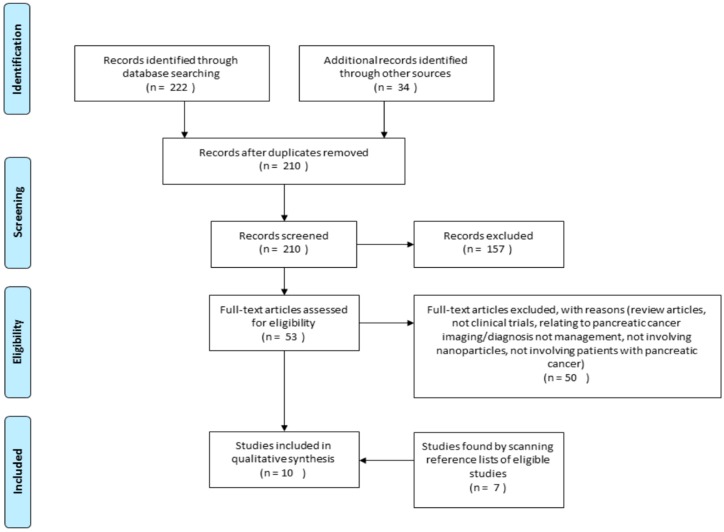
Pancreatic cancer is an aggressive disease with a five year survival rate of less than 5%, which is associated with late presentation. In recent years, research into nanomedicine and the use of nanoparticles as therapeutic agents for cancers has increased. This article describes the latest developments in the use of nanoparticles, and evaluates the risks and benefits of nanoparticles as an emerging therapy for pancreatic cancer. The Preferred Reporting Items of Systematic Reviews and Meta-Analyses checklist was used. Studies were extracted by searching the Embase, MEDLINE, SCOPUS, Web of Science, and Cochrane Library databases from inception to 18 March 2016 with no language restrictions. Clinical trials involving the use of nanoparticles as a therapeutic or prognostic option in patients with pancreatic cancer were considered. Selected studies were evaluated using the Jadad score for randomised control trials and the Therapy CA Worksheet for intervention studies. Of the 210 articles found, 10 clinical trials including one randomised control trial and nine phase I/II clinical trials met the inclusion criteria and were analysed. These studies demonstrated that nanoparticles can be used in conjunction with chemotherapeutic agents increasing their efficacy whilst reducing their toxicity. Increased efficacy of treatment with nanoparticles may improve the clinical outcomes and quality of life in patients with pancreatic cancer, although the long-term side effects are yet to be defined. The study registration number is CRD42015020009.
胰腺癌是一种侵袭性疾病,五年生存率低于5%,这与就诊延迟有关。近年来,纳米医学研究以及将纳米颗粒用作癌症治疗药物的研究有所增加。本文介绍了纳米颗粒应用的最新进展,并评估了纳米颗粒作为胰腺癌新兴疗法的风险和益处。使用了系统评价和Meta分析的首选报告项目清单。通过检索Embase、MEDLINE、SCOPUS、Web of Science和Cochrane图书馆数据库,从建库至2016年3月18日,不限语言,提取相关研究。纳入了涉及将纳米颗粒用作胰腺癌患者治疗或预后选择的临床试验。使用Jadad评分对随机对照试验进行评估,并使用治疗CA工作表对干预研究进行评估。在找到的210篇文章中,有10项临床试验(包括1项随机对照试验和9项I/II期临床试验)符合纳入标准并进行了分析。这些研究表明,纳米颗粒可与化疗药物联合使用,提高疗效同时降低毒性。纳米颗粒治疗效果的提高可能会改善胰腺癌患者的临床结局和生活质量,尽管其长期副作用尚待明确。研究注册号为CRD42015020009。