Vasaikar Suhas, Bhatia Pooja, Bhatia Partap G, Chu Yaiw Koon
Integrative Biology, Baylor College of Medicine, Houston, TX 77030, USA.
School of Biological Sciences, Indian Institute of Technology, Delhi 110016, India.
Biomedicines. 2016 Nov 21;4(4):27. doi: 10.3390/biomedicines4040027.
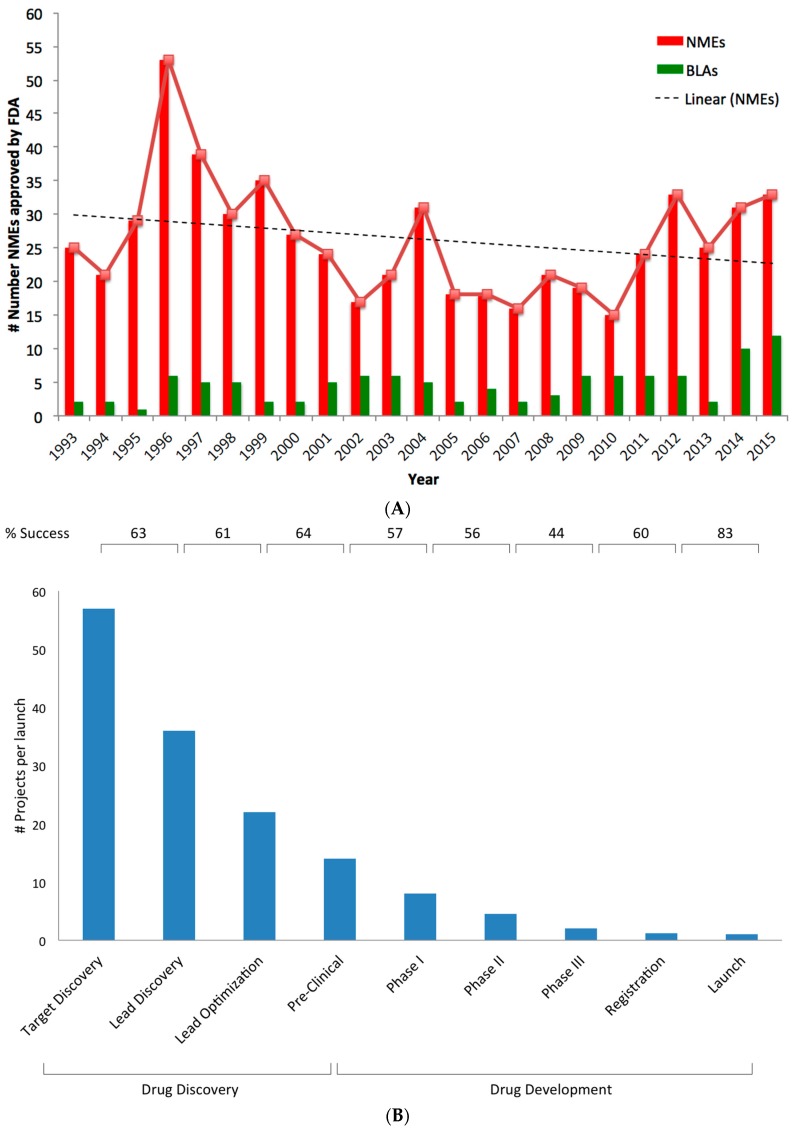
In the past decade, it was observed that the relationship between the emerging New Molecular Entities and the quantum of R&D investment has not been favorable. There might be numerous reasons but few studies stress the introduction of target based drug discovery approach as one of the factors. Although a number of drugs have been developed with an emphasis on a single protein target, yet identification of valid target is complex. The approach focuses on an in vitro single target, which overlooks the complexity of cell and makes process of validation drug targets uncertain. Thus, it is imperative to search for alternatives rather than looking at success stories of target-based drug discovery. It would be beneficial if the drugs were developed to target multiple components. New approaches like reverse engineering and translational research need to take into account both system and target-based approach. This review evaluates the strengths and limitations of known drug discovery approaches and proposes alternative approaches for increasing efficiency against treatment.
在过去十年中,人们观察到新兴的新分子实体与研发投入量之间的关系并不理想。可能有诸多原因,但很少有研究强调将基于靶点的药物发现方法作为其中一个因素。尽管已经开发了许多侧重于单一蛋白质靶点的药物,但确定有效的靶点很复杂。该方法专注于体外单一靶点,忽略了细胞的复杂性,使得药物靶点的验证过程变得不确定。因此,寻找替代方法而非只关注基于靶点的药物发现的成功案例势在必行。如果开发针对多种成分的药物将会有益。逆向工程和转化研究等新方法需要兼顾基于系统和基于靶点的方法。本综述评估了已知药物发现方法的优势和局限性,并提出提高治疗效率的替代方法。