Bedrunka Patricia, Graumann Peter L
LOEWE SYNMIKRO, LOEWE Center for Synthetic Microbiology and Department of Chemistry, Philipps University Marburg, Hans-Meerwein StrasseMarburg, Germany.
Front Microbiol. 2017 May 9;8:794. doi: 10.3389/fmicb.2017.00794. eCollection 2017.
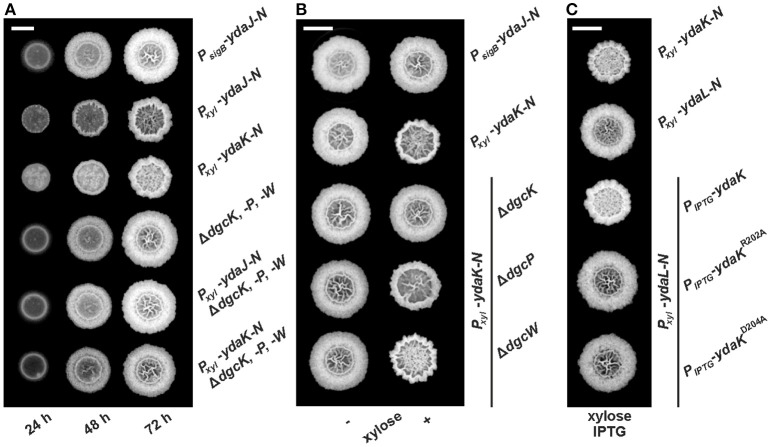
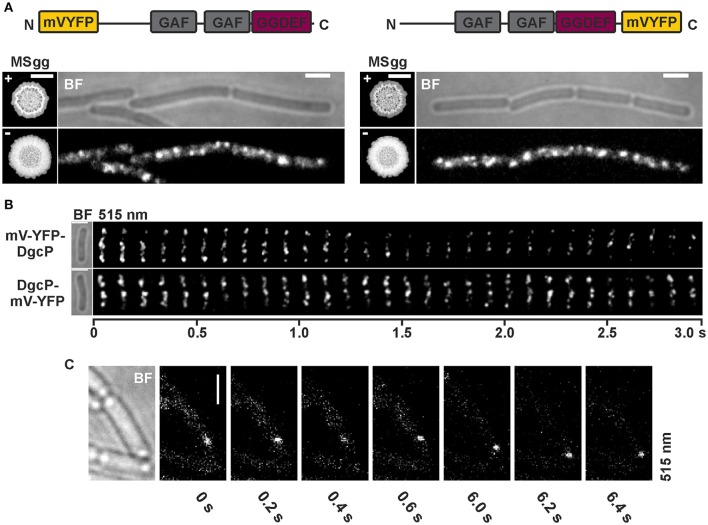
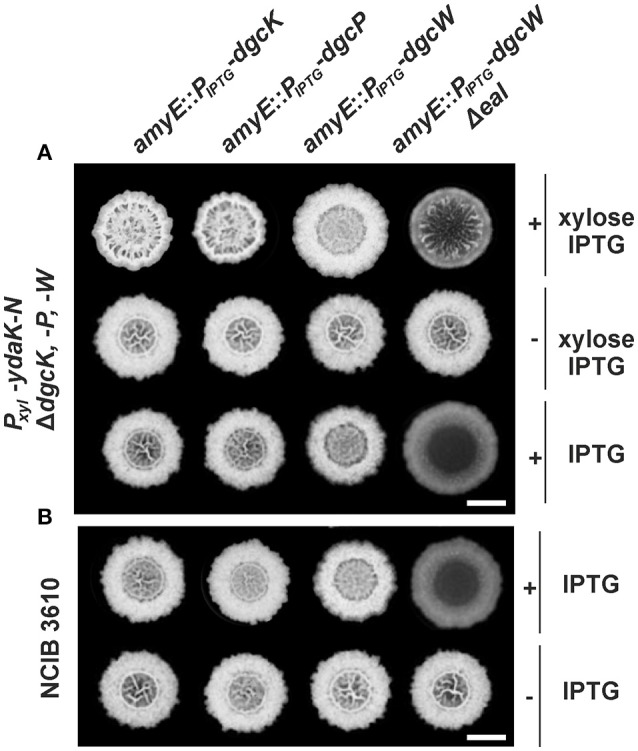
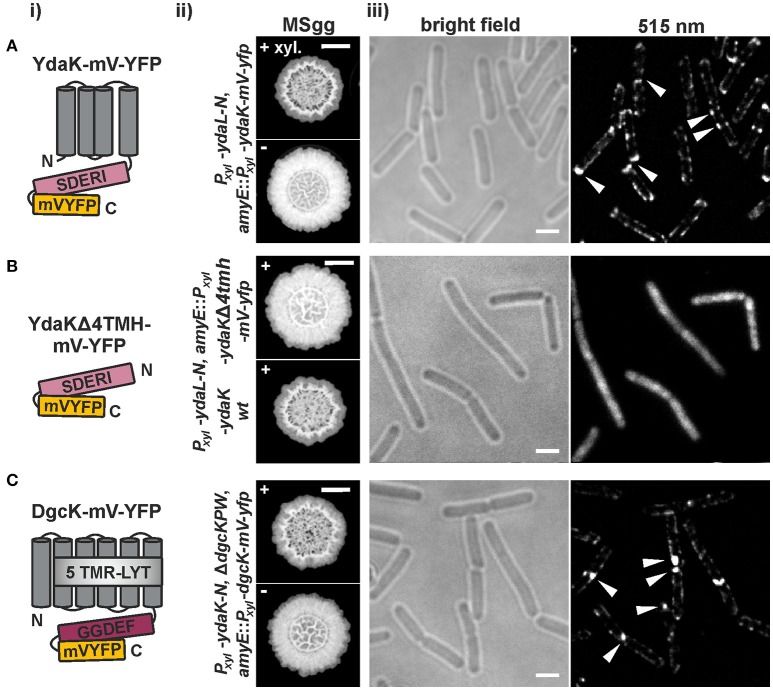
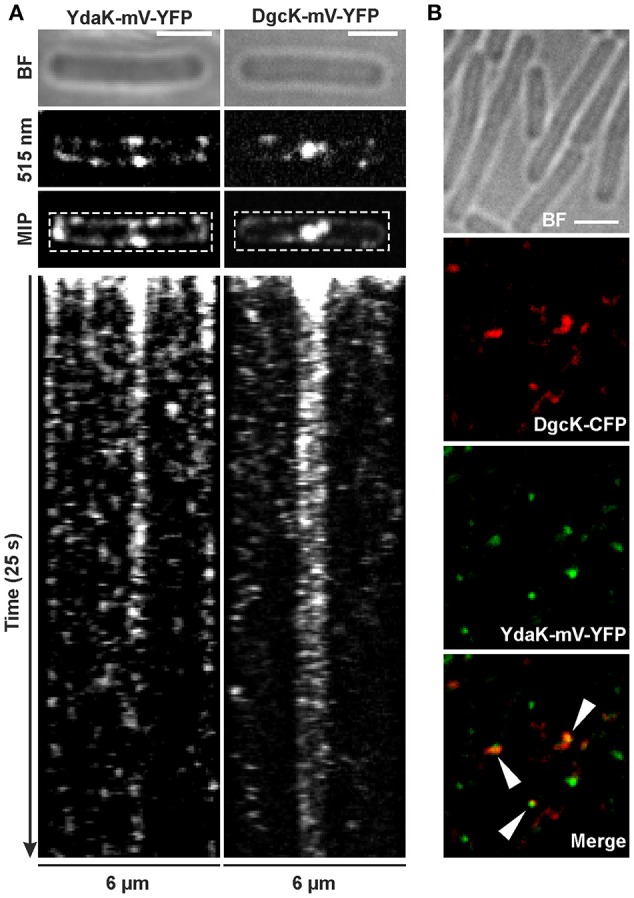
The universal and pleiotropic cyclic dinucleotide second messenger c-di-GMP is most prominently known to inversely regulate planktonic and sessile lifestyles of Gram-negative species. In the Gram-positive model organism , intracellular c-di-GMP levels are modulated by a concise set of three diguanylate cylases (DgcK, DgcP, DgcW) and one phosphodiesterase (PdeH). Two recent studies have reported the negative influence of the c-di-GMP receptor DgrA (PilZ domain protein) on swarming motility indicating a conserved role of this second messenger across the bacterial domain. However, it has been suggested that the degenerated GGDEF protein YdaK and the inactive EAL domain protein YkuI may also function as c-di-GMP receptors regulating potentially other processes than motility. Here we describe a novel c-di-GMP dependent signaling network in regulating the production of an unknown exopolysaccharide (EPS) that leads to strongly altered colony morphologies upon overproduction. The network consists of the c-di-GMP receptor YdaK and the c-di-GMP synthetase DgcK. Both proteins establish a spatially close signal-effector cluster at the membrane. The cytoplasmic DgcP synthetase can complement for DgcK only upon overproduction, while the third c-di-GMP synthetase, DgcW, of is not part of the signaling pathway. Removal of the regulatory EAL domain from DgcW reveals a distinct function in biofilm formation. Therefore, our study is compatible with the "local pool signaling" hypothesis, but shows that in case of the operon, this can easily be overcome by overproduction of non-cognate DGCs, indicating that global pools can also confer signals to regulatory circuits in a Gram-positive bacterium.
通用且具有多效性的环二核苷酸第二信使c-di-GMP最为人所知的是它能反向调节革兰氏阴性菌的浮游和固着生活方式。在革兰氏阳性模式生物中,细胞内c-di-GMP水平由一组简洁的三种二鸟苷酸环化酶(DgcK、DgcP、DgcW)和一种磷酸二酯酶(PdeH)调节。最近的两项研究报道了c-di-GMP受体DgrA(含PilZ结构域蛋白)对群体运动性有负面影响,这表明这种第二信使在细菌域中具有保守作用。然而,有人提出退化的GGDEF蛋白YdaK和无活性的EAL结构域蛋白YkuI也可能作为c-di-GMP受体发挥作用,调节除运动性之外的其他潜在过程。在此,我们描述了一个新的c-di-GMP依赖性信号网络,该网络调节一种未知胞外多糖(EPS)的产生,过量产生时会导致菌落形态发生显著改变。该网络由c-di-GMP受体YdaK和c-di-GMP合成酶DgcK组成。这两种蛋白在膜上形成空间紧密的信号-效应簇。胞质DgcP合成酶只有在过量产生时才能补充DgcK的功能,而第三种c-di-GMP合成酶DgcW不属于该信号通路。从DgcW中去除调节性EAL结构域后,其在生物膜形成中显示出独特功能。因此,我们的研究与“局部池信号传导”假说相符,但表明在操纵子的情况下,非同源DGC的过量产生可以很容易地克服这一点,这表明全局池也可以向革兰氏阳性菌中的调节回路传递信号。