Liu Wei Jing, Ye Lin, Huang Wei Fang, Guo Lin Jie, Xu Zi Gan, Wu Hong Luan, Yang Chen, Liu Hua Feng
The Institute of Nephrology, Guangdong Medical University, Zhanjiang, Guangdong 524001 China.
Key Laboratory of Chinese Internal Medicine of Ministry of Education and Beijing, Dongzhimen Hospital Affiliated to Beijing University of Chinese Medicine, Beijing, 100700 China.
Cell Mol Biol Lett. 2016 Dec 13;21:29. doi: 10.1186/s11658-016-0031-z. eCollection 2016.
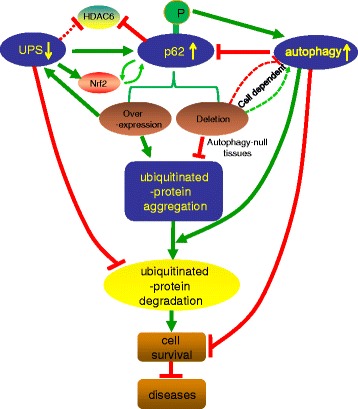
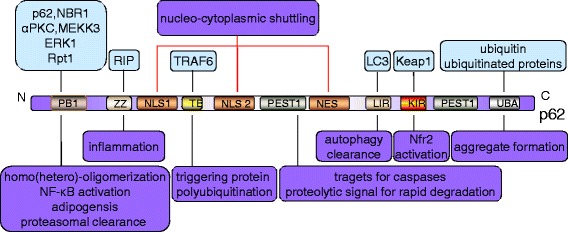
The ubiquitin-proteasome system (UPS) and autophagy are two distinct and interacting proteolytic systems. They play critical roles in cell survival under normal conditions and during stress. An increasing body of evidence indicates that ubiquitinated cargoes are important markers of degradation. p62, a classical receptor of autophagy, is a multifunctional protein located throughout the cell and involved in many signal transduction pathways, including the Keap1-Nrf2 pathway. It is involved in the proteasomal degradation of ubiquitinated proteins. When the cellular p62 level is manipulated, the quantity and location pattern of ubiquitinated proteins change with a considerable impact on cell survival. Altered p62 levels can even lead to some diseases. The proteotoxic stress imposed by proteasome inhibition can activate autophagy through p62 phosphorylation. A deficiency in autophagy may compromise the ubiquitin-proteasome system, since overabundant p62 delays delivery of the proteasomal substrate to the proteasome despite proteasomal catalytic activity being unchanged. In addition, p62 and the proteasome can modulate the activity of HDAC6 deacetylase, thus influencing the autophagic degradation.
泛素-蛋白酶体系统(UPS)和自噬是两个不同但相互作用的蛋白水解系统。它们在正常条件下以及应激期间对细胞存活起着关键作用。越来越多的证据表明,泛素化的货物是降解的重要标志物。p62是自噬的经典受体,是一种多功能蛋白,分布于整个细胞中,并参与许多信号转导途径,包括Keap1-Nrf2途径。它参与泛素化蛋白的蛋白酶体降解。当细胞内p62水平受到调控时,泛素化蛋白的数量和定位模式会发生变化,对细胞存活产生相当大的影响。p62水平的改变甚至可能导致一些疾病。蛋白酶体抑制所施加的蛋白毒性应激可通过p62磷酸化激活自噬。自噬缺陷可能会损害泛素-蛋白酶体系统,因为尽管蛋白酶体催化活性不变,但过量的p62会延迟蛋白酶体底物向蛋白酶体的递送。此外,p62和蛋白酶体可以调节HDAC6去乙酰化酶的活性,从而影响自噬降解。