Li Fangfang, Miao Luyang, Sun Hua, Zhang Yuyang, Bao Xiuqi, Zhang Dan
State Key Laboratory of Bioactive Substance and Function of Natural Medicines, Institute of Materia Medica, Chinese Academy of Medical Sciences & Peking Union Medical College, Beijing 100050, China.
Shenyang Pharmaceutical University, Shenyang 110016, China.
Acta Pharm Sin B. 2017 May;7(3):326-333. doi: 10.1016/j.apsb.2016.09.003. Epub 2016 Oct 31.
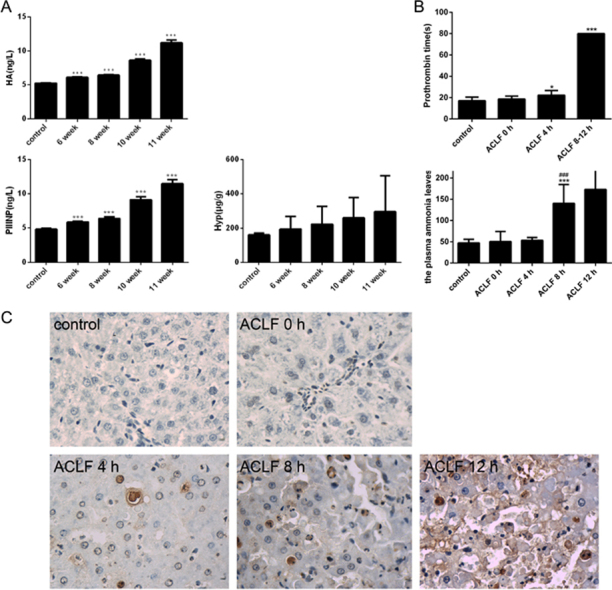
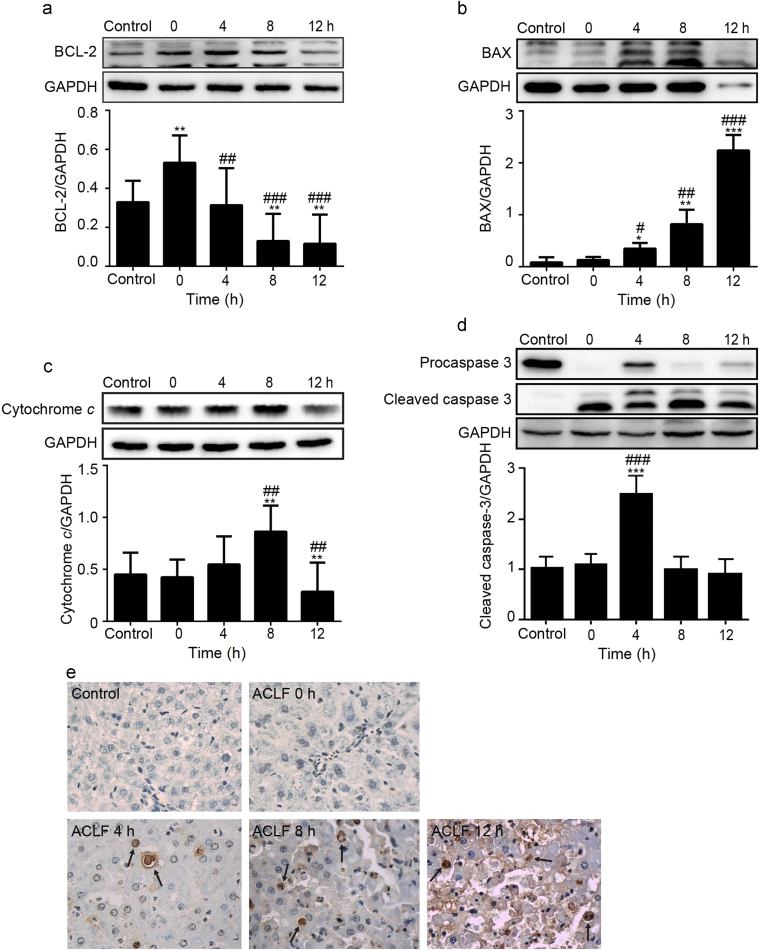
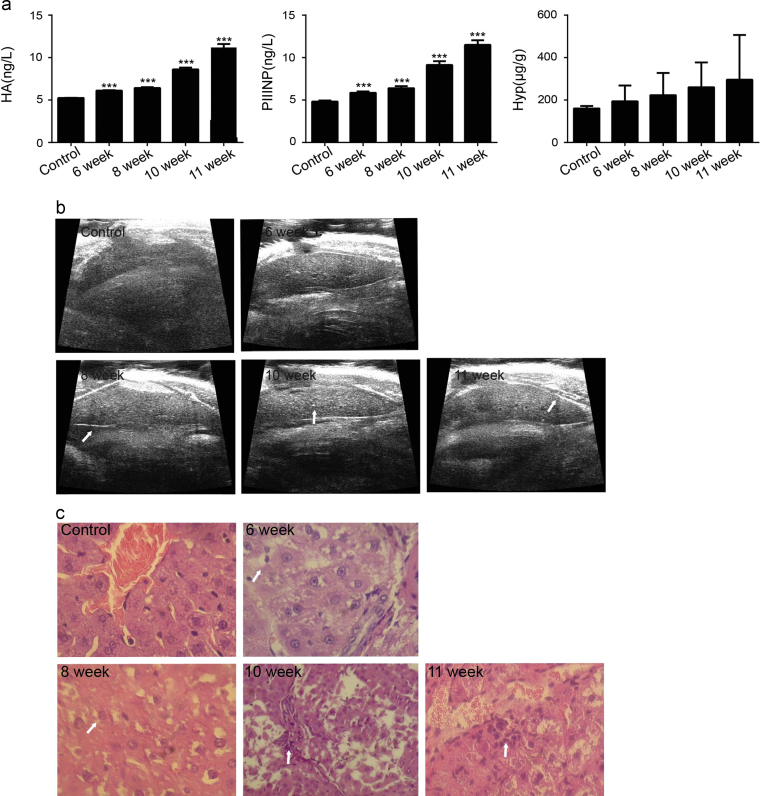
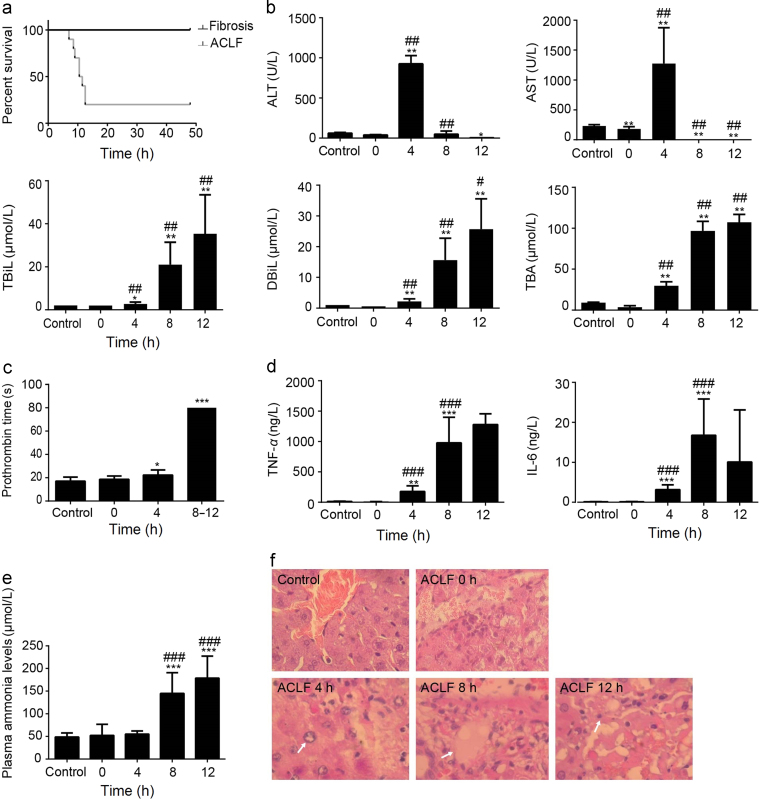
To establish an animal model of acute-on-chronic liver failure (ACLF) that would replicate the pathological process of ACLF in humans, rats were administered porcine serum (PS) for 11 weeks. Liver fibrosis was determined by pathological and biochemical assessments. The animals then were injected with d-galactosamine (d-gal) and lipopolysaccharide (LPS). The survival times of animals with cirrhosis and ACLF were determined over 48 h. Other animals were killed at 0, 4, 8 and 12 h after administration of d-gal/LPS. Liver injury was assessed by histopathological analysis and biochemical indices, and apoptosis was detected by Western blot and TUNEL analysis. After PS administration for 11 weeks the serum levels of hyaluronic acid and N-procollagen type III peptide increased significantly, and serious fibrosis and cirrhosis was observed at weeks 10 and 11. Cirrhotic rats were injected with d-gal/LPS to induced ACLF; the rate of mortality over 48 h was 80%. ALT and AST levels increased markedly at 4 h, but decreased significantly at 8 and 12 h post-treatment. The total bilirubin, direct bilirubin, and total bile acids levels increased markedly at 8 and 12 h. Clotting times, TNF- and IL-6 levels increased significantly, except for 12 h post-treatment. Apoptosis, inflammation and necrosis were elevated as determined by hematoxylin-eosin staining and TUNEL assays. BCL-2 levels decreased significantly, While BAX levels increased significantly. Cytochrome expression peaked at 8 h post-d-gal/LPS treatment. In conclusion, an ACLF model induced by PS and d-gal/LPS was established and the underlying mechanisms of ACLF development were explored.
为建立一种能复制人类急性-on-慢性肝功能衰竭(ACLF)病理过程的动物模型,给大鼠注射猪血清(PS)11周。通过病理和生化评估确定肝纤维化情况。然后给这些动物注射d-半乳糖胺(d-gal)和脂多糖(LPS)。测定肝硬化和ACLF动物的48小时存活时间。其他动物在注射d-gal/LPS后的0、4、8和12小时处死。通过组织病理学分析和生化指标评估肝损伤,通过蛋白质免疫印迹法和TUNEL分析检测细胞凋亡。注射PS 11周后,透明质酸和III型前胶原肽血清水平显著升高,在第10周和第11周观察到严重纤维化和肝硬化。给肝硬化大鼠注射d-gal/LPS诱导ACLF;48小时内死亡率为80%。治疗后4小时ALT和AST水平显著升高,但在8小时和12小时显著下降。总胆红素、直接胆红素和总胆汁酸水平在8小时和12小时显著升高。凝血时间、TNF-和IL-6水平显著升高,但治疗后12小时除外。通过苏木精-伊红染色和TUNEL检测确定细胞凋亡、炎症和坏死增加。BCL-2水平显著下降,而BAX水平显著升高。细胞色素表达在d-gal/LPS治疗后8小时达到峰值。总之,建立了由PS和d-gal/LPS诱导的ACLF模型,并探讨了ACLF发生发展的潜在机制。