Burkhardt Christian, Neuwirth Christoph, Sommacal Andreas, Andersen Peter M, Weber Markus
ALS Clinic/Neuromuscular Diseases Unit, Kantonsspital St. Gallen, St. Gallen, Switzerland.
Department of Pathology, Kantonsspital St. Gallen, St. Gallen, Switzerland.
PLoS One. 2017 May 23;12(5):e0177555. doi: 10.1371/journal.pone.0177555. eCollection 2017.
Non-invasive ventilation (NIV) and percutaneous gastrostomy (PEG) are guideline-recommended interventions for symptom management in amyotrophic lateral sclerosis (ALS). Their effect on survival is controversial and the impact on causes of death is unknown.
To investigate the effect of NIV and PEG on survival and causes of death in ALS patients.
Eighty deceased ALS patients underwent a complete post mortem analysis for causes of death between 2003 and 2015. Forty-two of these patients consented for genetic testing. Effects of NIV and PEG on survival and causes of death were analyzed in a multivariable Cox proportional hazard regression.
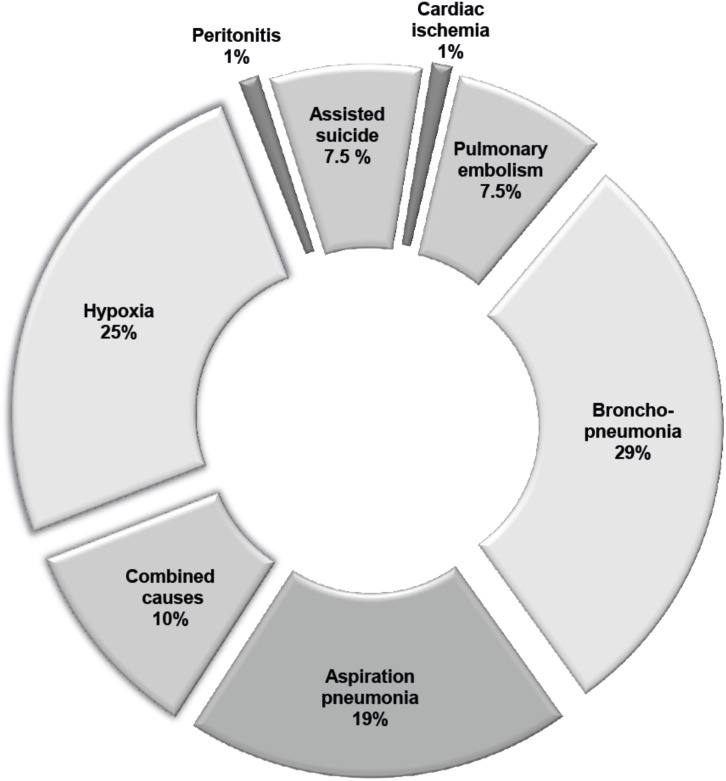
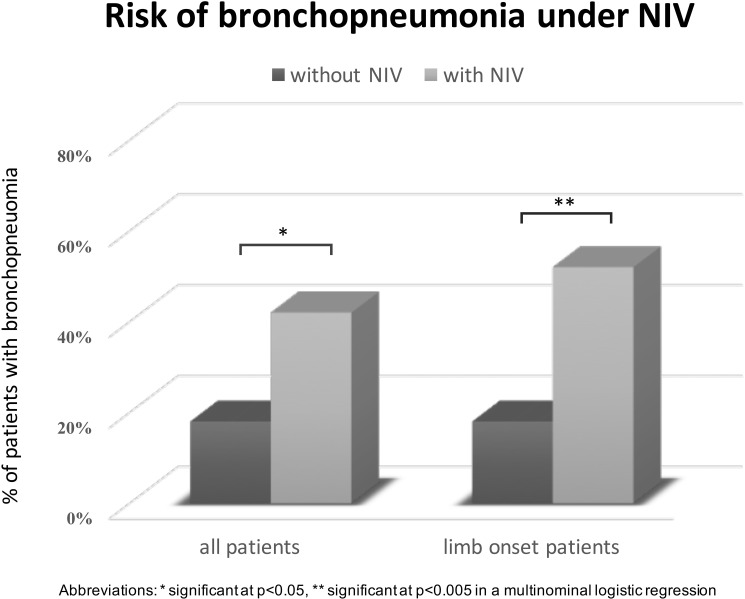
Six patients, who requested assisted suicide causing drug-induced hypoxia, were excluded from final analysis. Respiratory failure was the main cause of death in 72 out of 74 patients. Fifteen out of 74 died of aspiration pneumonia 23/74 of bronchopneumonia and 8/74 of a combination of aspiration pneumonia and bronchopneumonia. Twenty died of hypoxia without concomitant infection, and six patients had pulmonary embolism alone or in combination with pneumonia. NIV (p = 0.01) and PEG (p<0.01) had a significant impact on survival. In patients using NIV bronchopneumonia was significantly more frequent (p <0.04) compared to non-NIV patients. This effect was even more pronounced in limb onset patients (p<0.002). Patients with C9orf72 hexanucleotide repeat expansions showed faster disease progression and shorter survival (p = 0.01).
The use of NIV and PEG prolongs survival in ALS. This study supports current AAN and EFNS guidelines which recommend NIV and PEG as a treatment option in ALS. The risk of bronchopneumonia as cause of death may be increased by NIV.
无创通气(NIV)和经皮胃造瘘术(PEG)是肌萎缩侧索硬化症(ALS)症状管理指南推荐的干预措施。它们对生存的影响存在争议,对死亡原因的影响尚不清楚。
研究NIV和PEG对ALS患者生存及死亡原因的影响。
2003年至2015年间,80例已故ALS患者接受了完整的死因尸检分析。其中42例患者同意进行基因检测。在多变量Cox比例风险回归分析中分析了NIV和PEG对生存及死亡原因的影响。
6例因请求协助自杀导致药物性缺氧的患者被排除在最终分析之外。74例患者中,呼吸衰竭是72例的主要死因。74例中有15例死于吸入性肺炎,23/74死于支气管肺炎,8/74死于吸入性肺炎和支气管肺炎的合并症。20例死于无合并感染的缺氧,6例单独或合并肺炎发生肺栓塞。NIV(p = 0.01)和PEG(p<0.01)对生存有显著影响。与未使用NIV的患者相比,使用NIV的患者支气管肺炎明显更常见(p <0.04)。这种影响在肢体起病的患者中更为明显(p<0.002)。C9orf72六核苷酸重复扩增的患者疾病进展更快,生存期更短(p = 0.01)。
使用NIV和PEG可延长ALS患者的生存期。本研究支持美国神经病学学会(AAN)和欧洲神经病学联合会(EFNS)目前的指南,该指南推荐将NIV和PEG作为ALS的一种治疗选择。NIV可能会增加支气管肺炎作为死亡原因的风险。