Department of Psychiatry, University of Oxford, Warneford Hospital, Oxford, UK.
Addiction. 2017 Oct;112(10):1725-1739. doi: 10.1111/add.13877. Epub 2017 Jun 28.
The aims were to (1) estimate the prevalence of alcohol and drug use disorders in prisoners on reception to prison and (2) estimate and test sources of between study heterogeneity.
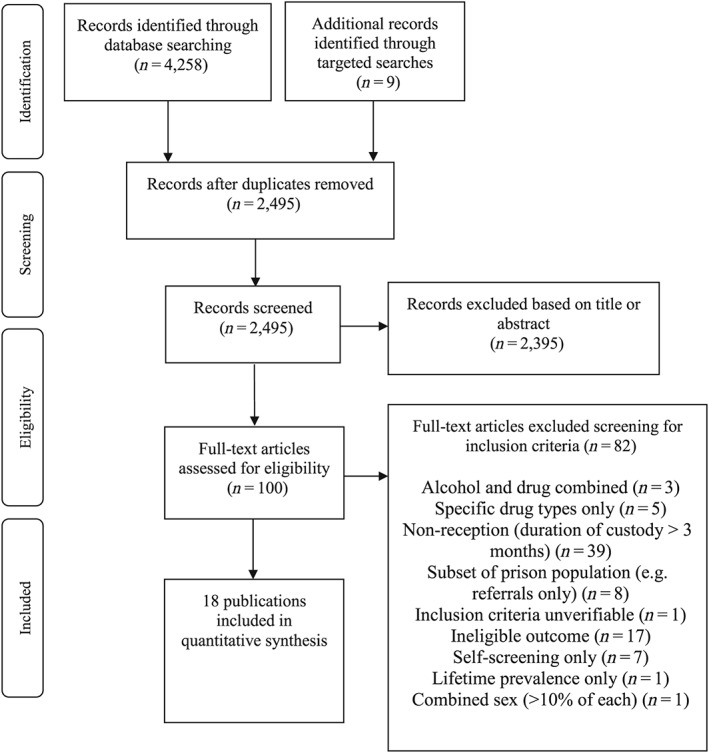
Studies reporting the 12-month prevalence of alcohol and drug use disorders in prisoners on reception to prison from 1 January 1966 to 11 August 2015 were identified from seven bibliographic indexes. Primary studies involving clinical interviews or validated instruments leading to DSM or ICD diagnoses were included; self-report surveys and investigations that assessed individuals more than 3 months after arrival to prison were not. Random-effects meta-analysis and subgroup and meta-regression analyses were conducted. Preferred Reporting Items for Systematic Reviews and Meta-Analyses (PRISMA) guidelines were followed.
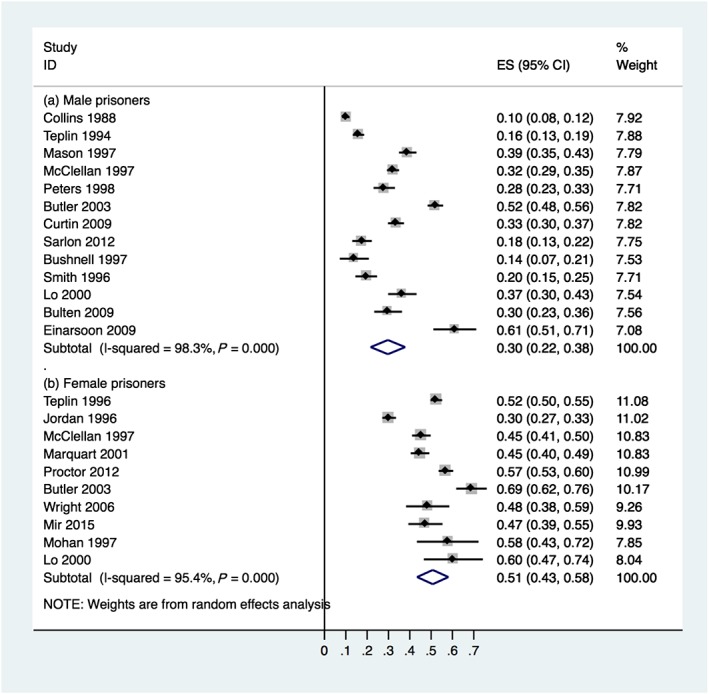
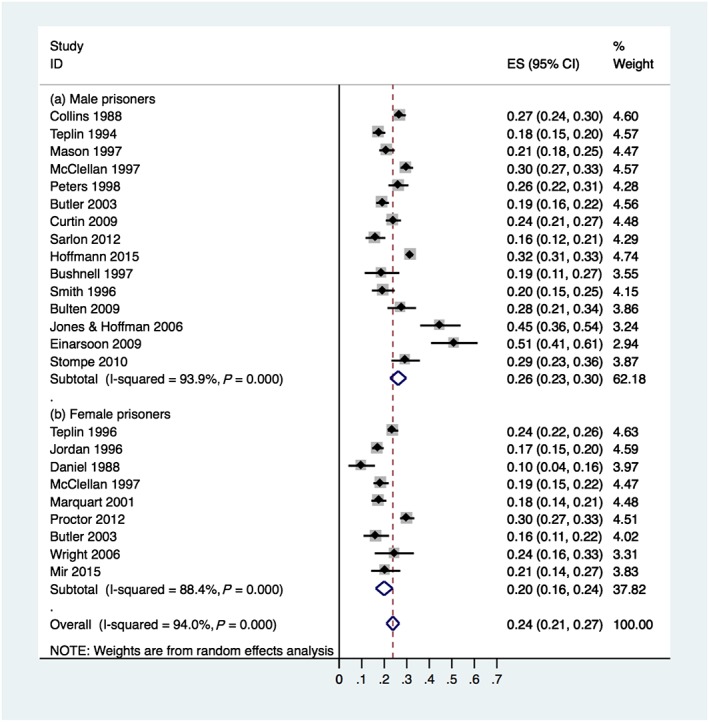
In total, 24 studies with a total of 18 388 prisoners across 10 countries were identified. The random-effects pooled prevalence estimate of alcohol use disorder was 24% [95% confidence interval (CI) = 21-27], with very high heterogeneity (I = 94%). These ranged from 16 to 51% in male and 10-30% in female prisoners. For drug use disorders, there was evidence of heterogeneity by sex, and the pooled prevalence estimate in male prisoners was 30% (95% CI = 22-38; I = 98%; 13 studies; range 10-61%) and, in female prisoners, was 51% (95% CI = 43-58; I = 95%; 10 studies; range 30-69%). On meta-regression, sources of heterogeneity included higher prevalence of drug use disorders in women, increasing rates of drug use disorders in recent decades, and participation rate.
Substance use disorders are highly prevalent in prisoners. Approximately a quarter of newly incarcerated prisoners of both sexes had an alcohol use disorder, and the prevalence of a drug use disorder was at least as high in men, and higher in women.
本研究旨在:(1)评估新收监囚犯的酒精和药物使用障碍患病率;(2)评估并检验研究间异质性的来源。
从七个文献索引中确定了 1966 年 1 月 1 日至 2015 年 8 月 11 日期间报告新收监囚犯中酒精和药物使用障碍 12 个月患病率的研究。本研究纳入了涉及临床访谈或使用经过验证的工具来诊断 DSM 或 ICD 诊断的原发性研究;不包括仅使用自我报告调查和在囚犯入监 3 个月后以上进行评估的研究。本研究进行了随机效应荟萃分析和亚组及荟萃回归分析。研究遵循了系统评价和荟萃分析的首选报告项目(PRISMA)指南。
本研究共纳入了 10 个国家的 24 项研究,共计 18388 名囚犯。酒精使用障碍的随机效应汇总患病率估计值为 24%(95%置信区间[CI]:21-27),异质性非常高(I²=94%)。男性囚犯的患病率范围为 16-51%,女性囚犯的患病率范围为 10-30%。药物使用障碍的患病率存在性别异质性,男性囚犯的汇总患病率估计值为 30%(95%CI:22-38;I²=98%;13 项研究;范围 10-61%),女性囚犯的患病率估计值为 51%(95%CI:43-58;I²=95%;10 项研究;范围 30-69%)。通过荟萃回归分析,异质性的来源包括女性药物使用障碍的患病率较高、近几十年来药物使用障碍的发生率增加以及参与率。
物质使用障碍在囚犯中高度流行。大约四分之一的新收监男女囚犯患有酒精使用障碍,男性囚犯的药物使用障碍患病率至少同样高,女性囚犯的患病率更高。