• 文献检索
  • 文档翻译
  • 深度研究
  • 学术资讯
  • Suppr Zotero 插件Zotero 插件
  • 邀请有礼
  • 套餐&价格
  • 历史记录
应用&插件
Suppr Zotero 插件Zotero 插件浏览器插件Mac 客户端Windows 客户端微信小程序
定价
高级版会员购买积分包购买API积分包
服务
文献检索文档翻译深度研究API 文档MCP 服务
关于我们
关于 Suppr公司介绍联系我们用户协议隐私条款
关注我们

Suppr 超能文献

核心技术专利:CN118964589B侵权必究
粤ICP备2023148730 号-1Suppr @ 2026

文献检索

告别复杂PubMed语法,用中文像聊天一样搜索,搜遍4000万医学文献。AI智能推荐,让科研检索更轻松。

立即免费搜索

文件翻译

保留排版,准确专业,支持PDF/Word/PPT等文件格式,支持 12+语言互译。

免费翻译文档

深度研究

AI帮你快速写综述,25分钟生成高质量综述,智能提取关键信息,辅助科研写作。

立即免费体验

活性硫物种概念:十五年回顾

The Reactive Sulfur Species Concept: 15 Years On.

作者信息

Giles Gregory I, Nasim Muhammad Jawad, Ali Wesam, Jacob Claus

机构信息

Department of Pharmacology and Toxicology, University of Otago, PO Box 56, Dunedin 9054, New Zealand.

Division of Bioorganic Chemistry, School of Pharmacy, Saarland University, Campus B2 1, Saarbruecken D-66123, Germany.

出版信息

Antioxidants (Basel). 2017 May 23;6(2):38. doi: 10.3390/antiox6020038.

DOI:10.3390/antiox6020038
PMID:28545257
原文链接:https://pmc.ncbi.nlm.nih.gov/articles/PMC5488018/
Abstract

Fifteen years ago, in 2001, the concept of "Reactive Sulfur Species" or RSS was advocated as a working hypothesis. Since then various organic as well as inorganic RSS have attracted considerable interest and stimulated many new and often unexpected avenues in research and product development. During this time, it has become apparent that molecules with sulfur-containing functional groups are not just the passive "victims" of oxidative stress or simple conveyors of signals in cells, but can also be stressors in their own right, with pivotal roles in cellular function and homeostasis. Many "exotic" sulfur-based compounds, often of natural origin, have entered the fray in the context of nutrition, ageing, chemoprevention and therapy. In parallel, the field of inorganic RSS has come to the forefront of research, with short-lived yet metabolically important intermediates, such as various sulfur-nitrogen species and polysulfides (S), playing important roles. Between 2003 and 2005 several breath-taking discoveries emerged characterising unusual sulfur redox states in biology, and since then the truly unique role of sulfur-dependent redox systems has become apparent. Following these discoveries, over the last decade a "hunt" and, more recently, mining for such modifications has begun-and still continues-often in conjunction with new, innovative and complex labelling and analytical methods to capture the (entire) sulfur "redoxome". A key distinction for RSS is that, unlike oxygen or nitrogen, sulfur not only forms a plethora of specific reactive species, but sulfur also targets itself, as sulfur containing molecules, i.e., peptides, proteins and enzymes, preferentially react with RSS. Not surprisingly, today this sulfur-centred redox signalling and control inside the living cell is a burning issue, which has moved on from the predominantly thiol/disulfide biochemistry of the past to a complex labyrinth of interacting signalling and control pathways which involve various sulfur oxidation states, sulfur species and reactions. RSS are omnipresent and, in some instances, are even considered as the true bearers of redox control, perhaps being more important than the Reactive Oxygen Species (ROS) or Reactive Nitrogen Species (RNS) which for decades have dominated the redox field. In other(s) words, in 2017, sulfur redox is "on the rise", and the idea of RSS resonates throughout the Life Sciences. Still, the RSS story isn't over yet. Many RSS are at the heart of "mistaken identities" which urgently require clarification and may even provide the foundations for further scientific revolutions in the years to come. In light of these developments, it is therefore the perfect time to revisit the original hypotheses, to select highlights in the field and to question and eventually update our concept of "Reactive Sulfur Species".
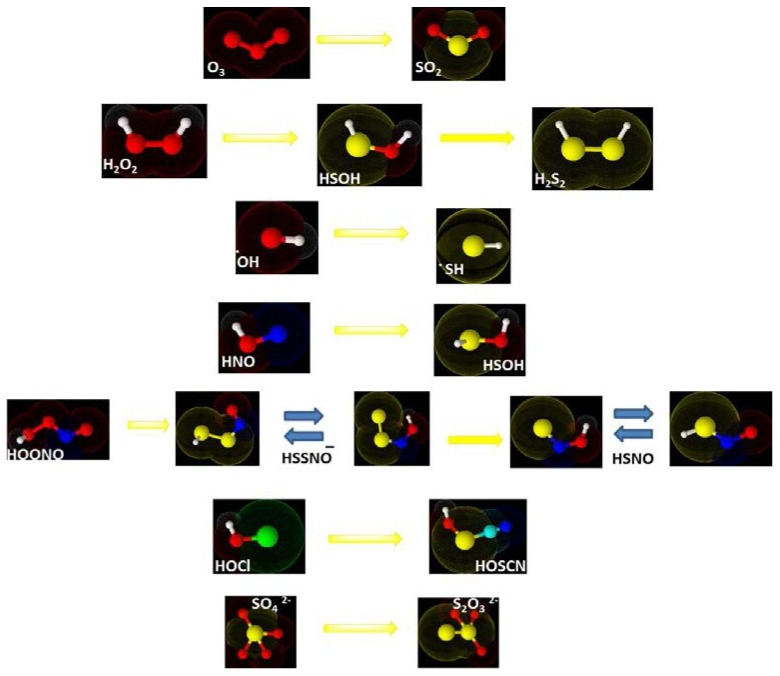
https://cdn.ncbi.nlm.nih.gov/pmc/blobs/bde8/5488018/6316e338aee4/antioxidants-06-00038-g006.jpg
https://cdn.ncbi.nlm.nih.gov/pmc/blobs/bde8/5488018/04133ee4761c/antioxidants-06-00038-g001.jpg
https://cdn.ncbi.nlm.nih.gov/pmc/blobs/bde8/5488018/a7bc3b41fdca/antioxidants-06-00038-g002.jpg
https://cdn.ncbi.nlm.nih.gov/pmc/blobs/bde8/5488018/40550d59a4cd/antioxidants-06-00038-g003.jpg
https://cdn.ncbi.nlm.nih.gov/pmc/blobs/bde8/5488018/5d69d49080b2/antioxidants-06-00038-g004.jpg
https://cdn.ncbi.nlm.nih.gov/pmc/blobs/bde8/5488018/29822448c7fc/antioxidants-06-00038-g005.jpg
https://cdn.ncbi.nlm.nih.gov/pmc/blobs/bde8/5488018/6316e338aee4/antioxidants-06-00038-g006.jpg
https://cdn.ncbi.nlm.nih.gov/pmc/blobs/bde8/5488018/04133ee4761c/antioxidants-06-00038-g001.jpg
https://cdn.ncbi.nlm.nih.gov/pmc/blobs/bde8/5488018/a7bc3b41fdca/antioxidants-06-00038-g002.jpg
https://cdn.ncbi.nlm.nih.gov/pmc/blobs/bde8/5488018/40550d59a4cd/antioxidants-06-00038-g003.jpg
https://cdn.ncbi.nlm.nih.gov/pmc/blobs/bde8/5488018/5d69d49080b2/antioxidants-06-00038-g004.jpg
https://cdn.ncbi.nlm.nih.gov/pmc/blobs/bde8/5488018/29822448c7fc/antioxidants-06-00038-g005.jpg
https://cdn.ncbi.nlm.nih.gov/pmc/blobs/bde8/5488018/6316e338aee4/antioxidants-06-00038-g006.jpg
摘要

十五年前,即2001年,“反应性硫物种”(RSS)的概念作为一个工作假设被提出。从那时起,各种有机和无机的RSS引起了相当大的关注,并在研究和产品开发中激发了许多新的、常常出人意料的途径。在此期间,很明显含硫官能团的分子不仅是氧化应激的被动“受害者”或细胞中信号的简单传递者,而且本身也可以成为应激源,在细胞功能和内环境稳定中起关键作用。许多通常源自天然的“奇特”硫基化合物已在营养、衰老、化学预防和治疗等方面进入了竞争领域。与此同时,无机RSS领域已成为研究的前沿,一些寿命短但具有重要代谢意义的中间体,如各种硫氮物种和多硫化物(S),发挥着重要作用。在2003年至2005年期间,出现了几项惊人的发现,揭示了生物学中不寻常的硫氧化还原状态,从那时起,硫依赖性氧化还原系统真正独特的作用变得明显。在这些发现之后,在过去十年里,一场对这种修饰的“搜寻”,以及最近的挖掘已经开始——并且仍在继续——通常与新的、创新的和复杂的标记及分析方法相结合,以捕获(整个)硫“氧化还原组 ”。RSS的一个关键区别在于,与氧或氮不同,硫不仅能形成大量特定的反应性物种,而且硫还以自身为目标,因为含硫分子,即肽、蛋白质和酶,优先与RSS反应。毫不奇怪,如今活细胞内这种以硫为中心的氧化还原信号传导和控制是一个紧迫的问题,它已从过去主要的硫醇/二硫键生物化学发展到一个由涉及各种硫氧化态、硫物种和反应的相互作用的信号传导和控制途径组成的复杂迷宫。RSS无处不在,在某些情况下,甚至被认为是氧化还原控制的真正承担者,可能比几十年来主导氧化还原领域的活性氧(ROS)或活性氮(RNS)更重要。换句话说,在2017年,硫氧化还原“正在兴起”,RSS的概念在整个生命科学领域引起共鸣。然而,RSS的故事还没有结束。许多RSS处于“身份错误”的核心,这迫切需要澄清,甚至可能为未来几年的进一步科学革命奠定基础。鉴于这些发展,因此现在是重新审视原始假设、挑选该领域的亮点、质疑并最终更新我们的“反应性硫物种”概念的绝佳时机。

相似文献

1
The Reactive Sulfur Species Concept: 15 Years On.活性硫物种概念:十五年回顾
Antioxidants (Basel). 2017 May 23;6(2):38. doi: 10.3390/antiox6020038.
2
The biology of reactive sulfur species (RSS).活性硫物种(RSS)的生物学。
Plant Physiol Biochem. 2012 Oct;59:98-107. doi: 10.1016/j.plaphy.2012.03.016. Epub 2012 Apr 7.
3
The emerging key role of reactive sulfur species in abiotic stress tolerance in plants.活性硫物种在植物非生物胁迫耐受中的新兴关键作用。
Physiol Plant. 2023 May-Jun;175(3):e13945. doi: 10.1111/ppl.13945.
4
Reactive oxygen species or reactive sulfur species: why we should consider the latter.活性氧或活性硫:我们为何应该考虑后者。
J Exp Biol. 2020 Feb 26;223(Pt 4):jeb196352. doi: 10.1242/jeb.196352.
5
S-sulfhydration as a cellular redox regulation.S-硫醇化作为一种细胞氧化还原调节机制。
Biosci Rep. 2015 Nov 25;36(2):e00304. doi: 10.1042/BSR20150147.
6
Reactive sulfur species: an emerging concept in oxidative stress.活性硫物质:氧化应激中的一个新兴概念。
Biol Chem. 2002 Mar-Apr;383(3-4):375-88. doi: 10.1515/BC.2002.042.
7
Inorganic Reactive Sulfur-Nitrogen Species: Intricate Release Mechanisms or Cacophony in Yellow, Blue and Red?无机反应性硫氮物种:复杂的释放机制还是黄、蓝、红三色的杂音?
Antioxidants (Basel). 2017 Feb 15;6(1):14. doi: 10.3390/antiox6010014.
8
Persulfide Signaling in Stress-Initiated Calmodulin Kinase Response.硫代物信号在应激诱导的钙调蛋白激酶反应中的作用。
Antioxid Redox Signal. 2020 Dec 20;33(18):1308-1319. doi: 10.1089/ars.2020.8138. Epub 2020 Aug 19.
9
Reactive sulfur species (RSS): persulfides, polysulfides, potential, and problems.活性硫物种(RSS):过硫化物、多硫化物、潜力和问题。
Curr Opin Chem Biol. 2019 Apr;49:1-8. doi: 10.1016/j.cbpa.2018.08.012. Epub 2018 Sep 19.
10
Are Reactive Sulfur Species the New Reactive Oxygen Species?活性硫物种是新的活性氧物种吗?
Antioxid Redox Signal. 2020 Dec 1;33(16):1125-1142. doi: 10.1089/ars.2020.8132. Epub 2020 Aug 5.

引用本文的文献

1
The role of NRF2 transcription factor in inflammatory skin diseases.NRF2转录因子在炎症性皮肤病中的作用。
Biofactors. 2025 Mar-Apr;51(2):e70013. doi: 10.1002/biof.70013.
2
Antimicrobial Potential of Polyphenols: Mechanisms of Action and Microbial Responses-A Narrative Review.多酚的抗菌潜力:作用机制与微生物反应——一篇叙述性综述
Antioxidants (Basel). 2025 Feb 10;14(2):200. doi: 10.3390/antiox14020200.
3
Diverse Fluorescent Probe Concepts for Detection and Monitoring of Reactive Oxygen Species.用于检测和监测活性氧物种的多种荧光探针概念

本文引用的文献

1
The Effects of Allicin, a Reactive Sulfur Species from Garlic, on a Selection of Mammalian Cell Lines.大蒜中的活性硫物质大蒜素对多种哺乳动物细胞系的影响。
Antioxidants (Basel). 2016 Dec 26;6(1):1. doi: 10.3390/antiox6010001.
2
Protein cysteine oxidation in redox signaling: Caveats on sulfenic acid detection and quantification.氧化还原信号传导中的蛋白质半胱氨酸氧化:亚磺酸检测与定量的注意事项
Arch Biochem Biophys. 2017 Mar 1;617:26-37. doi: 10.1016/j.abb.2016.09.013. Epub 2016 Sep 28.
3
4,5-Diaryl-3H-1,2-dithiole-3-thiones and related compounds as combretastatin A-4/oltipraz hybrids: Synthesis, molecular modelling and evaluation as antiproliferative agents and inhibitors of tubulin.
Chem Asian J. 2025 Apr 3;20(7):e202401524. doi: 10.1002/asia.202401524. Epub 2025 Feb 20.
4
Navigating the dichotomy of reactive oxygen, nitrogen, and sulfur species: detection strategies and therapeutic interventions.应对活性氧、氮和硫物种的二分法:检测策略与治疗干预
RSC Chem Biol. 2025 Jan 17;6(3):338-357. doi: 10.1039/d5cb00006h. eCollection 2025 Mar 5.
5
Promising tools into oxidative stress: A review of non-rodent model organisms.有前景的氧化应激研究工具:非啮齿类动物模型生物综述。
Redox Biol. 2024 Nov;77:103402. doi: 10.1016/j.redox.2024.103402. Epub 2024 Oct 16.
6
Oxidative stress in relation to serotonin under general anaesthesia in dogs undergoing ovariectomy.在接受卵巢切除术的犬全身麻醉下与 5-羟色胺相关的氧化应激。
Vet Q. 2024 Dec;44(1):1-8. doi: 10.1080/01652176.2024.2379319. Epub 2024 Jul 19.
7
Reactive Oxygen Species Signaling and Oxidative Stress: Transcriptional Regulation and Evolution.活性氧信号传导与氧化应激:转录调控与进化
Antioxidants (Basel). 2024 Mar 1;13(3):312. doi: 10.3390/antiox13030312.
8
Comparison of Reactive Sites in 2(1)-Quinolone Derivatives for the Detection of Biologically Important Sulfur Compounds.2(1)-喹诺酮衍生物中反应位点的比较用于检测生物重要的硫化合物。
Molecules. 2023 Aug 9;28(16):5965. doi: 10.3390/molecules28165965.
9
Understanding Reactive Sulfur Species through P/S Synergy.通过磷/硫协同作用理解活性硫物种
Inorg Chem. 2023 Aug 24. doi: 10.1021/acs.inorgchem.3c01976.
10
WR1065 conjugated to thiol-PEG polymers as novel anticancer prodrugs: broad spectrum efficacy, synergism, and drug resistance reversal.与硫醇-聚乙二醇聚合物偶联的WR1065作为新型抗癌前药:广谱疗效、协同作用及耐药逆转
Front Oncol. 2023 Jul 28;13:1212604. doi: 10.3389/fonc.2023.1212604. eCollection 2023.
4,5-二芳基-3H-1,2-二硫杂环戊烯-3-硫酮及相关化合物作为康普瑞他汀A-4/奥替普拉杂合物:合成、分子模拟以及作为抗增殖剂和微管蛋白抑制剂的评价
Eur J Med Chem. 2016 Oct 21;122:520-529. doi: 10.1016/j.ejmech.2016.06.055. Epub 2016 Jul 1.
4
Unravelling chemical priming machinery in plants: the role of reactive oxygen-nitrogen-sulfur species in abiotic stress tolerance enhancement.解析植物化学预适应机制:活性氧氮硫物种在提高非生物胁迫耐受性中的作用。
Curr Opin Plant Biol. 2016 Oct;33:101-107. doi: 10.1016/j.pbi.2016.06.020. Epub 2016 Jul 13.
5
Inorganic sulfur-nitrogen compounds: from gunpowder chemistry to the forefront of biological signaling.无机硫氮化合物:从火药化学到生物信号前沿
Dalton Trans. 2016 Apr 14;45(14):5908-19. doi: 10.1039/c5dt05034k. Epub 2016 Feb 22.
6
Natural selenium particles from Staphylococcus carnosus: Hazards or particles with particular promise?来自肉葡萄球菌的天然硒颗粒:是危害还是具有特殊前景的颗粒?
J Hazard Mater. 2017 Feb 15;324(Pt A):22-30. doi: 10.1016/j.jhazmat.2016.02.001. Epub 2016 Feb 2.
7
A novel persulfide detection method reveals protein persulfide- and polysulfide-reducing functions of thioredoxin and glutathione systems.一种新型的过硫化物检测方法揭示了硫氧还蛋白和谷胱甘肽系统的蛋白质过硫化物及多硫化物还原功能。
Sci Adv. 2016 Jan 22;2(1):e1500968. doi: 10.1126/sciadv.1500968. eCollection 2016 Jan.
8
Special issue on "Free Radical and Redox Biochemistry of Thiols".“硫醇的自由基与氧化还原生物化学”特刊
Free Radic Res. 2016;50(2):123-5. doi: 10.3109/10715762.2015.1121254.
9
A case of mistaken identity: are reactive oxygen species actually reactive sulfide species?身份错认的一例:活性氧物种实际上是活性硫化物物种吗?
Am J Physiol Regul Integr Comp Physiol. 2016 Apr 1;310(7):R549-60. doi: 10.1152/ajpregu.00455.2015. Epub 2016 Jan 13.
10
Inspired by Nature: The Use of Plant-derived Substrate/Enzyme Combinations to Generate Antimicrobial Activity in situ.受自然启发:利用植物衍生的底物/酶组合原位产生抗菌活性。
Nat Prod Commun. 2015 Oct;10(10):1733-8.