Xu Yi, Tong Yanyue, Zhu Jianyong, Lei Zhangming, Wan Lijun, Zhu Xiuwen, Ye Feng, Xie Liping
Department of Urology, Quzhou Hospital, Zhejiang University, Quzhou City, 324000, China.
Department of Urology, First Affiliated Hospital, School of Medicine, Zhejiang University, Hangzhou City, 310003, China.
BMC Cancer. 2017 May 25;17(1):373. doi: 10.1186/s12885-017-3339-9.
Nearly 30% of clear cell renal cell carcinoma (ccRCC) patients present with metastasis at the time of diagnosis, and the prognosis for these patients is poor. Therefore, novel potential prognostic biomarkers and therapeutic targets for ccRCC could be helpful. Emerging evidence indicates that lncRNAs play important roles in cancer tumorigenesis and could be used as potential biomarkers or therapeutic targets. PANDAR (promoter of CDKN1A antisense DNA damage activated RNA) is a relatively novel lncRNA that plays an important role in the development of multiple cancers. However, the clinical significance and molecular mechanism of PANDAR in ccRCC are still elusive. In the present study, we attempted to elucidate the role of PANDAR in ccRCC.
The relative expression level of lncRNA PANDAR was quantified by real-time qPCR in 62 paired ccRCC tissues and in renal cancer cell lines, and its association with overall survival was assessed by statistical analysis. The biological functions of lncRNA PANDAR on ccRCC cells were determined both in vitro and in vivo.
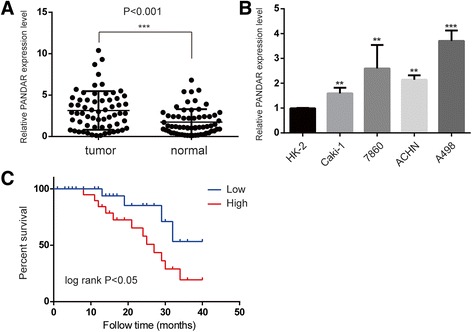
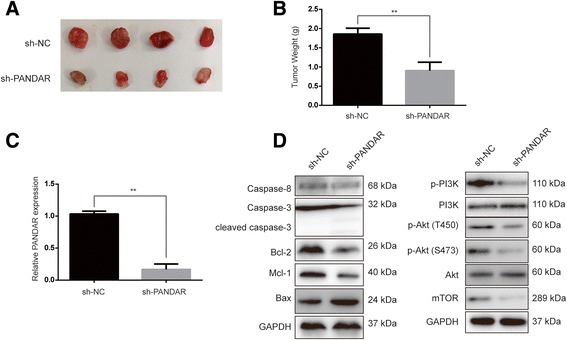
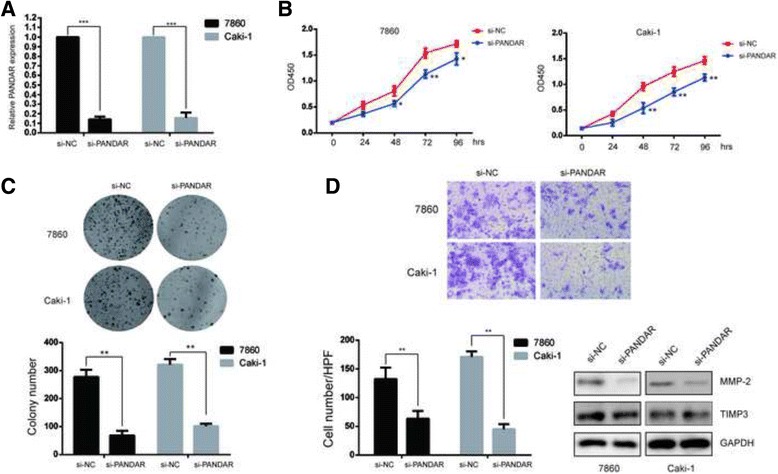
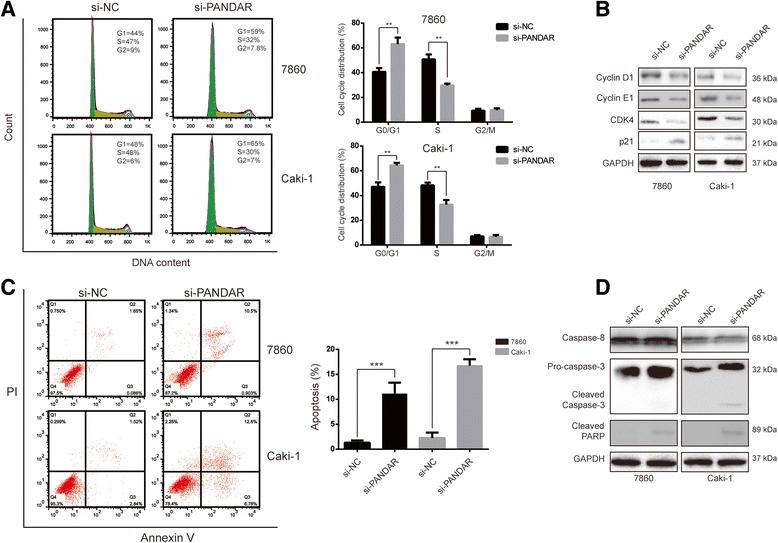
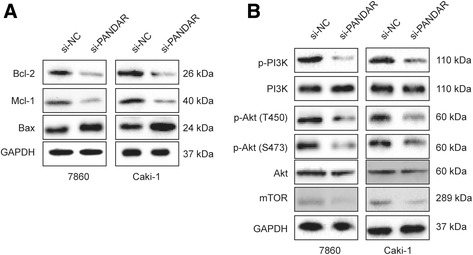
PANDAR expression was significantly upregulated in tumor tissues and cell lines compared with normal counterparts. Moreover, PANDAR served as an independent predictor of overall survival, and increased PANDAR expression was positively correlated with an advanced TNM stage. Further experiments demonstrated that PANDAR silencing can significantly inhibit cell proliferation and invasion, induce cell cycle arrest in the G1 phase and significantly promote apoptosis in 7860 and Caki-1 cell lines. In addition, in vivo experiments confirmed that downregulation of PANDAR inhibited the tumorigenic ability of 7860 cells in nude mice. Silencing of PANDAR also inhibited the expression of Bcl-2 and Mcl-1 and upregulated the expression of Bax in vivo.
Our results suggest that PANDAR is involved in ccRCC progression and may serve as a potential prognostic biomarker and therapeutic target.
近30%的透明细胞肾细胞癌(ccRCC)患者在诊断时即出现转移,这些患者的预后较差。因此,寻找ccRCC新的潜在预后生物标志物和治疗靶点可能会有所帮助。新出现的证据表明,长链非编码RNA(lncRNAs)在癌症肿瘤发生中起重要作用,可作为潜在的生物标志物或治疗靶点。PANDAR(CDKN1A反义DNA损伤激活RNA启动子)是一种相对较新的lncRNA,在多种癌症的发展中起重要作用。然而,PANDAR在ccRCC中的临床意义和分子机制仍不清楚。在本研究中,我们试图阐明PANDAR在ccRCC中的作用。
通过实时定量PCR(qPCR)检测62对ccRCC组织及肾癌细胞系中lncRNA PANDAR的相对表达水平,并通过统计分析评估其与总生存期的关系。在体外和体内确定lncRNA PANDAR对ccRCC细胞的生物学功能。
与正常组织相比,肿瘤组织和细胞系中PANDAR的表达显著上调。此外,PANDAR是总生存期的独立预测因子,PANDAR表达增加与晚期TNM分期呈正相关。进一步实验表明,PANDAR沉默可显著抑制7860和Caki-1细胞系的细胞增殖和侵袭,诱导细胞周期停滞在G1期,并显著促进细胞凋亡。此外,体内实验证实,PANDAR下调可抑制7860细胞在裸鼠中的致瘤能力。PANDAR沉默还可抑制体内Bcl-2和Mcl-1的表达,并上调Bax的表达。
我们的结果表明,PANDAR参与了ccRCC的进展,可能作为潜在的预后生物标志物和治疗靶点。