Division of Allergy, Pulmonary, and Critical Care Medicine, Vanderbilt University Medical Center, 1161 21st Ave South, Medical Center North T-1218, Nashville, 37232, Tennessee, USA.
Department of Pathology, Microbiology, and Immunology, Vanderbilt University Medical Center, Nashville, TN, USA.
Crit Care. 2017 May 25;21(1):120. doi: 10.1186/s13054-017-1700-7.
It is unclear how to identify which patients at risk for acute respiratory distress syndrome (ARDS) will develop this condition during critical illness. Elevated microparticle (MP) concentrations in the airspace during ARDS are associated with activation of coagulation and in vitro studies have demonstrated that MPs contribute to acute lung injury, but the significance of MPs in the circulation during ARDS has not been well studied. The goal of the present study was to test the hypothesis that elevated levels of circulating MPs could prospectively identify critically ill patients who will develop ARDS and that elevated circulating MPs are associated with poor clinical outcomes.
A total of 280 patients with platelet-poor plasma samples from the prospective Validating Acute Lung Injury biomarkers for Diagnosis (VALID) cohort study were selected for this analysis. Demographics and clinical data were obtained by chart review. MP concentrations in plasma were measured at study enrollment on intensive care unit (ICU) day 2 and on ICU day 4 by MP capture assay. Activation of coagulation was measured by plasma recalcification (clot) times.
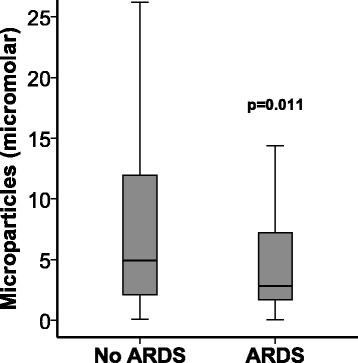
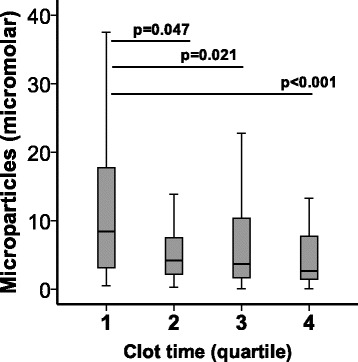
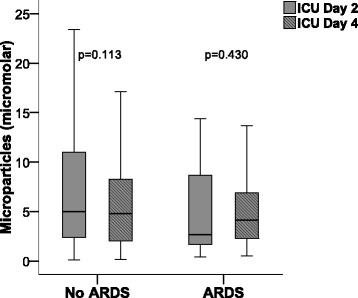
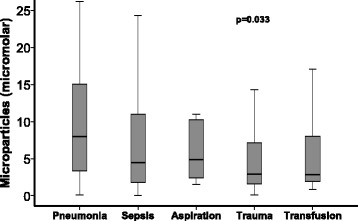
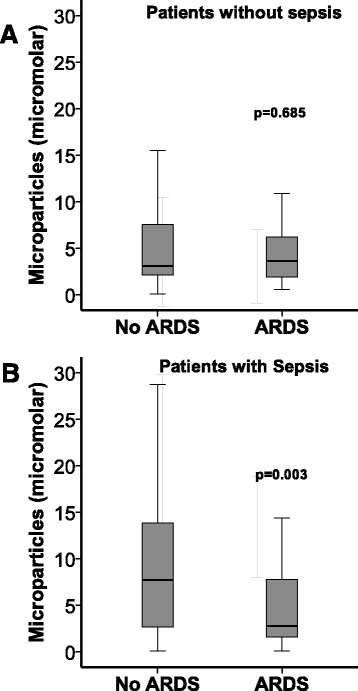
ARDS developed in 90 of 280 patients (32%) in the study. Elevated plasma MP concentrations were associated with reduced risk of developing ARDS (odds ratio (OR) 0.70 per 10 μM increase in MP concentration, 95% CI 0.50-0.98, p = 0.042), but had no significant effect on hospital mortality. MP concentration was greatest in patients with sepsis, pneumonia, or aspiration as compared with those with trauma or receiving multiple blood transfusions. MP levels did not significantly change over time. The inverse association of MP levels with ARDS development was most striking in patients with sepsis. After controlling for age, presence of sepsis, and severity of illness, higher MP concentrations were independently associated with a reduced risk of developing ARDS (OR 0.69, 95% CI 0.49-0.98, p = 0.038). MP concentration was associated with reduced plasma recalcification time.
Elevated levels of circulating MPs are independently associated with a reduced risk of ARDS in critically ill patients. Whether this is due to MP effects on systemic coagulation warrants further investigation.
目前尚不清楚如何识别哪些处于急性呼吸窘迫综合征(ARDS)风险中的危重病患者会出现这种情况。ARDS 患者肺泡中升高的微颗粒(MP)浓度与凝血激活有关,体外研究表明 MPs 有助于急性肺损伤,但 ARDS 循环中 MPs 的意义尚未得到很好的研究。本研究的目的是检验以下假设:循环 MPs 水平升高可前瞻性识别可能发生 ARDS 的危重病患者,并且循环 MPs 升高与不良临床结局相关。
选择前瞻性 Validating Acute Lung Injury biomarkers for Diagnosis(VALID)队列研究的 280 例血小板缺乏血浆样本患者进行此项分析。通过病历回顾获取人口统计学和临床数据。在研究入组时(入住 ICU 第 2 天)和第 4 天通过 MPs 捕获测定法测量血浆中的 MPs 浓度。通过血浆再钙化(凝块)时间测量凝血的激活情况。
在研究中的 280 例患者中,90 例(32%)发生 ARDS。血浆 MPs 浓度升高与 ARDS 发病风险降低相关(每增加 10 μM MPs 浓度,OR 0.70,95%CI 0.50-0.98,p=0.042),但对住院死亡率无显著影响。与创伤或接受多次输血的患者相比,患有脓毒症、肺炎或吸入性肺炎的患者 MPs 浓度最高。MP 水平随时间无明显变化。在患有脓毒症的患者中,MP 水平与 ARDS 发病呈负相关,最为明显。在校正年龄、脓毒症存在和疾病严重程度后,较高的 MPs 浓度与发生 ARDS 的风险降低独立相关(OR 0.69,95%CI 0.49-0.98,p=0.038)。MP 浓度与血浆再钙化时间缩短有关。
循环 MPs 水平升高与危重病患者 ARDS 的发病风险降低独立相关。这是否是由于 MPs 对全身凝血的影响还需要进一步研究。