Kleinstäuber Maria, Lambert Michael J, Hiller Wolfgang
Division of Clinical Psychology and Psychotherapy, Philipps-University, Gutenbergstr. 18, D-35037, Marburg, Germany.
Psychological Medicine, School of Medicine, Faculty of Medical and Health Sciences, University of Auckland, Hospital Bldg. 599, 2 Park Rd, Grafton Auckland, Auckland, 1023, New Zealand.
BMC Psychiatry. 2017 May 25;17(1):195. doi: 10.1186/s12888-017-1351-x.
Early dramatic treatment response suggests a subset of patients who respond to treatment before most of it has been offered. These early responders tend to be over represented among those who are well at termination and at follow-up. Early response patterns in psychotherapy have been investigated only for a few of mental disorders so far. The main aim of the current study was to examine early response after five therapy-preparing sessions of a cognitive behavior therapy (CBT) for syndromes of medically unexplained symptoms (MUS).
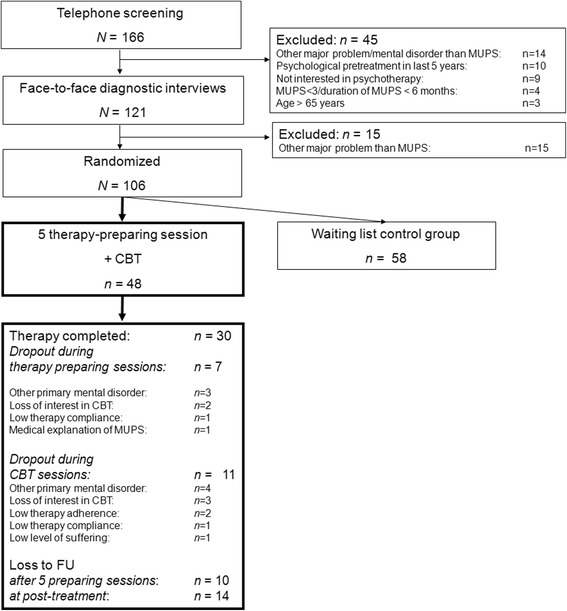
In the context of a randomized, waiting-list controlled trial 48 patients who suffered from ≥3 MUS over ≥6 months received 5 therapy-preparing sessions and 20 sessions of CBT for somatoform disorders. They completed self-report scales of somatic symptom severity (SOMS-7 T), depression (BDI-II), anxiety (BSI), illness anxiety and behavior (IAS) at pre-treatment, after 5 therapy-preparing sessions (FU-5P) and at therapy termination (FU-20 T).
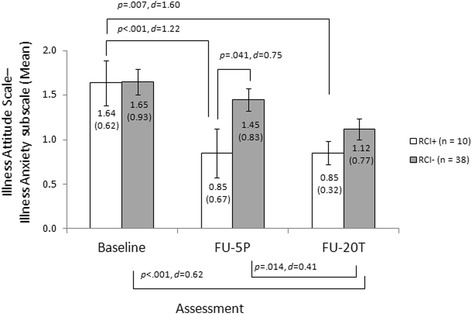
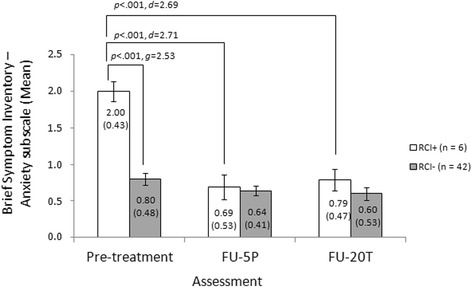
The current analyses are based on data from the treatment arm only. Repeated measure ANOVAs revealed a significant decrease of depression (d = 0.34), anxiety (d = 0.60), illness anxiety (d = 0.38) and illness behavior (d = 0.42), but no change of somatic symptom severity (d = -0.03) between pre-treatment and FU-5P. Hierarchical linear multiple regression analyses showed that symptom improvements between pre-treatment and FU-5P predict a better outcome at therapy termination for depression and illness anxiety, after controlling for pre-treatment scores. Mixed-effect ANOVAs revealed significant group*time interaction effects indicating differences in the course of symptom improvement over the therapy between patients who fulfilled a reliable change (i.e., early response) during the 5 therapy-preparing sessions and patients who did not reach an early reliable change. Demographic or clinical variables at pre-treatment were not significantly correlated with differential scores between pre-treatment and FU-5P (-.23 ≤ r ≤ .23).
Due to several limitations (e.g., small sample size, lack of a control group) the results of this study have to be interpreted cautiously. Our findings show that reliable changes in regard to affective-cognitive and behavioral variables can take place very early in CBT of patients with distressing MUS. These early changes seem to be predictive of the outcome at therapy termination. Future studies are needed in order to replicate our results, and to identify mechanisms of these early response patterns in somatoform patients.
ISRCTN. ISRCTN17188363 . Registered retrospectively on 29 March 2007.
早期显著的治疗反应表明,有一部分患者在大部分治疗尚未实施之前就对治疗产生了反应。这些早期反应者在治疗结束时和随访时状况良好的人群中往往占比过高。到目前为止,仅针对少数精神障碍对心理治疗中的早期反应模式进行了研究。本研究的主要目的是考察针对医学上无法解释的症状(MUS)综合征的认知行为疗法(CBT)在进行五次治疗准备疗程后的早期反应。
在一项随机、等待列表对照试验中,48名患有≥3种MUS且病程≥6个月的患者接受了5次治疗准备疗程以及20次针对躯体形式障碍的CBT治疗。他们在治疗前、5次治疗准备疗程后(FU - 5P)以及治疗结束时(FU - 20T)完成了躯体症状严重程度(SOMS - 7T)、抑郁(BDI - II)、焦虑(BSI)、疾病焦虑和行为(IAS)的自我报告量表。
当前分析仅基于治疗组的数据。重复测量方差分析显示,在治疗前与FU - 5P之间,抑郁(d = 0.34)、焦虑(d = 0.60)、疾病焦虑(d = 0.38)和疾病行为(d = 0.42)显著降低,但躯体症状严重程度无变化(d = -0.03)。分层线性多元回归分析表明,在控制治疗前分数后,治疗前与FU - 5P之间的症状改善可预测治疗结束时抑郁和疾病焦虑的更好结局。混合效应方差分析显示出显著的组×时间交互效应,表明在5次治疗准备疗程期间实现可靠变化(即早期反应)的患者与未实现早期可靠变化的患者在治疗过程中症状改善的进程存在差异。治疗前的人口统计学或临床变量与治疗前和FU - 5P之间的差异分数无显著相关性(-.23≤r≤.23)。
由于存在若干局限性(例如样本量小、缺乏对照组),本研究结果必须谨慎解释。我们的研究结果表明,在对患有令人痛苦的MUS的患者进行CBT治疗的早期,情感 - 认知和行为变量方面可以发生可靠的变化。这些早期变化似乎可预测治疗结束时的结局。需要进一步的研究来复制我们的结果,并确定躯体形式障碍患者这些早期反应模式的机制。
ISRCTN。ISRCTN17188363。于2007年3月29日进行回顾性注册。