Division of Angiology and Hemostasis, University Hospital of Geneva and Faculty of Medicine, Switzerland.
National Reference Laboratory for Histocompatibility, Transplantation Immunology Unit, Department of Genetic and Laboratory Medicine, University Hospital of Geneva and Faculty of Medicine, Switzerland.
Haematologica. 2017 Aug;102(8):1324-1332. doi: 10.3324/haematol.2017.170381. Epub 2017 May 26.
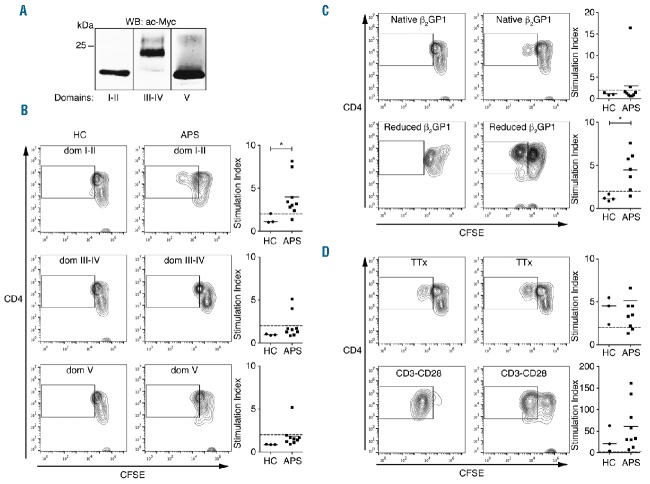
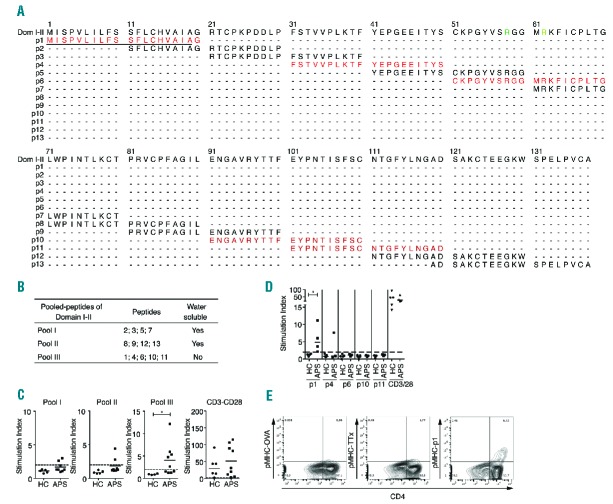
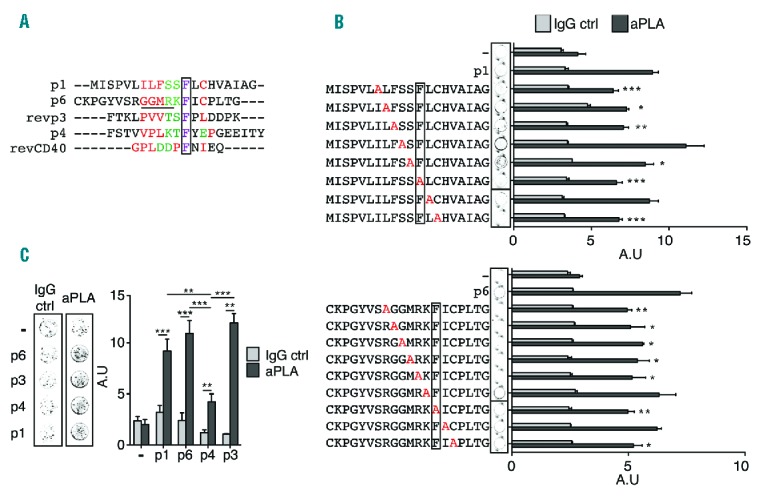
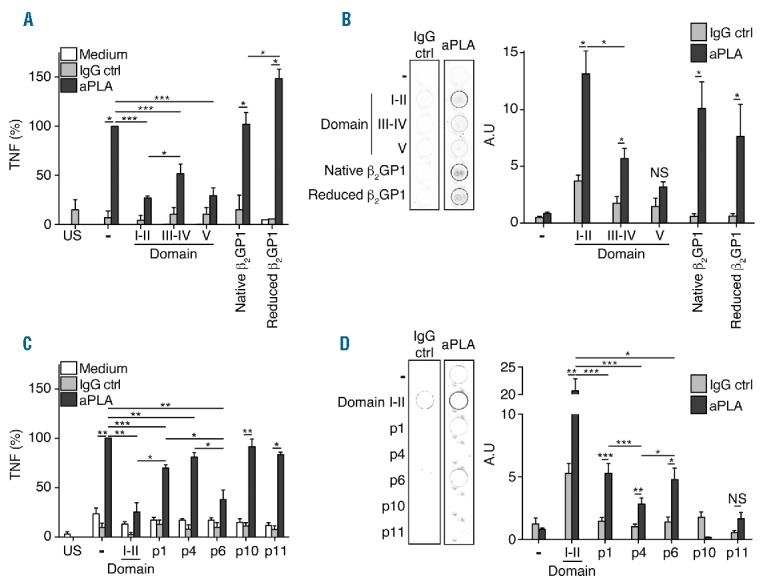
Antiphospholipid antibody syndrome is an autoimmune disease characterized by the presence of so-called antiphospholipid antibodies and clinical manifestations such as recurrent thromboembolic or pregnancy complications. Although the main antigenic determinant for antiphospholipid antibodies has been identified as the β-2-glycoprotein 1 (β2GP1), the precise epitope recognized by antiphospholipid antibodies still remains largely unknown. In the study herein, we wanted to identify a sequence in domain I of β2GP1 able to induce the proliferation of CD4 T cells isolated from antiphospholipid antibody syndrome patients, but not from healthy donors, and to interact with antiphospholipid antibodies. We have characterized a sequence in domain I of β2GP1 that triggers CD4 T-cell proliferation. A comparison of this sequence with the previously reported binding of antiphospholipid antibodies to discontinuous epitope R39-R43 reveals the presence of an indeterminate motif in β2GP1, in which the polarity determines the characteristics and specificity of antiphospholipid antibodies-interacting motifs. Using point mutations, we characterized the main antiphospholipid antibodies-interacting motif as ϕϕϕζζFxC, but also established ϕϕϕζζFxϕ-related motifs as potential antiphospholipid antibodies epitopes, in which ϕ represents nonpolar residues and ζ polar residues, with charges of the residues not being involved. Of specific importance, these different motifs are present at least once in all antiphospholipid antibodies-related receptors described so far. We have further demonstrated, , that peptides and domains of β2GP1 containing these motifs were able to interact with antiphospholipid antibodies and inhibit their monocyte activating activity. These results established that the antiphospholipid antibodies-interacting motifs are determined by the polarity, but not by the sequence or charge, of amino acids. These data could also contribute to the future development of more sensitive and specific diagnostic tools for antiphospholipid antibody syndrome determination and potential peptide- or β2GP1 domain-based clinical therapies.
抗磷脂抗体综合征是一种自身免疫性疾病,其特征为存在所谓的抗磷脂抗体和诸如复发性血栓栓塞或妊娠并发症等临床表现。尽管抗磷脂抗体的主要抗原决定簇已被鉴定为β-2-糖蛋白 1(β2GP1),但抗磷脂抗体所识别的精确表位仍在很大程度上未知。在本研究中,我们希望鉴定出能够诱导来自抗磷脂抗体综合征患者的 CD4 T 细胞而非来自健康供体的增殖的β2GP1 结构域 I 中的序列,并且该序列能够与抗磷脂抗体相互作用。我们已经鉴定出β2GP1 结构域 I 中能够触发 CD4 T 细胞增殖的序列。与先前报道的抗磷脂抗体与不连续表位 R39-R43 结合的序列进行比较,揭示了β2GP1 中存在不确定的基序,其中极性决定了抗磷脂抗体相互作用基序的特征和特异性。通过点突变,我们将主要的抗磷脂抗体相互作用基序鉴定为ϕϕϕζζFxC,但也确定了ϕϕϕζζFxϕ相关基序作为潜在的抗磷脂抗体表位,其中ϕ表示非极性残基,ζ表示极性残基,而残基的电荷则不参与。特别重要的是,到目前为止,所有描述的抗磷脂抗体相关受体中至少存在一次这些不同的基序。我们还进一步证明了,包含这些基序的β2GP1 肽和结构域能够与抗磷脂抗体相互作用并抑制其单核细胞激活活性。这些结果表明,抗磷脂抗体相互作用基序由氨基酸的极性决定,而不是由序列或电荷决定。这些数据还可以为未来开发更敏感和特异的抗磷脂抗体综合征诊断工具以及基于肽或β2GP1 结构域的临床治疗方法做出贡献。