Shevlin Mark, McElroy Eoin, Murphy Jamie
School of Psychology and Psychology Research Institute, Ulster University, Magee campus, Londonderry, BT48 7JL, Northern Ireland, UK.
Soc Psychiatry Psychiatr Epidemiol. 2017 Sep;52(9):1135-1145. doi: 10.1007/s00127-017-1396-7. Epub 2017 May 26.
Heterotypic psychopathological continuity (i.e. one disorder predicting another at a later time point) contradicts the conventional view that psychiatric disorders are discrete, static entities. Studying this phenomenon may help to tease out the complex mechanisms that underpin psychiatric comorbidity. To date, no studies have explicitly compared heterotypic effects within and across higher order dimensions of psychopathology.
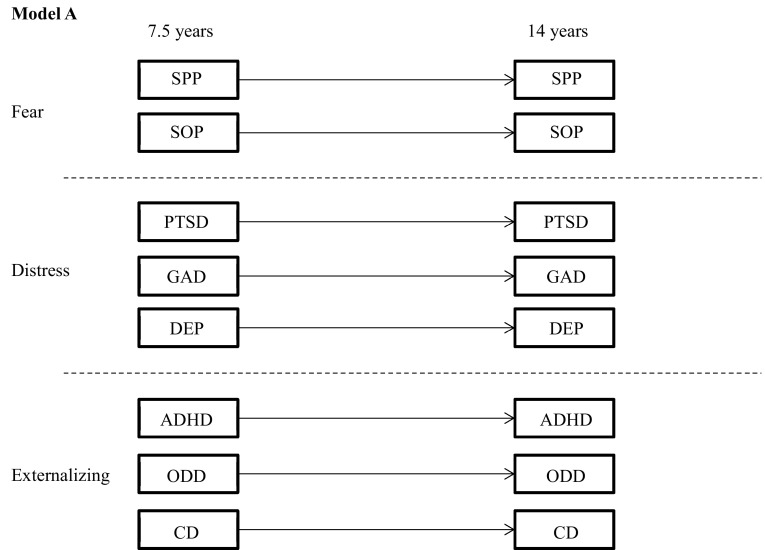
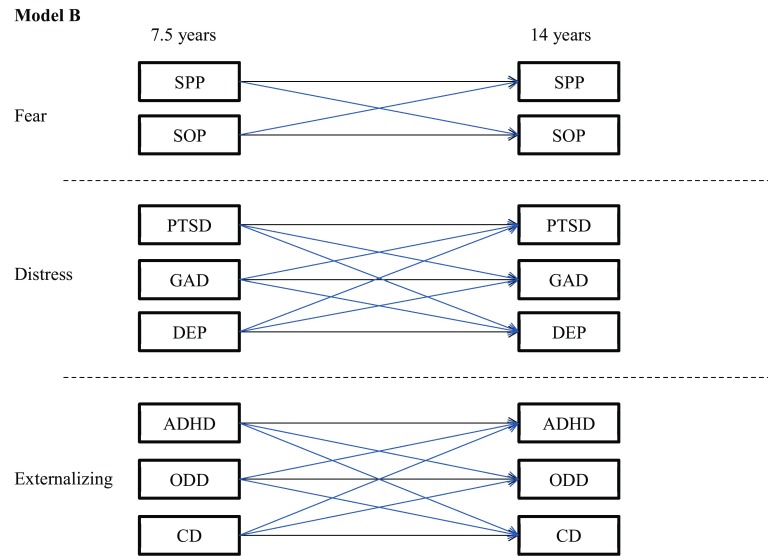
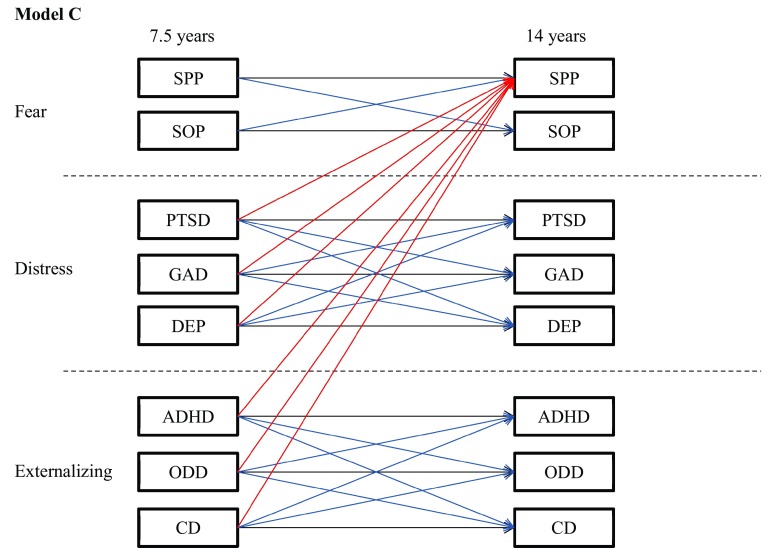
Patterns of homotypic and heterotypic psychopathological continuity were examined using cohort data from the Avon Longitudinal Study of Parents and Children (ALSPAC, N = 4815). Eight common psychiatric disorders were assessed at age 7.5 and again at age 14 years using the maternal report version of the Development and Well-Being Assessment (DAWBA). Cross-lagged models were used to compare patterns of homotypic and heterotypic continuity within and across three higher order dimensions of psychopathology; internalizing-fear, internalizing-distress, and externalizing.
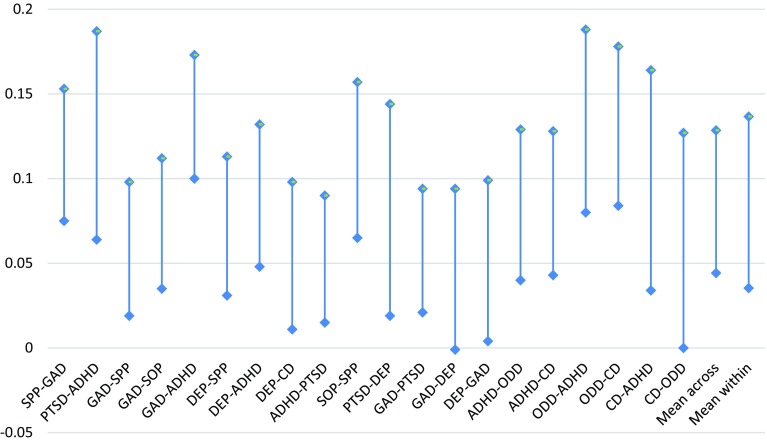
Homotypic continuity was universal. Considerable heterotypic continuity was observed even after controlling for homotypic continuity and the presence of all disorders at baseline. Heterotypic continuity was more common within higher order dimensions, but a number of significant cross-dimension effects were observed, with ADHD acting as a strong predictor of subsequent internalizing disorders.
Heterotypic continuity may reflect elements of shared aetiology, or local-level interactions between disorders.
异型精神病理连续性(即一种障碍在稍后时间点预测另一种障碍)与精神障碍是离散、静态实体的传统观点相矛盾。研究这一现象可能有助于梳理出精神共病背后的复杂机制。迄今为止,尚无研究明确比较精神病理学高阶维度内和跨维度的异型效应。
使用阿冯父母与儿童纵向研究(ALSPAC,N = 4815)的队列数据检查同型和异型精神病理连续性模式。在7.5岁时评估了八种常见精神障碍,并在14岁时再次使用发展与幸福评估(DAWBA)的母亲报告版本进行评估。使用交叉滞后模型比较精神病理学三个高阶维度内和跨维度的同型和异型连续性模式;内化-恐惧、内化-痛苦和外化。
同型连续性普遍存在。即使在控制了同型连续性和基线时所有障碍的存在之后,仍观察到相当多的异型连续性。异型连续性在高阶维度内更常见,但也观察到一些显著的跨维度效应,注意缺陷多动障碍(ADHD)是随后内化障碍的强预测因子。
异型连续性可能反映了共同病因的要素,或障碍之间的局部水平相互作用。