
环戊二烯基镎配合物的还原化学:从结构到理解
Reduction chemistry of neptunium cyclopentadienide complexes: from structure to understanding.
作者信息
Dutkiewicz Michał S, Apostolidis Christos, Walter Olaf, Arnold Polly L
机构信息
European Commission , Directorate for Nuclear Safety and Security , Joint Research Centre , Postfach 2340 , D-76125 , Karlsruhe , Germany . Email:
EaStCHEM School of Chemistry , The University of Edinburgh , Joseph Black Building, David Brewster Road , Edinburgh , EH9 3FJ , UK . Email:
出版信息
Chem Sci. 2017 Apr 1;8(4):2553-2561. doi: 10.1039/c7sc00034k. Epub 2017 Jan 30.
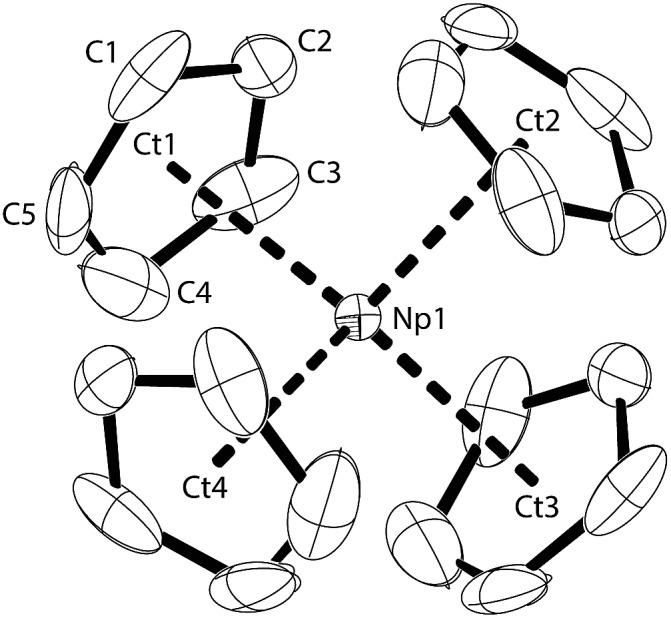
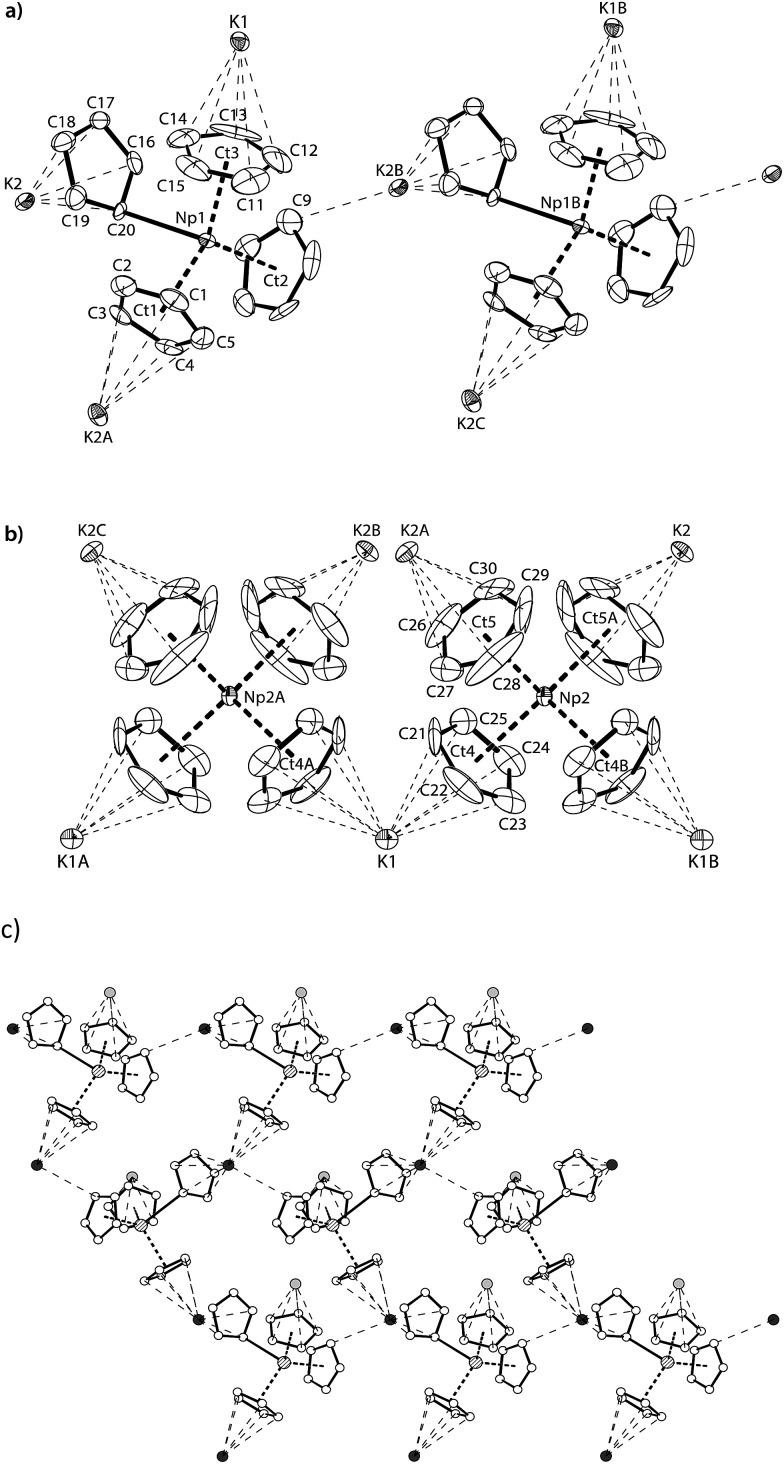
Neptunium complexes in the formal oxidation states II, III, and IV supported by cyclopentadienyl ligands are explored, and significant differences between Np and U highlighted as a result. A series of neptunium(iii) cyclopentadienyl (Cp) complexes [Np(Cp)], its bis-acetonitrile adduct [Np(Cp)(NCMe)], and its KCp adduct K[Np(Cp)] and [Np(Cp')] (Cp' = CHSiMe) have been made and characterised providing the first single crystal X-ray analyses of Np Cp complexes. In all NpCp derivatives there are three Cp rings in η-coordination around the Np centre; additionally in [Np(Cp)] and K[Np(Cp)] one Cp ring establishes a μ-η-interaction to one C atom of a neighbouring Np(Cp) unit. The solid state structure of K[Np(Cp)] is unique in containing two different types of metal-Cp coordination geometries in the same crystal. Np(Cp) units are found exhibiting four units of η-coordinated Cp rings like in the known complex [Np(Cp)], the structure of which is now reported. A detailed comparison of the structures gives evidence for the change of ionic radii of -8 pm associated with change in oxidation state between Np and Np. The rich redox chemistry associated with the syntheses is augmented by the reduction of [Np(Cp')] by KC in the presence of 2.2.2-cryptand to afford a neptunium(ii) complex that is thermally unstable above -10 °C like the U and Th complexes K(2.2.2-cryptand)[Th/U(Cp')]. Together, these spontaneous and controlled redox reactions of organo-neptunium complexes, along with information from structural characterisation, show the relevance of organometallic Np chemistry to understanding fundamental structure and bonding in the minor actinides.
研究了由环戊二烯基配体支撑的处于正二价、正三价和正四价形式氧化态的镎配合物,结果突出了镎与铀之间的显著差异。制备并表征了一系列镎(Ⅲ)环戊二烯基(Cp)配合物[Np(Cp)]、其二乙腈加合物[Np(Cp)(NCMe)]、其KCp加合物K[Np(Cp)]以及[Np(Cp')](Cp' = CHSiMe),提供了首个镎Cp配合物的单晶X射线分析。在所有NpCp衍生物中,有三个Cp环以η配位方式围绕Np中心;此外,在[Np(Cp)]和K[Np(Cp)]中,一个Cp环与相邻Np(Cp)单元的一个C原子形成μ-η相互作用。K[Np(Cp)]的固态结构独特,在同一晶体中包含两种不同类型的金属-Cp配位几何结构。发现Np(Cp)单元呈现出四个η配位的Cp环单元,就像在已知配合物[Np(Cp)]中一样,现在报道了其结构。结构的详细比较证明了与Np和Np之间氧化态变化相关的离子半径变化为-8 pm。与合成相关的丰富氧化还原化学通过在2.2.2-穴醚存在下KC对[Np(Cp')]的还原得到增强,从而得到一种镎(Ⅱ)配合物,该配合物在高于-10°C时热不稳定,类似于U和Th配合物K(2.2.2-穴醚)[Th/U(Cp')]。总之,这些有机镎配合物的自发和可控氧化还原反应,连同结构表征信息,表明有机金属镎化学对于理解次锕系元素的基本结构和键合具有重要意义。




 Zotero 插件