Kupeli N, Norton S, Chilcot J, Campbell I C, Schmidt U H, Troop N A
Marie Curie Palliative Care Research Department, University College London, London, UK.
Health Psychology Section, Institute of Psychiatry, Psychology and Neuroscience, King's College London, London, UK.
Health Psychol Behav Med. 2017 Apr 18;5(1):214-228. doi: 10.1080/21642850.2017.1316667. eCollection 2017.
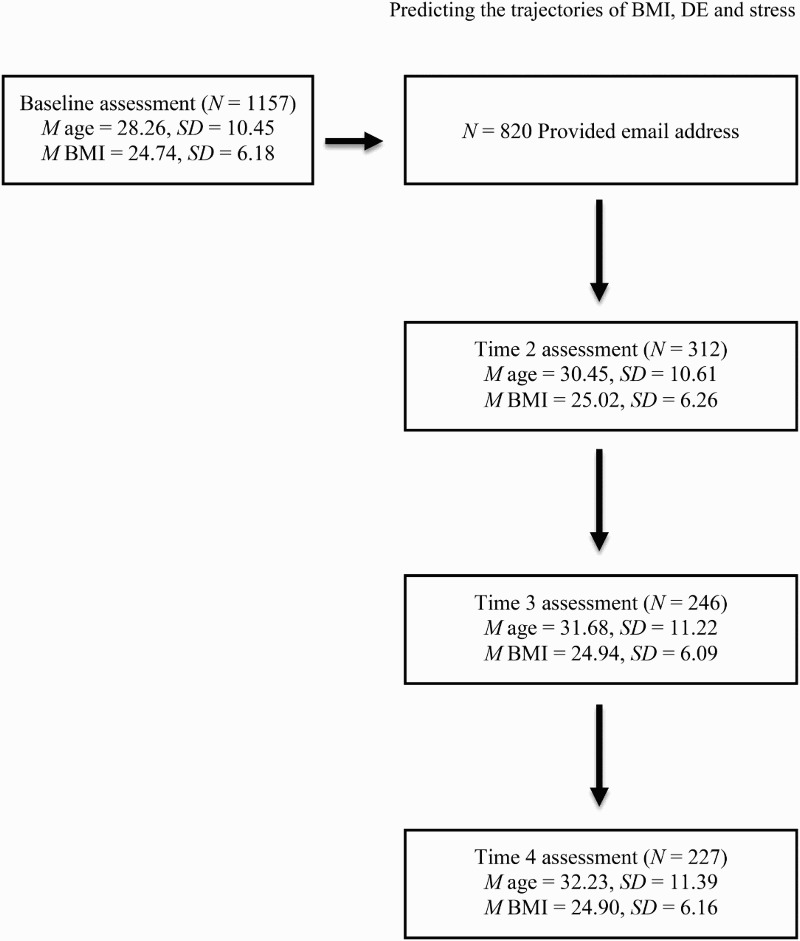
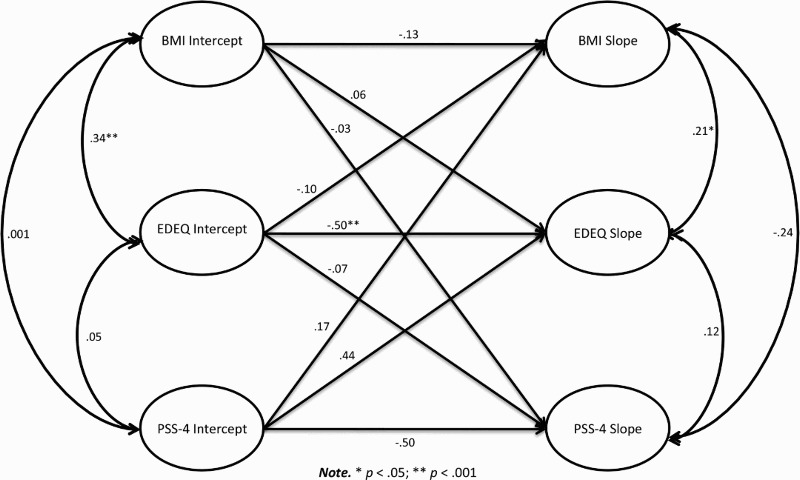
Evidence suggests that stress plays a role in changes in body weight and disordered eating. The present study examined the effect of mood, affect systems (attachment and social rank) and affect regulatory processes (self-criticism, self-reassurance) on the stress process and how this impacts on changes in weight and disordered eating. A large sample of women participated in a community-based prospective, longitudinal online study in which measures of body mass index (BMI), disordered eating, perceived stress, attachment, social rank, mood and self-criticism/reassurance were measured at 6-monthly intervals over an 18-month period. Latent Growth Curve Modelling showed that BMI increased over 18 months while stress and disordered eating decreased and that these changes were predicted by high baseline levels of these constructs. Independently of this, however, increases in stress predicted a reduction in BMI which was, itself, predicted by baseline levels of self-hatred and unfavourable social comparison. This study adds support to the evidence that stress is important in weight change. In addition, this is the first study to show in a longitudinal design, that social rank and self-criticism (as opposed to self-reassurance) at times of difficulty predict increases in stress and, thus, suggests a role for these constructs in weight regulation.
有证据表明,压力在体重变化和饮食失调中起作用。本研究考察了情绪、情感系统(依恋和社会等级)以及情感调节过程(自我批评、自我安慰)对压力过程的影响,以及这如何影响体重变化和饮食失调。一大群女性参与了一项基于社区的前瞻性纵向在线研究,在18个月的时间里,每隔6个月测量一次体重指数(BMI)、饮食失调、感知压力、依恋、社会等级、情绪以及自我批评/自我安慰。潜在生长曲线模型显示,在18个月的时间里,BMI增加,而压力和饮食失调减少,这些变化可由这些构念的高基线水平预测。然而,除此之外,压力增加预示着BMI会降低,而这本身又由自我厌恶和不利社会比较的基线水平预测。这项研究为压力在体重变化中很重要的证据提供了支持。此外,这是第一项在纵向设计中表明,困难时期的社会等级和自我批评(与自我安慰相反)预示着压力增加的研究,因此表明这些构念在体重调节中发挥作用。