Kongtip Pornpimol, Techasaensiri Benyachalee, Nankongnab Noppanun, Adams Jane, Phamonphon Akkarat, Surach Anu, Sangprasert Supha, Thongsuksai Aree, Srikumpol Prayoon, Woskie Susan
Department of Occupational Health and Safety, Faculty of Public Health, Mahidol University, 420/1 Rajvithi Road, Bangkok 10400, Thailand.
Department of Pediatrics, Faculty of Medicine, Ramathibodi Hospital, Mahidol University, Bangkok 10400, Thailand.
Int J Environ Res Public Health. 2017 May 27;14(6):570. doi: 10.3390/ijerph14060570.
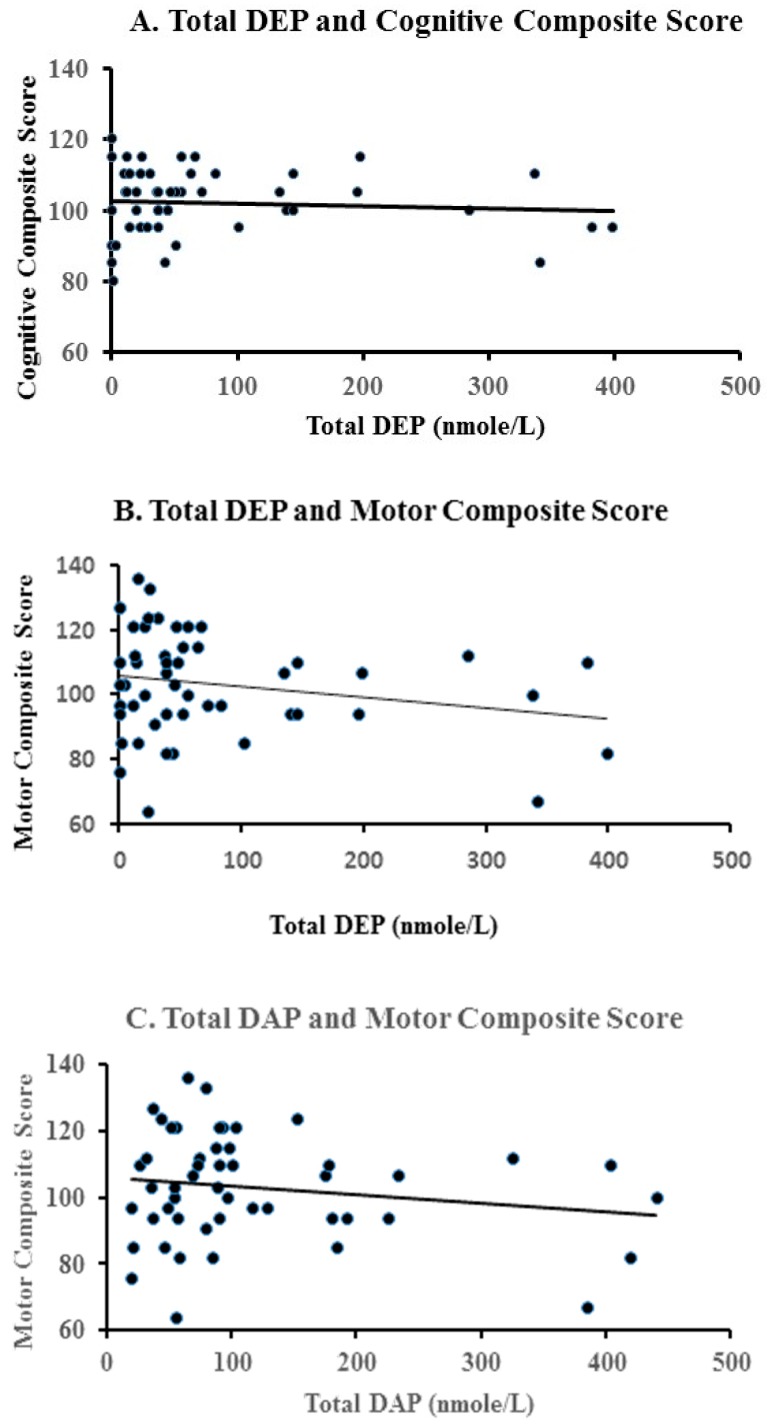
A birth cohort was begun to investigate the levels and sources of pesticide exposure in pregnant women living in Thailand, and to examine the effects of pesticide exposure on infant neurodevelopment at five months of age. Subjects were interviewed using questionnaires regarding their demographic characteristics, educational background, and work and home activities related to pesticide exposures. Spot urine samples were collected at 28 weeks gestation and analyzed by gas chromatography-mass spectrometry to determine maternal metabolite levels of organophosphate pesticides including dimethyl phosphate (DMP); total DEP (diethyl phosphate (DEP), diethyl thiophosphate (DETP), and diethyl dithiophosphate (DEDTP), and total DAP (the sum of all metabolite levels). At five months of age, infant development was evaluated using the Bayley Scales of Infant and Toddler Development-III (Bayley-III). Higher total DEP and total DAP metabolite levels from the mother at 28 weeks' gestation were significantly associated with reduced motor composite scores on the Bayley-III at five months of age. The total DEP levels were also significantly associated with reduced cognitive composite scores. Prenatal concentrations of maternal urinary metabolites were associated with infant cognitive and motor development. The results of several studies now suggest the need for public health intervention to reduce prenatal pesticide exposures from both agricultural and domestic use.
启动了一项出生队列研究,以调查泰国孕妇的农药暴露水平和来源,并研究农药暴露对5个月大婴儿神经发育的影响。通过问卷调查对受试者进行访谈,内容涉及她们的人口统计学特征、教育背景以及与农药暴露相关的工作和家庭活动。在妊娠28周时采集即时尿样,并用气相色谱-质谱法进行分析,以测定母体中有机磷农药的代谢物水平,包括磷酸二甲酯(DMP);总DEP(磷酸二乙酯(DEP)、硫代磷酸二乙酯(DETP)和二硫代磷酸二乙酯(DEDTP)),以及总DAP(所有代谢物水平之和)。在婴儿5个月大时,使用贝利婴幼儿发展量表第三版(Bayley-III)对其发育情况进行评估。母亲在妊娠28周时较高的总DEP和总DAP代谢物水平与婴儿5个月大时Bayley-III运动综合评分降低显著相关。总DEP水平也与认知综合评分降低显著相关。母体尿代谢物的产前浓度与婴儿的认知和运动发育有关。现在多项研究结果表明,需要进行公共卫生干预,以减少农业和家庭使用中产前农药暴露。