Llop Sabrina, Murcia Mario, Iñiguez Carmen, Roca Marta, González Llúcia, Yusà Vicent, Rebagliato Marisa, Ballester Ferran
Epidemiology and Environmental Health Joint Research Unit, FISABIO-Universitat Jaume I-Universitat de València, Av. Catalunya 21, 46020, Valencia, Spain.
Spanish Consortium for Research on Epidemiology and Public Health (CIBERESP), Av. Monforte de Lemos, 3-5. Pabellón 11, 28029, Madrid, Spain.
Environ Health. 2017 May 17;16(1):46. doi: 10.1186/s12940-017-0255-z.
Prenatal exposure to organophosphate pesticides (OPs) has been associated with impaired child development. Pesticide exposure determinants need to be studied in order to identify sources and pathways of pesticide exposure. The aim of this paper is to describe prenatal exposure to OPs and evaluate the associated factors in pregnant women.
The study population consisted of pregnant women (n = 573) who participated in the INMA birth cohort study in Valencia (Spain, 2003-2006). OP metabolites were analyzed in maternal urine at the 32nd week of gestation using a liquid chromatography-high resolution mass spectrometry method. The analysis included non-specific (diethyl phosphate [DEP], diethyl thiophosphate [DETP], dimethyl thiophosphate [DMTP], dimethyl dithiophosphate [DMDTP]) and specific metabolites (2-diethylamino-6-methyl-4-pyrimidinol [DEAMPY], 2-isopropyl-4-methyl-6-hydroxypyrimidine [IMPY], para-nitrophenol [PNP], and 3,5,6-trichloro-2-pyridinol [TCPY]). Information about the sociodemographic, environmental, and dietary characteristics was obtained by questionnaire. The association between log-transformed OPs and covariates was analyzed using multivariable interval censored regression.
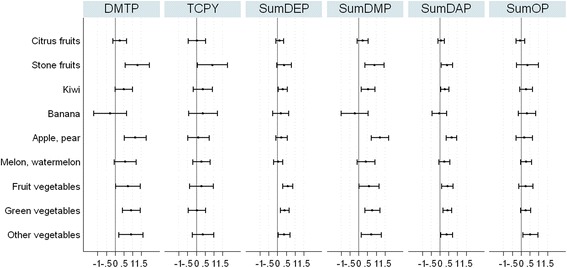
The detection frequencies were low, DMTP and TCPY being the most frequently detected metabolites (53.8% and 39.1%, respectively). All the OP metabolites were positively associated with maternal intake of fruits and vegetables. Other maternal characteristics related to the OPs were body mass index (BMI) before pregnancy and smoking habit during pregnancy. Women with lower BMI and those who did not smoke presented higher OP concentrations. Moreover, mothers who had a yard or garden with plants at home or who lived in an urban area were also more exposed to OPs.
The OP detection frequencies and the concentrations observed in our study population were low, compared with most of the previously published studies. Given the high vulnerability of the fetus to neurotoxicant exposure, further research on the determinants of the body burden of OPs during pregnancy would be necessary. The knowledge gained from such studies would enhance the effectiveness of public health control and future recommendations in order to reduce the risk to both the health of pregnant women and the health and development of their children.
孕期接触有机磷农药(OPs)与儿童发育受损有关。需要研究农药接触的决定因素,以确定农药接触的来源和途径。本文旨在描述孕妇孕期对OPs的接触情况,并评估相关因素。
研究人群包括参与西班牙巴伦西亚INMA出生队列研究(2003 - 2006年)的孕妇(n = 573)。在妊娠第32周时,采用液相色谱 - 高分辨率质谱法分析孕妇尿液中的OP代谢物。分析包括非特异性代谢物(磷酸二乙酯[DEP]、硫代磷酸二乙酯[DETP]、甲基硫代磷酸二甲酯[DMTP]、二甲基二硫代磷酸酯[DMDTP])和特异性代谢物(2 - 二乙氨基 - 6 - 甲基 - 4 - 嘧啶醇[DEAMPY]、2 - 异丙基 - 4 - 甲基 - 6 - 羟基嘧啶[IMPY]、对硝基苯酚[PNP]和3,5,6 - 三氯 - 2 - 吡啶醇[TCPY])。通过问卷调查获取有关社会人口学、环境和饮食特征的信息。使用多变量区间删失回归分析对数转换后的OPs与协变量之间的关联。
检测频率较低,DMTP和TCPY是最常检测到的代谢物(分别为53.8%和39.1%)。所有OP代谢物均与孕妇水果和蔬菜摄入量呈正相关。与OPs相关的其他孕妇特征包括孕前体重指数(BMI)和孕期吸烟习惯。BMI较低且不吸烟的女性OP浓度较高。此外,家中有带植物的院子或花园的母亲或居住在城市地区的母亲也更容易接触到OPs。
与大多数先前发表的研究相比,我们研究人群中OP的检测频率和浓度较低。鉴于胎儿对神经毒物暴露的高度易感性,有必要进一步研究孕期OPs体内负荷的决定因素。从这类研究中获得的知识将提高公共卫生控制的有效性和未来的建议,以降低对孕妇健康以及其子女健康和发育的风险。