Kenville Rouven, Maudrich Tom, Carius Daniel, Ragert Patrick
Faculty of Sport Science, Institute for General Kinesiology and Exercise Science, University of LeipzigLeipzig, Germany.
Department of Neurology, Max Planck Institute for Human Cognitive and Brain SciencesLeipzig, Germany.
Front Hum Neurosci. 2017 May 15;11:241. doi: 10.3389/fnhum.2017.00241. eCollection 2017.
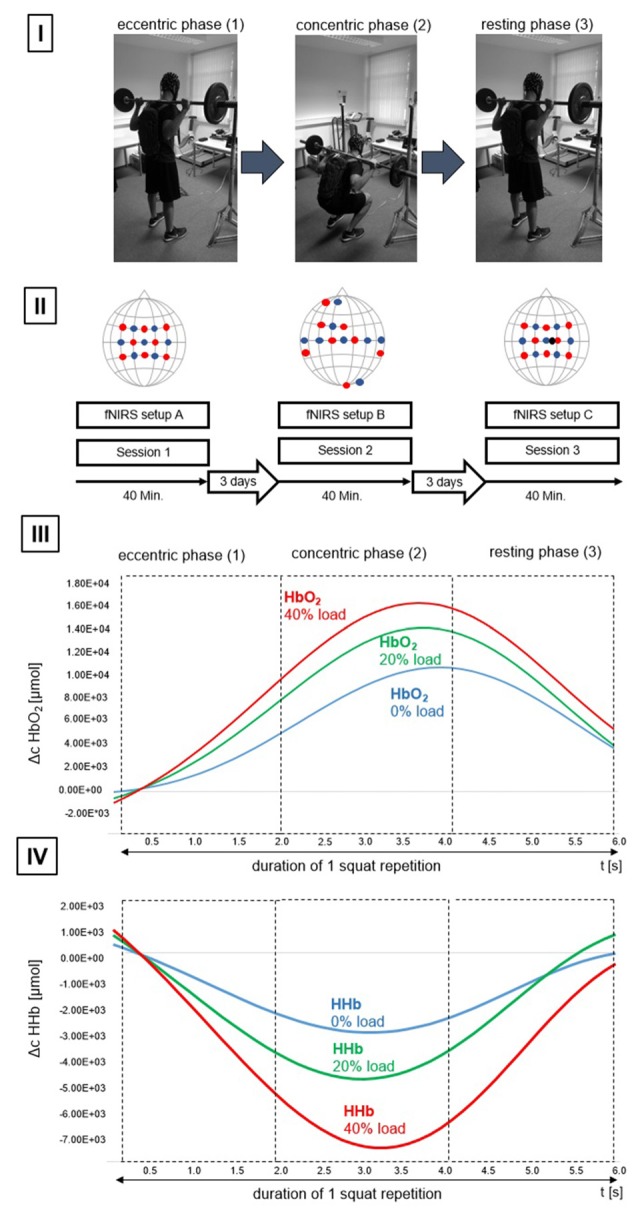
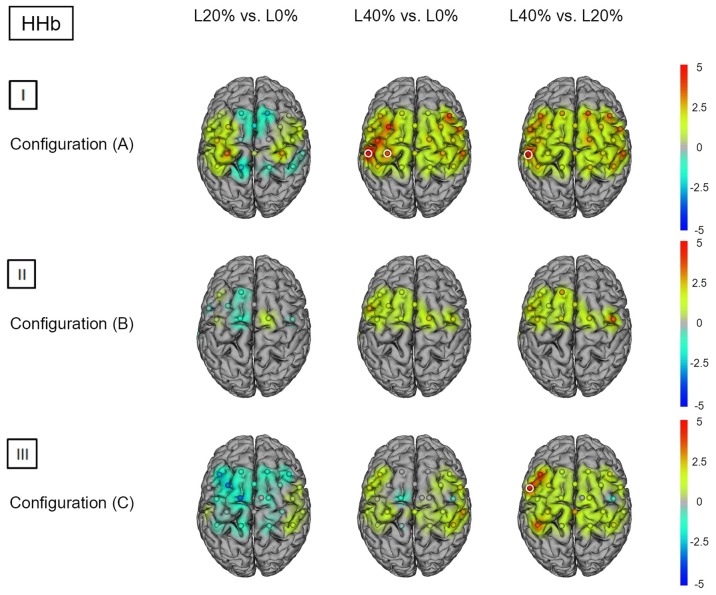
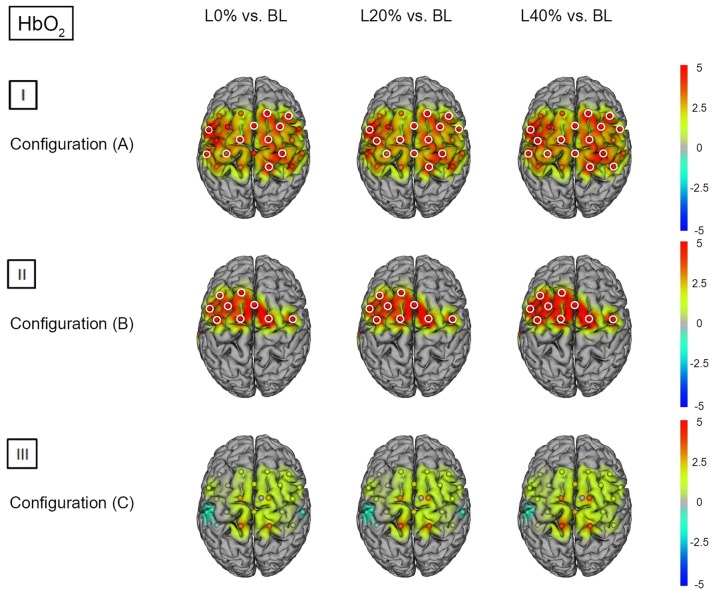
Functional near-infrared spectroscopy (fNIRS) serves as a promising tool to examine hemodynamic response alterations in a sports-scientific context. The present study aimed to investigate how brain activity within the human motor system changes its processing in dependency of different barbell load conditions while executing a barbell squat (BS). Additionally, we used different fNIRS probe configurations to identify and subsequently eliminate potential exercise induced systemic confounders such as increases in extracerebral blood flow. Ten healthy, male participants were enrolled in a crossover design. Participants performed a BS task with random barbell load levels (0% 1RM (1 repetition maximum), 20% 1RM and 40% 1RM for a BS) during fNIRS recordings. Initially, we observed global hemodynamic response alterations within and outside the human motor system. However, short distance channel regression of fNIRS data revealed a focalized hemodynamic response alteration within bilateral superior parietal lobe (SPL) for oxygenated hemoglobin (HbO) and not for deoxygenated hemoglobin (HHb) when comparing different load levels. These findings indicate that the previously observed load/force-brain relationship for simple and isolated movements is also present in complex multi-joint movements such as the BS. Altogether, our results show the feasibility of fNIRS to investigate brain processing in a sports-related context. We suggest for future studies to incorporate short distance channel regression of fNIRS data to reduce the likelihood of false-positive hemodynamic response alterations during complex whole movements.
功能近红外光谱技术(fNIRS)是一种很有前景的工具,可用于在运动科学背景下检测血流动力学反应变化。本研究旨在探究在进行杠铃深蹲(BS)时,人类运动系统内的大脑活动如何根据不同的杠铃负荷条件改变其处理过程。此外,我们使用了不同的fNIRS探头配置来识别并随后消除潜在的运动诱发的全身混杂因素,如脑外血流增加。十名健康男性参与者参与了交叉设计。在fNIRS记录期间,参与者以随机的杠铃负荷水平(杠铃深蹲的1RM(最大重复次数)的0%、20%和40%)执行BS任务。最初,我们观察到人类运动系统内外的整体血流动力学反应变化。然而,当比较不同负荷水平时,fNIRS数据的短距离通道回归显示,双侧顶上叶(SPL)内氧合血红蛋白(HbO)而非脱氧血红蛋白(HHb)存在局部血流动力学反应变化。这些发现表明,先前观察到的简单孤立运动的负荷/力-脑关系在诸如BS这样的复杂多关节运动中也存在。总之,我们的结果表明fNIRS在运动相关背景下研究大脑处理过程的可行性。我们建议未来的研究纳入fNIRS数据的短距离通道回归,以降低复杂整体运动期间血流动力学反应变化出现假阳性的可能性。