Jiang Fuping, Shen Yunze, Ma Chuanxin, Zhang Xiaowen, Cao Weidong, Rui Yukui
College of Resources and Environmental Sciences, China Agricultural University, Beijing, China.
China Astronaut Research and Training Center, Beijing, China.
PLoS One. 2017 May 30;12(5):e0178088. doi: 10.1371/journal.pone.0178088. eCollection 2017.
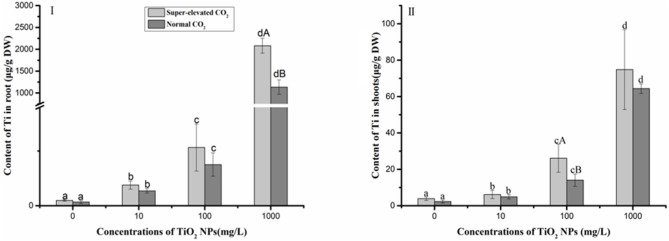
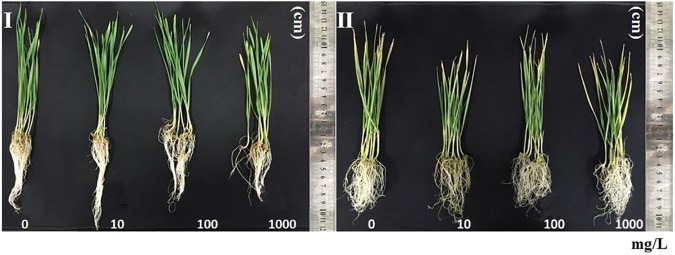
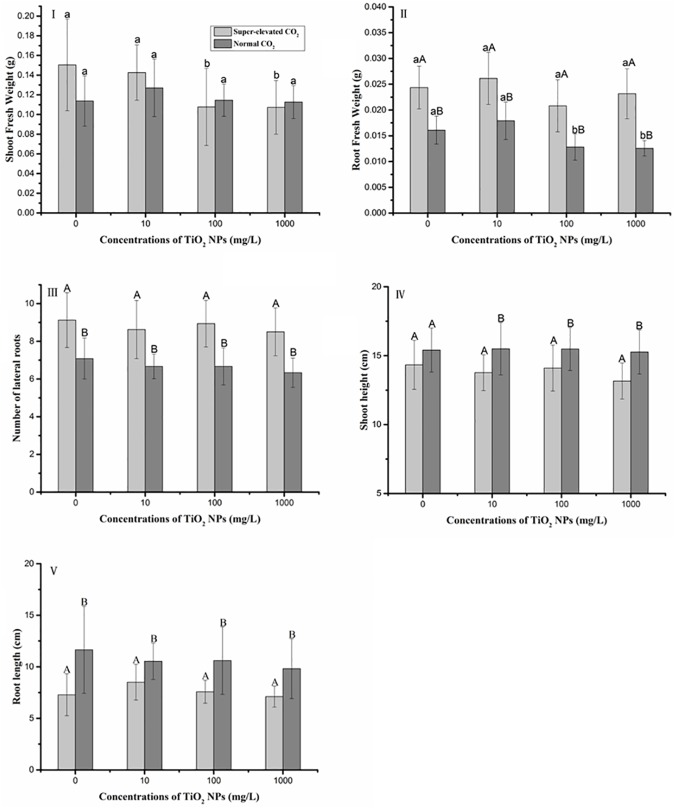
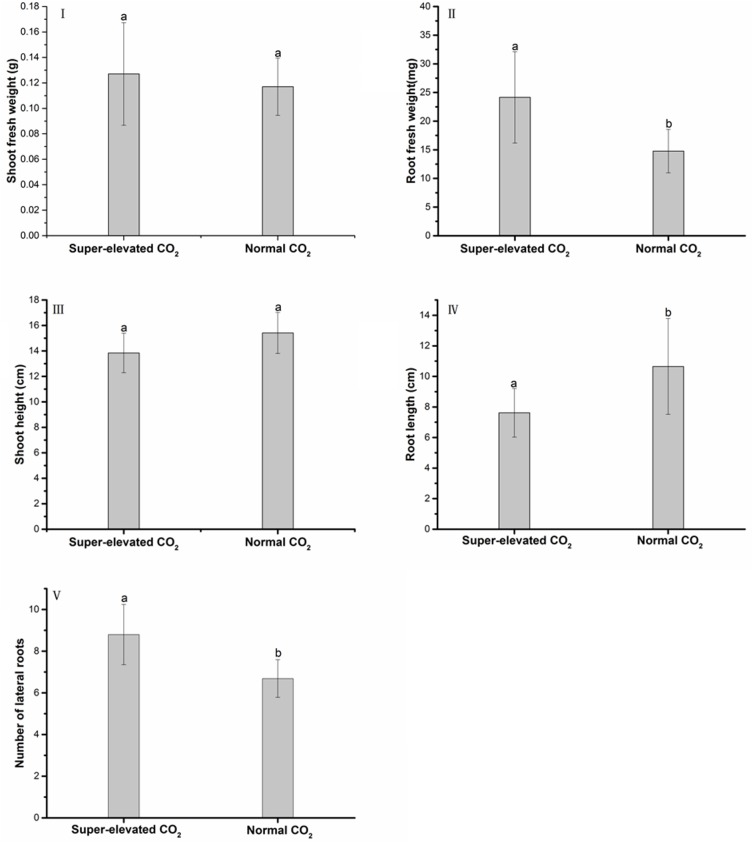
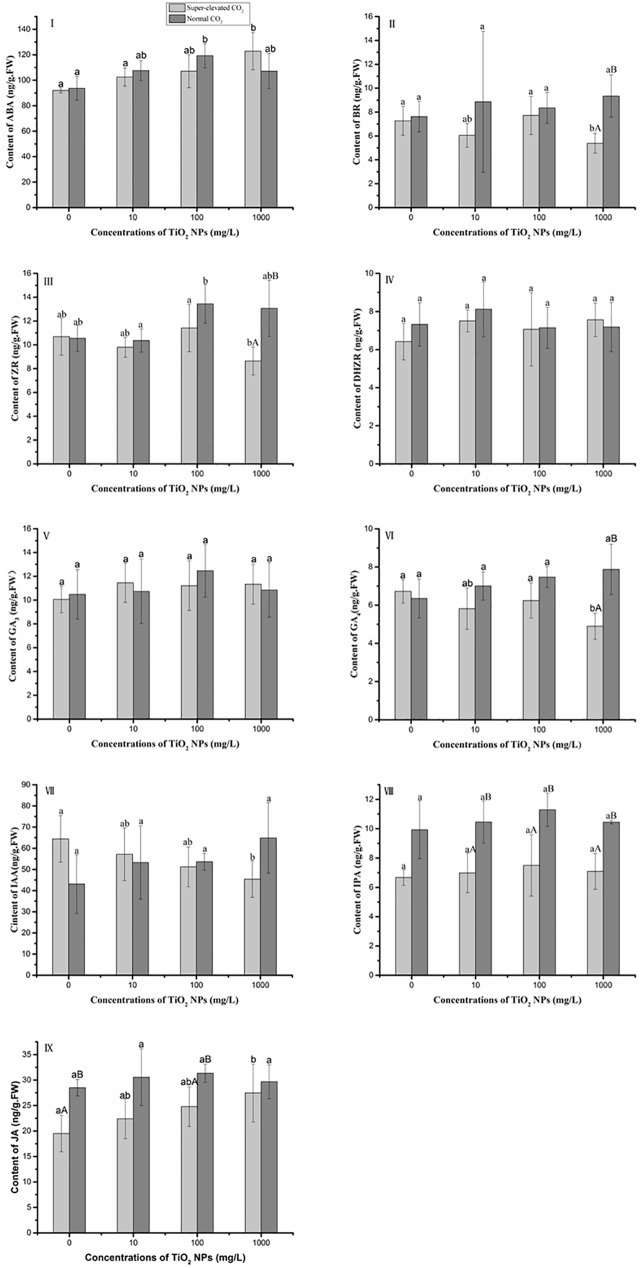
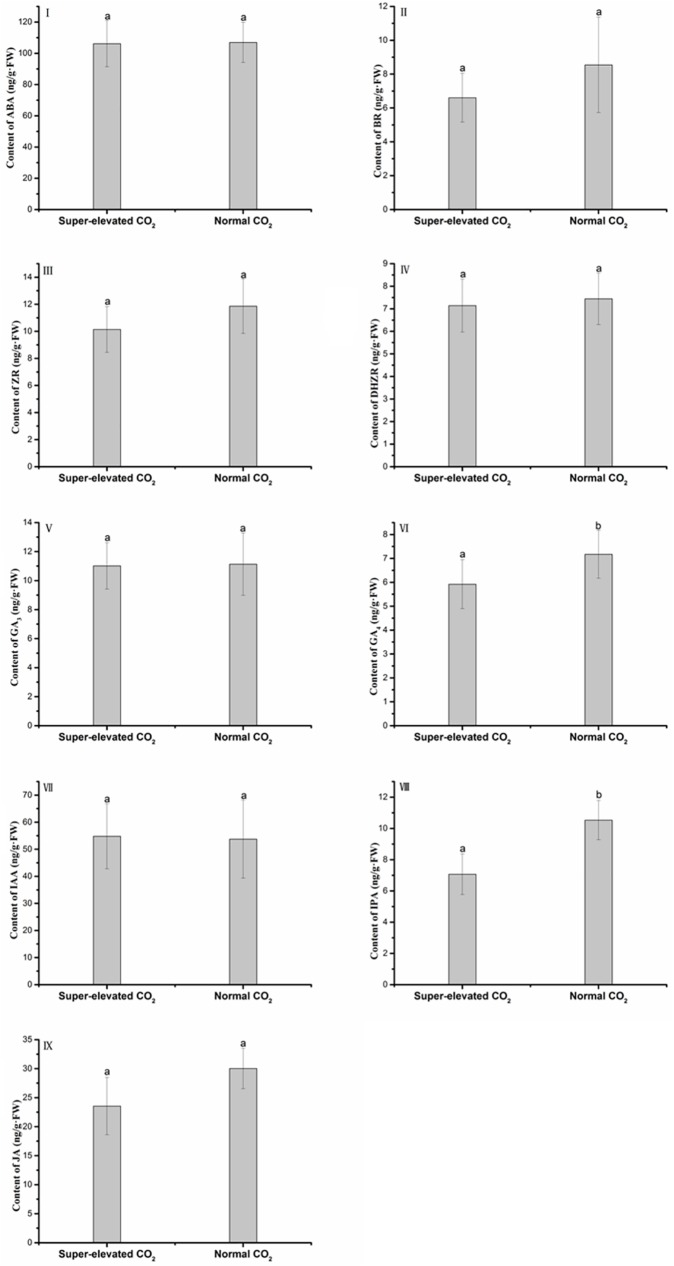
Concerns over the potential risks of nanomaterials to ecosystem have been raised, as it is highly possible that nanomaterials could be released to the environment and result in adverse effects on living organisms. Carbon dioxide (CO2) is one of the main greenhouse gases. The level of CO2 keeps increasing and subsequently causes a series of environmental problems, especially for agricultural crops. In the present study, we investigated the effects of TiO2 NPs on wheat seedlings cultivated under super-elevated CO2 conditions (5000 mg/L CO2) and under normal CO2 conditions (400 mg/L CO2). Compared to the normal CO2 condition, wheat grown under the elevated CO2 condition showed increases of root biomass and large numbers of lateral roots. Under both CO2 cultivation conditions, the abscisic acid (ABA) content in wheat seedlings increased with increasing concentrations of TiO2 NPs. The indolepropioponic acid (IPA) and jasmonic acid (JA) content notably decreased in plants grown under super-elevated CO2 conditions, while the JA content increased with increasing concentrations of TiO2 NPs. Ti accumulation showed a dose-response manner in both wheat shoots and roots as TiO2 NPs concentrations increased. Additionally, the presence of elevated CO2 significantly promoted Ti accumulation and translocation in wheat treated with certain concentrations of TiO2 NPs. This study will be of benefit to the understanding of the joint effects and physiological mechanism of high-CO2 and nanoparticle to terrestrial plants.
人们对纳米材料对生态系统的潜在风险表示担忧,因为纳米材料很有可能释放到环境中并对生物造成不利影响。二氧化碳(CO₂)是主要的温室气体之一。CO₂水平持续上升,进而引发一系列环境问题,尤其是对农作物而言。在本研究中,我们调查了二氧化钛纳米颗粒(TiO₂ NPs)对在超高水平CO₂条件(5000毫克/升CO₂)和正常CO₂条件(400毫克/升CO₂)下培养的小麦幼苗的影响。与正常CO₂条件相比,在高CO₂条件下生长的小麦根系生物量增加,侧根数量增多。在两种CO₂培养条件下,小麦幼苗中的脱落酸(ABA)含量均随TiO₂ NPs浓度的增加而增加。在超高水平CO₂条件下生长的植物中,吲哚丙酸(IPA)和茉莉酸(JA)含量显著降低,而JA含量随TiO₂ NPs浓度的增加而增加。随着TiO₂ NPs浓度的增加,钛在小麦地上部分和根系中的积累呈现剂量反应关系。此外,高浓度CO₂的存在显著促进了在一定浓度TiO₂ NPs处理下的小麦中钛的积累和转运。本研究将有助于理解高CO₂和纳米颗粒对陆生植物的联合效应及生理机制。