Volkow Patricia, Cesarman-Maus Gabriela, Garciadiego-Fossas Pamela, Rojas-Marin Enrique, Cornejo-Juárez Patricia
Infectious Diseases Department, Instituto Nacional de Cancerología (INCan), Av. San Fernando No. 22, Col. Sección XVI, Deleg. Tlalpan, 14080, Mexico City, Mexico.
Hematology Department, Instituto Nacional de Cancerología (INCan), Mexico City, Mexico.
AIDS Res Ther. 2017 May 30;14(1):30. doi: 10.1186/s12981-017-0156-9.
To investigate the predictive factors for the development of Kaposi sarcoma-related immune reconstitution inflammatory syndrome (KS-IRIS) and long-term prognosis in patients starting combined antiretroviral therapy (cART).
We studied a retrospective-cohort of consecutive antiretroviral-naïve patients with KS initiating cART from January 2005 to December 2011 and followed through June 2013. KS-IRIS was defined as ≥2 of the following: abrupt increase in number of KS lesions, appearance or exacerbation of lung-opacities or lymphedema, concomitantly with an increase in CD4+ cell-count ≥50 cells/mm and a decrease of >1 log in viral-load once started cART. We compared individuals who met KS-IRIS criteria with those that did not and described the long-term follow-up.
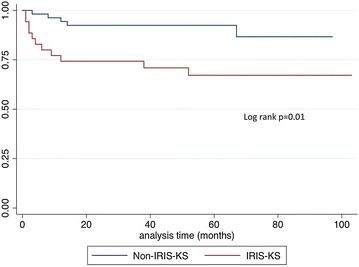
We included 89 patients, 88 males; 35 (39%) developed KS-IRIS at a median of 10 weeks (IQR 4-16). KS-IRIS patients had more pulmonary-involvement (60% vs. 16.6% of patients; p < 0.0001), eight died attributed to pulmonary-KS. Thrombocytopenia <100,000/mm at follow-up occurred in 36% of KS-IRIS vs. 4% in non-KS-IRIS patients (p = 0.0002), 45% KS-IRIS patients with thrombocytopenia died, non without KS-IRIS. Chemotherapy (bleomicyn-vincristine) was more frequently prescribed in KS-IRIS patients (88.6% vs. 29.6%) with no differences in outcome; 80% of all patients achieve KS complete remission, 52% of them never received chemotherapy. No difference between groups in the long-term follow-up (mean 52.4 ± 27.4 months) was found, only one patient developed a secondary malignancy (1.12%).
Lung-involvement was predictive of IRIS development. Thrombocytopenia in KS-IRIS patients at week 12 follow-up after cART initiation was associated with high mortality. Over a third of patients with KS achieve remission without chemotherapy. Individuals that survive the initial period of KS-IRIS adhere to cART had a good long-term prognosis.
探讨开始联合抗逆转录病毒治疗(cART)的患者发生卡波西肉瘤相关免疫重建炎症综合征(KS-IRIS)的预测因素及长期预后。
我们研究了一组回顾性队列,这些连续的初治抗逆转录病毒患者于2005年1月至2011年12月开始接受cART治疗并伴有KS,随访至2013年6月。KS-IRIS定义为符合以下至少2项:KS病灶数量突然增加、肺部混浊或淋巴水肿出现或加重,同时CD4+细胞计数增加≥50个细胞/mm且开始cART后病毒载量下降>1 log。我们将符合KS-IRIS标准的个体与不符合的个体进行比较,并描述长期随访情况。
我们纳入了89例患者,88例男性;35例(39%)在中位时间10周(四分位间距4-16周)时发生KS-IRIS。KS-IRIS患者肺部受累更多(60%对16.6%的患者;p<0.0001),8例死于肺部KS。随访时血小板减少<100,000/mm在KS-IRIS患者中发生率为36%,在非KS-IRIS患者中为4%(p=0.0002),45%有血小板减少的KS-IRIS患者死亡,非KS-IRIS患者无死亡。KS-IRIS患者更常接受化疗(博来霉素-长春新碱)(88.6%对29.6%),但预后无差异;所有患者中80%实现KS完全缓解,其中52%从未接受化疗。两组在长期随访(平均52.4±27.4个月)中未发现差异,仅1例患者发生继发性恶性肿瘤(1.12%)。
肺部受累可预测IRIS的发生。cART开始后12周随访时KS-IRIS患者的血小板减少与高死亡率相关。超过三分之一的KS患者未经化疗实现缓解。在KS-IRIS初始期存活且坚持cART的个体长期预后良好。