Cupisti Adamasco, D'Alessandro Claudia, Finato Viviana, Del Corso Claudia, Catania Battista, Caselli Gian Marco, Egidi Maria Francesca
Department of Clinical and Experimental Medicine, University of Pisa, Via Roma 67, 56126, Pisa, Italy.
Nephrology and Dialysis Unit, S. Miniato Hospital, S. Miniato, Italy.
BMC Nephrol. 2017 May 30;18(1):180. doi: 10.1186/s12882-017-0593-7.
This study aimed to evaluate the prevalence of sedentarism, and to assess physical capacity and nutritional status in a cohort of older patients on peritoneal dialysis (PD), with respect to age-matched non-dialysis CKD population, using highly accessible, simple methods, namely the Rapid Assessment of Physical activity (RAPA) test and the 30″ Sit-to-stand (STS) test.
This cross-sectional multicenter study included 151 renal patients older than 60 years; 71 pts. (44 m, age 72 ± 7 yrs) were on PD and 80 pts. (63 m, age 74 ± 7 yrs) were affected by 3-4 stage CKD.
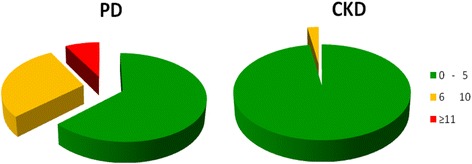
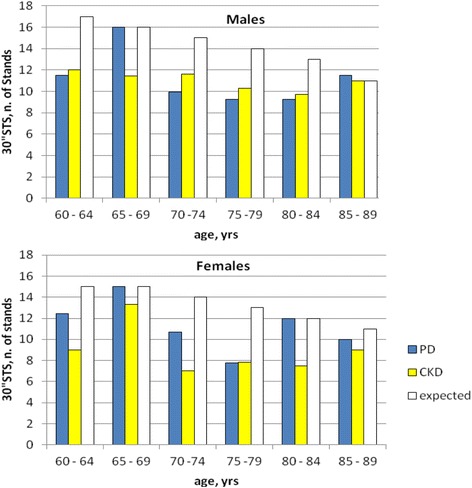
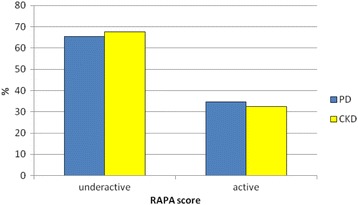
The prevalence of sedentary/underactive patients was double of that of the active patients as assessed by RAPA test, both in the PD (65.3%) and in the CKD (67.5%) cohort. The 30"STS test showed a reduced physical performance in both groups: 84.5% of PD patients and 87.5% of CKD patients did not reach the expected number of stands by age and gender. A malnutrition-inflammation score (MIS) ≥ 6 occurred in 37 % of PD patients and in 2.5 % of CKD patients. In PD patients, an independent significant association was observed between 30"STS test and MIS (beta -0.510, p = 0.013), as well as between RAPA and MIS (beta -0.544, p = 003) and phase angle (beta -0.506, p = 0.028).
A high prevalence of low- performance capacity and sedentarism has been detected among elderly patients on PD or with CKD stage 3-4. Apart from age, a condition of malnutrition-inflammation was the major determinant of poor physical activity and capacity in PD patients. Better body composition seems to be positively associated with physical activity in PD and with physical capacity in CKD patients. Routine clinical management should include a close evaluation of nutritional status and evaluation of physical activity and capacity which can be easily assessed by RAPA and 30″STS tests.
本研究旨在评估腹膜透析(PD)老年患者队列中的久坐不动患病率,并使用易于实施的简单方法,即快速身体活动评估(RAPA)测试和30秒坐立(STS)测试,评估其身体能力和营养状况,并与年龄匹配的非透析慢性肾脏病(CKD)人群进行比较。
这项横断面多中心研究纳入了151名60岁以上的肾病患者;71名患者(44名男性,年龄72±7岁)接受腹膜透析,80名患者(63名男性,年龄74±7岁)患有3-4期慢性肾脏病。
通过RAPA测试评估,久坐/活动不足患者的患病率在腹膜透析组(65.3%)和慢性肾脏病组(67.5%)中均是活动患者的两倍。30秒STS测试显示两组的身体表现均有所下降:84.5%的腹膜透析患者和87.5%的慢性肾脏病患者未达到按年龄和性别预期的站立次数。37%的腹膜透析患者和2.5%的慢性肾脏病患者的营养不良-炎症评分(MIS)≥6。在腹膜透析患者中,观察到30秒STS测试与MIS之间存在独立显著关联(β-0.510,p=0.013),RAPA与MIS之间(β-0.544,p=0.003)以及相位角与MIS之间(β-0.506,p=0.028)也存在独立显著关联。
在接受腹膜透析或患有3-4期慢性肾脏病的老年患者中,发现低身体能力和久坐不动的患病率很高。除年龄外,营养不良-炎症状态是腹膜透析患者身体活动和能力差的主要决定因素。更好的身体组成似乎与腹膜透析患者的身体活动以及慢性肾脏病患者的身体能力呈正相关。常规临床管理应包括对营养状况的密切评估以及对身体活动和能力的评估,这可以通过RAPA和30秒STS测试轻松进行评估。