Carter Howard H, Spence Angela L, Ainslie Philip N, Pugh Christopher J A, Naylor Louise H, Green Daniel J
School of Human Sciences, The University of Western Australia, Crawley, Western Australia.
Centre for Heart, Lung and Vascular Health, University of British Columbia, Okanagan Campus, School of Health and Exercise Sciences, Kelowna, British Columbia, Canada.
Physiol Rep. 2017 May;5(10):e13285. doi: 10.14814/phy2.13285.
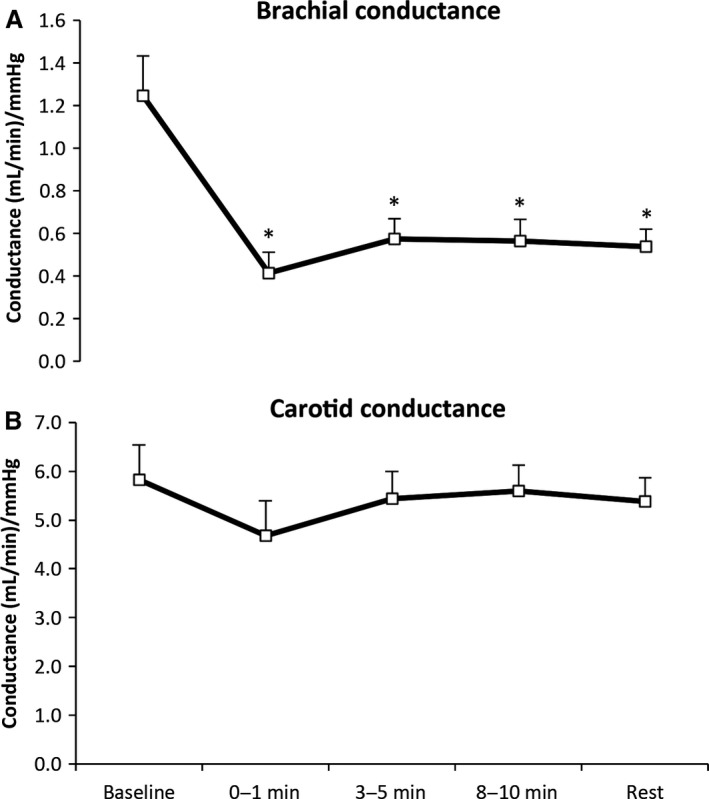
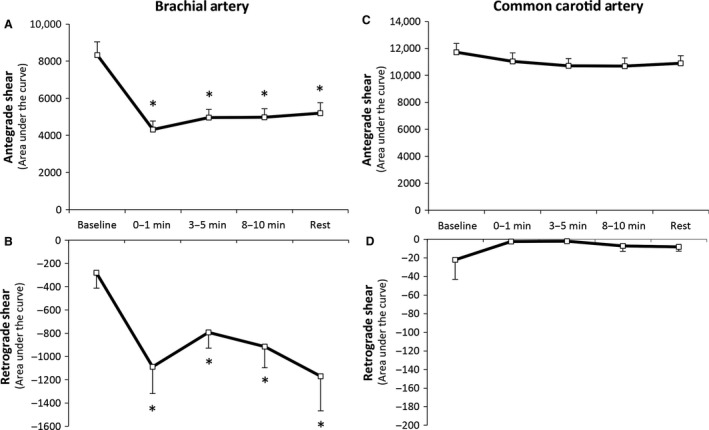
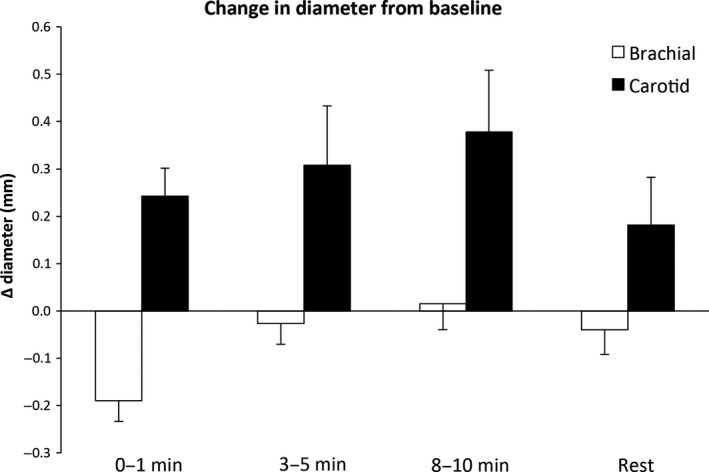
Arterial shear stress is a potent stimulus to vascular adaptation in humans. Typically, increases in retrograde shear have been found to acutely impair vascular function while increases in antegrade shear enhance function. We hypothesized that blood flow and shear stress through the brachial and carotid arteries would change in a similar manner in response to water immersion, an intervention which modifies hemodynamics. Nine healthy young male subjects were recruited to undergo controlled water immersion in a standing upright position to the level of the right atrium in 30°C water. Diameters were continuously and simultaneously recorded in the brachial and common carotid arteries along with mean arterial pressure (MAP), cardiac output (CO), and heart rate before, during, and after 10 min of immersion. MAP and CO increased during water immersion (baseline vs. 8-10 min; 80 ± 9 vs. 91 ± 12 mmHg; and 4.8 ± 0.7 vs. 5.1 ± 0.6 L/min, < 0.01 and < 0.05, respectively). We observed a differential regulation of flow and shear stress patterns in the brachial and carotid arteries in response to water immersion; brachial conductance decreased markedly in response to immersion (1.25 ± 0.56 vs. 0.57 ± 0.30 mL.min/mmHg, < 0.05), whereas it was unaltered in the carotid artery (5.82 ± 2.14 vs. 5.60 ± 1.59). Our findings indicate that adaptations to systemic stimuli and arterial adaptation may be vessel bed specific in humans, highlighting the need to assess multiple vascular sites in future studies.
动脉剪切应力是人类血管适应性的一种强大刺激因素。通常,已发现逆行剪切力增加会急性损害血管功能,而顺行剪切力增加则会增强血管功能。我们推测,肱动脉和颈动脉的血流及剪切应力会以类似方式变化,以响应水浸这一改变血液动力学的干预措施。招募了9名健康年轻男性受试者,使其在30°C的水中站立位进行控制性水浸至右心房水平。在浸入前、浸入10分钟期间及浸入后,连续同时记录肱动脉和颈总动脉的直径以及平均动脉压(MAP)、心输出量(CO)和心率。水浸期间MAP和CO增加(基线值与8 - 10分钟时;80±9与91±12 mmHg;以及4.8±0.7与5.1±0.6 L/min,分别P<0.01和P<0.05)。我们观察到,响应水浸时,肱动脉和颈动脉的血流及剪切应力模式存在差异调节;肱动脉传导率在浸入时显著降低(1.25±0.56与0.57±0.30 mL·min/mmHg,P<0.05),而颈动脉未改变(5.82±2.14与5.60±1.59)。我们的研究结果表明,人类对全身刺激的适应和动脉适应可能因血管床而异,这突出了在未来研究中评估多个血管部位的必要性。