Glenthøj Louise Birkedal, Hjorthøj Carsten, Kristensen Tina Dam, Davidson Charlie Andrew, Nordentoft Merete
Mental Health Centre Copenhagen, Copenhagen University Hospital, Hellerup, DK-2900 Denmark.
Centre for Clinical Intervention and Neuropsychiatric Schizophrenia Research, CINS, Glostrup, DK-2600 Denmark.
NPJ Schizophr. 2017 May 8;3:20. doi: 10.1038/s41537-017-0021-9. eCollection 2017.
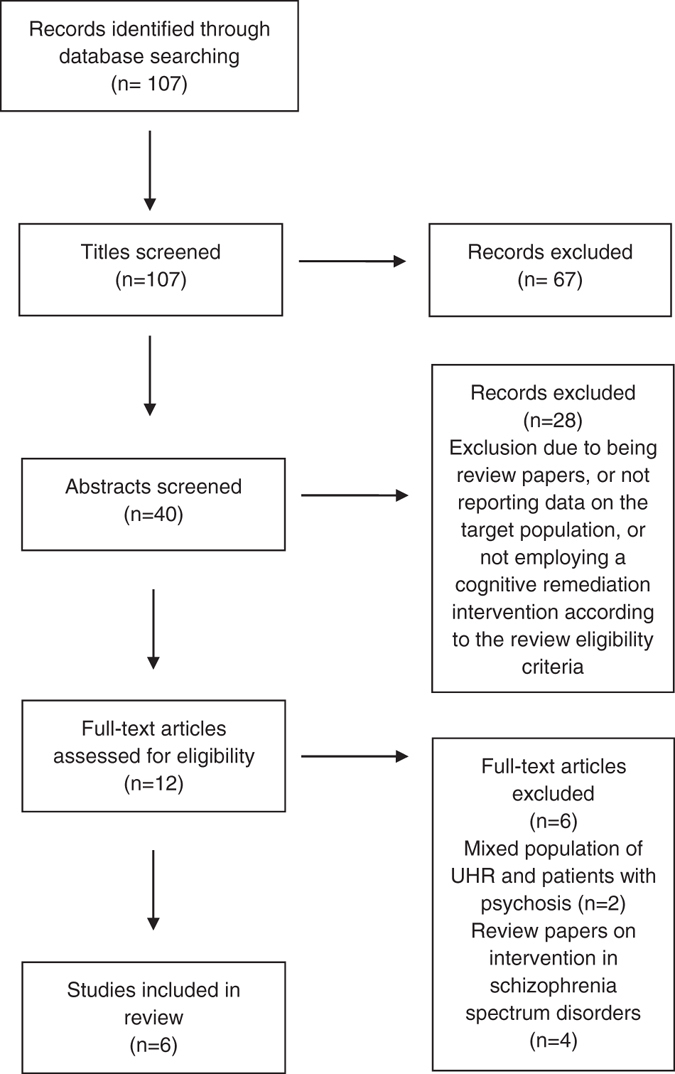
Cognitive deficits are prominent features of the ultra-high risk state for psychosis that are known to impact functioning and course of illness. Cognitive remediation appears to be the most promising treatment approach to alleviate the cognitive deficits, which may translate into functional improvements. This study systematically reviewed the evidence on the effectiveness of cognitive remediation in the ultra-high risk population. The electronic databases MEDLINE, PsycINFO, and Embase were searched using keywords related to cognitive remediation and the UHR state. Studies were included if they were peer-reviewed, written in English, and included a population meeting standardized ultra-high risk criteria. Six original research articles were identified. All the studies provided computerized, bottom-up-based cognitive remediation, predominantly targeting neurocognitive function. Four out of five studies that reported a cognitive outcome found cognitive remediation to improve cognition in the domains of verbal memory, attention, and processing speed. Two out of four studies that reported on functional outcome found cognitive remediation to improve the functional outcome in the domains of social functioning and social adjustment. Zero out of the five studies that reported such an outcome found cognitive remediation to affect the magnitude of clinical symptoms. Research on the effect of cognitive remediation in the ultra-high risk state is still scarce. The current state of evidence indicates an effect of cognitive remediation on cognition and functioning in ultra-high risk individuals. More research on cognitive remediation in ultra-high risk is needed, notably in large-scale trials assessing the effect of neurocognitive and/or social cognitive remediation on multiple outcomes.
认知缺陷是精神病超高风险状态的突出特征,已知会影响功能和病程。认知康复似乎是缓解认知缺陷最有前景的治疗方法,这可能转化为功能改善。本研究系统回顾了认知康复在超高风险人群中有效性的证据。使用与认知康复和超高风险状态相关的关键词检索了电子数据库MEDLINE、PsycINFO和Embase。纳入的研究需经过同行评审、用英文撰写且包含符合标准化超高风险标准的人群。共识别出6篇原创研究文章。所有研究均提供基于自下而上的计算机化认知康复,主要针对神经认知功能。在报告认知结果的5项研究中,有4项发现认知康复可改善言语记忆、注意力和处理速度等领域的认知。在报告功能结果的4项研究中,有2项发现认知康复可改善社会功能和社会适应等领域的功能结果。在报告该结果的5项研究中,没有一项发现认知康复会影响临床症状的严重程度。关于认知康复在超高风险状态下效果的研究仍然很少。目前的证据表明认知康复对超高风险个体的认知和功能有影响。需要对超高风险状态下的认知康复进行更多研究,特别是在评估神经认知和/或社会认知康复对多种结果影响的大规模试验中。