Jang Joanne W, Drumm Michael R, Efstathiou Jason A, Paly Jonathan J, Niemierko Andrzej, Ancukiewicz Marek, Talcott James A, Clark Jack A, Zietman Anthony L
Beth Israel Deaconess Medical Center, Boston, Massachusetts.
Department of Radiation Oncology, Massachusetts General Hospital, Harvard Medical School, Boston, Massachusetts.
Cancer Med. 2017 Jul;6(7):1827-1836. doi: 10.1002/cam4.1103. Epub 2017 May 31.
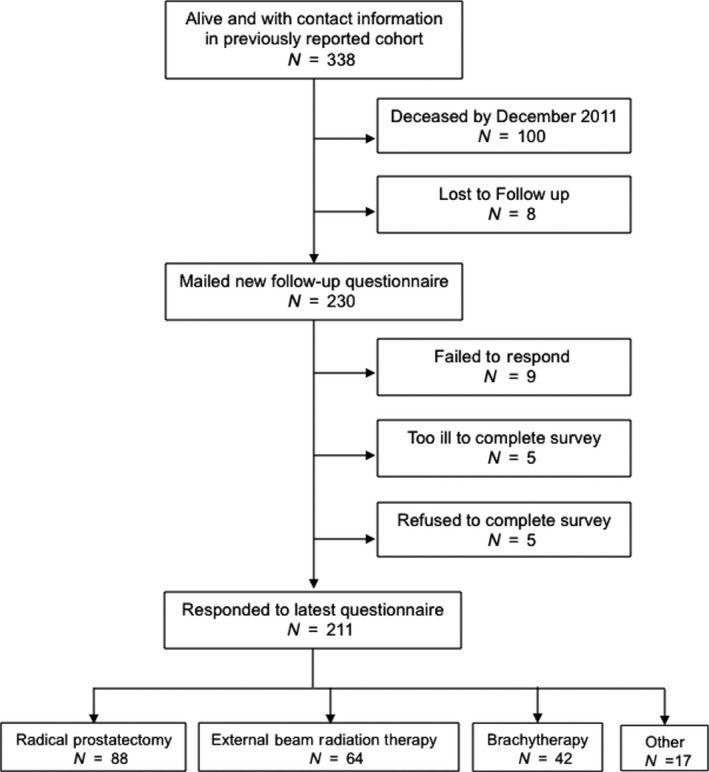
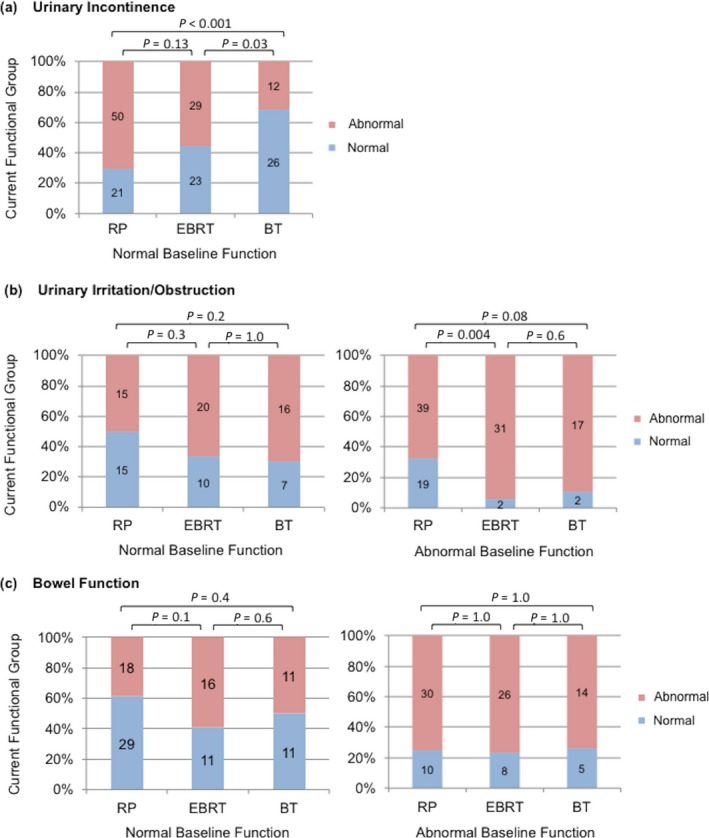
Definitive treatment for prostate cancer includes radical prostatectomy (RP), external beam radiation therapy (EBRT), and brachytherapy (BT). The different side effect profiles of these options are crucial factors for patients and clinicians when deciding between treatments. This study reports long-term health-related quality of life (HRQOL) for patients in their second decade after treatment for prostate cancer. We used a validated survey to assess urinary, bowel, and sexual function and HRQOL in a prospective cohort of patients diagnosed with localized prostate cancer 14-18 years previously. We report and compare the outcomes of patients who were initially treated with RP, EBRT, or BT. Of 230 eligible patients, the response rate was 92% (n = 211) and median follow-up was 14.6 years. Compared to baseline, RP patients had significantly worse urinary incontinence and sexual function, EBRT patients had worse scores in all domains, and BT patients had worse urinary incontinence, urinary irritation/obstruction, and sexual function. When comparing treatment groups, RP patients underwent larger declines in urinary continence than did BT patients, and EBRT and BT patients experienced larger changes in urinary irritation/obstruction. Baseline functional status was significantly associated with long-term function for urinary obstruction and bowel function domains. This is one of the few prospective reports on quality of life for prostate cancer patients beyond 10 years, and adds information about the late consequences of treatment choices. These data may help patients make informed decisions regarding treatment choice based on symptoms they may experience in the decades ahead.
前列腺癌的确定性治疗方法包括根治性前列腺切除术(RP)、外照射放疗(EBRT)和近距离放射治疗(BT)。这些治疗方法不同的副作用特征是患者和临床医生在选择治疗方案时的关键因素。本研究报告了前列腺癌患者治疗后第二个十年的长期健康相关生活质量(HRQOL)。我们使用经过验证的调查问卷,对14 - 18年前被诊断为局限性前列腺癌的前瞻性队列患者的泌尿、肠道和性功能以及HRQOL进行评估。我们报告并比较了最初接受RP、EBRT或BT治疗的患者的结果。在230名符合条件的患者中,应答率为92%(n = 211),中位随访时间为14.6年。与基线相比,RP患者的尿失禁和性功能明显更差,EBRT患者在所有领域的得分都更差,BT患者的尿失禁、尿路刺激/梗阻和性功能更差。在比较治疗组时,RP患者尿失禁的下降幅度比BT患者更大,EBRT和BT患者在尿路刺激/梗阻方面的变化更大。基线功能状态与尿路梗阻和肠道功能领域的长期功能显著相关。这是关于前列腺癌患者10年以上生活质量的少数前瞻性报告之一,并增加了有关治疗选择后期后果的信息。这些数据可能有助于患者根据未来几十年可能出现的症状,对治疗选择做出明智的决定。