Research Reactor Institute, Kyoto University 2-1010 Asashiro-nishi, Kumatori-cho, Sennan-gun 590-0494, Japan.
Light/Quantum Beam Field, Research Center for Advanced Measurement and Characterization, National Institute for Materials Science (NIMS), 1-1-1 Kouto, Sayo-cho, Sayo-gun 679-5148, Japan.
Nat Commun. 2017 May 31;8:15449. doi: 10.1038/ncomms15449.
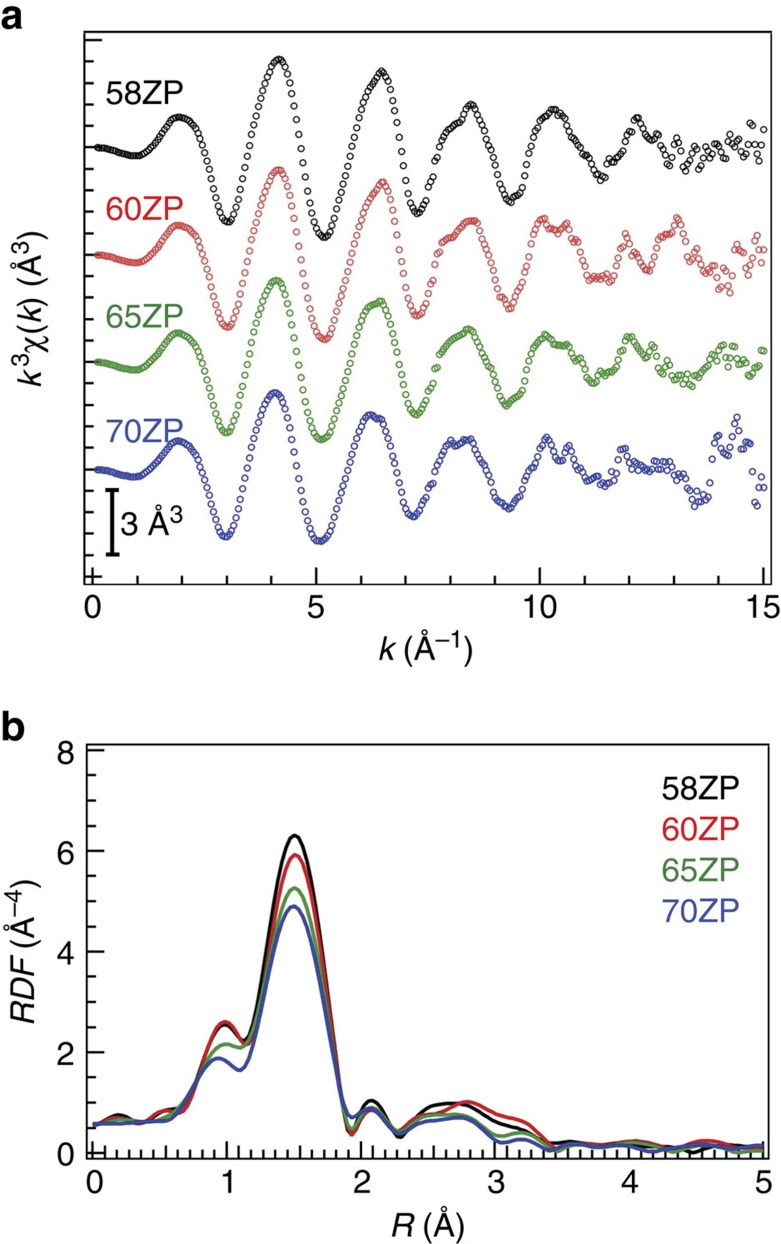
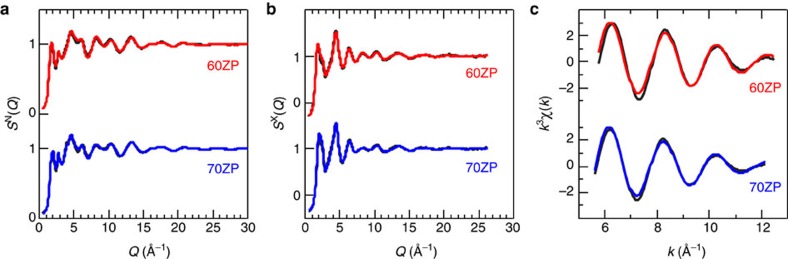
Understanding glass structure is still challenging due to the result of disorder, although novel materials design on the basis of atomistic structure has been strongly demanded. Here we report on the atomic structures of the zinc phosphate glass determined by reverse Monte Carlo modelling based on diffraction and spectroscopic data. The zinc-rich glass exhibits the network formed by ZnO (averaged x<4) polyhedra. Although the elastic modulus, refractive index and glass transition temperature of the zinc phosphate glass monotonically increase with the amount of ZnO, we find for the first time that the thermal expansion coefficient is very sensitive to the substitution of the phosphate chain network by a network consisting of Zn-O units in zinc-rich glass. Our results imply that the control of the structure of intermediate groups may enable new functionalities in the design of oxide glass materials.
由于无序的结果,理解玻璃结构仍然具有挑战性,尽管基于原子结构的新型材料设计强烈需要。在这里,我们报告了基于衍射和光谱数据的反向蒙特卡罗建模确定的磷酸锌玻璃的原子结构。富锌玻璃表现出由 ZnO(平均 x<4)多面体形成的网络。尽管磷酸锌玻璃的弹性模量、折射率和玻璃化转变温度随 ZnO 量的增加而单调增加,但我们首次发现,富锌玻璃中由 Zn-O 单元组成的网络替代磷酸盐链网络时,热膨胀系数非常敏感。我们的结果表明,控制中间基团的结构可能使氧化物玻璃材料的设计具有新的功能。