Xiao S, Liu Q, Hou M
Department of Hematology, Qilu Hospital, Shandong University, Jinan 250012, China.
Zhonghua Xue Ye Xue Za Zhi. 2017 May 14;38(5):394-398. doi: 10.3760/cma.j.issn.0253-2727.2017.05.008.
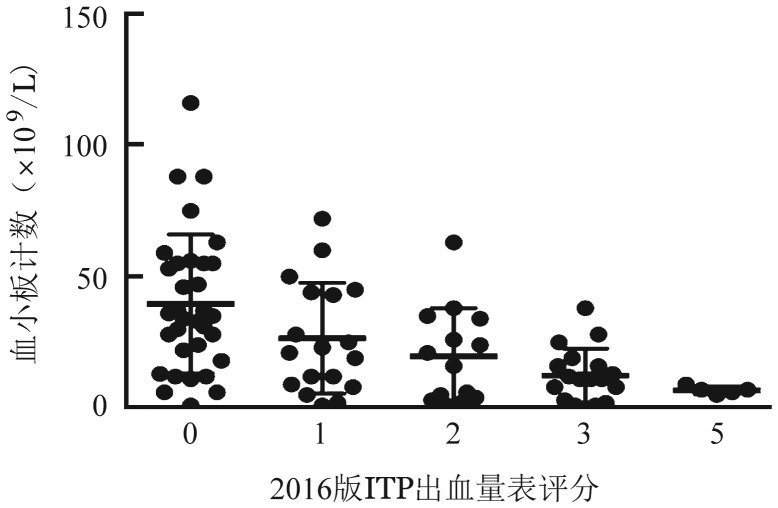
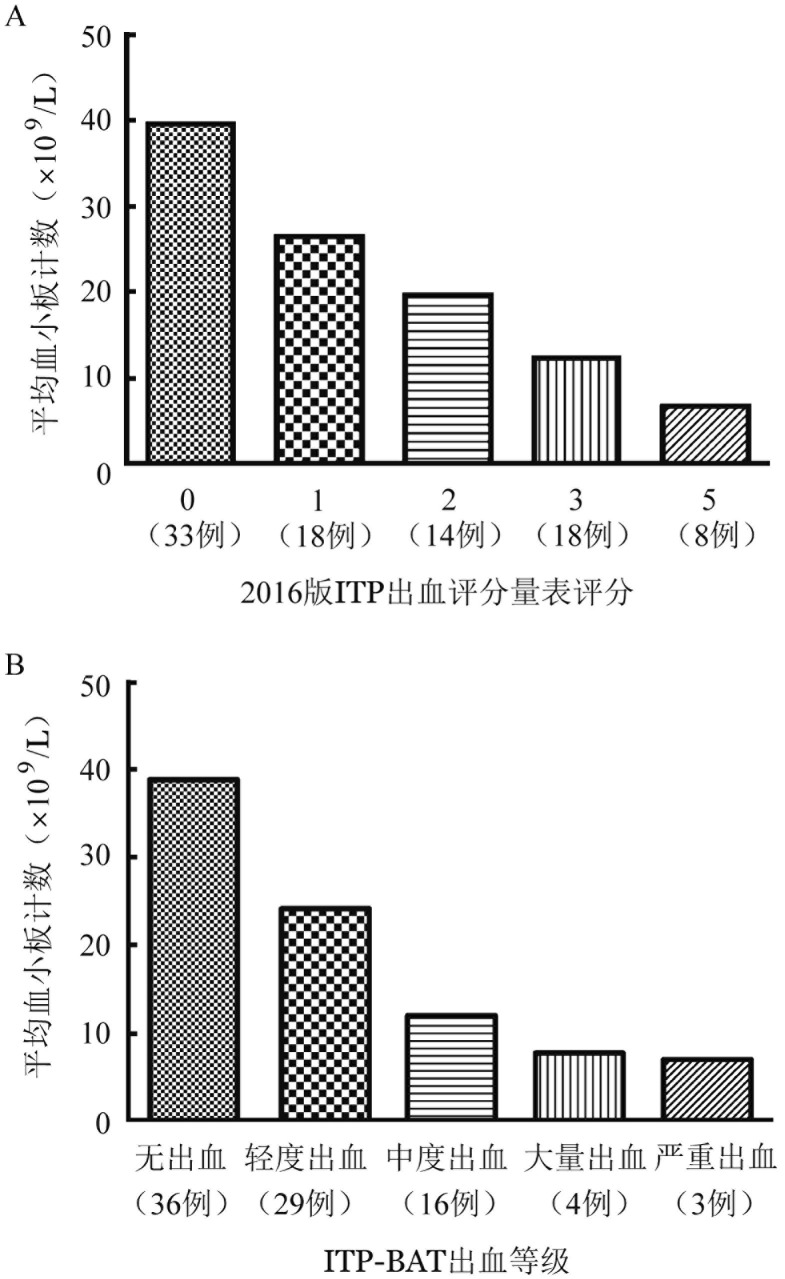
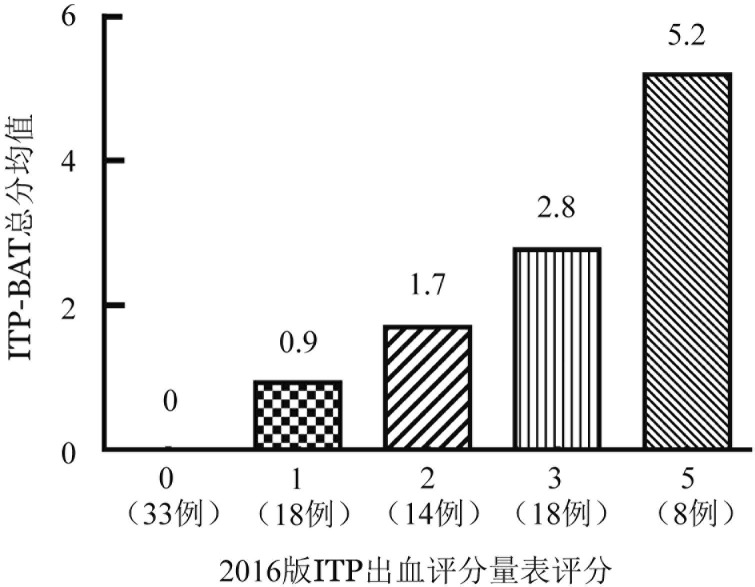
To evaluate prospectively the clinical significance of immune thrombocytopenia (ITP) bleeding scale (version 2016 of ITP bleeding scale) recommended in consensus of Chinese experts on diagnosis and treatment of adult primary immune thrombocytopenia (version 2016) by Chinese Medical Association. A total of 88 patients were assessed by ITP bleeding scale (version 2016) and ITP specific bleeding assessment tool (ITP-BAT) to analyze the association between bleeding score of ITP bleeding scale (version 2016) and platelet counts, gender, disease stage, also to evaluate interinstrument consistency between two bleeding grading systems. Among 47 newly diagnosed ITP patients treated with high dose dexamethasone, bleeding score of ITP bleeding scale (version 2016) and platelet counts were assessed before treatment, one week and two weeks after treatment, respectively, and the responsiveness of ITP bleeding scale (version 2016) was evaluated. Bleeding score of ITP patients was negatively correlated with platelet counts (=-0.515, <0.001) . Gender and disease stage had no significant influence on bleeding score (=4.255, =0.382; =5.251, =0.753) . ITP bleeding scale was in excellent agreement with ITP-BAT. Change of bleeding score of 47 ITP patients before and after high dose dexamethasone treatment had significant difference (=-5.612, <0.001) , also, the same result was observed in patients who didn't get complete response (=-3.969, <0.001) . Back-to-back scoring consistency of two doctors was 94.4% (=0.918) . It took less time to accomplish ITP bleeding scale (version 2016) than that of ITP-BAT [3 (2-6) min 7 (4-13) min, =-8.213, <0.001]. ITP bleeding scale (version 2016) has good responsiveness, strong assessment consistency, close correlation with ITP-BAT and less time-consuming in clinical application. It can be used as an effective tool of condition judgement, risk assessment and efficacy evaluation of ITP patients.
为前瞻性评估中华医学会成人原发免疫性血小板减少症诊断与治疗中国专家共识(2016年版)中推荐的免疫性血小板减少症(ITP)出血量表(ITP出血量表2016版)的临床意义。采用ITP出血量表(2016版)和ITP特异性出血评估工具(ITP - BAT)对88例患者进行评估,分析ITP出血量表(2016版)出血评分与血小板计数、性别、疾病分期之间的关联,同时评估两种出血分级系统之间的工具间一致性。在47例接受大剂量地塞米松治疗的新诊断ITP患者中,分别在治疗前、治疗1周和2周后评估ITP出血量表(2016版)出血评分和血小板计数,并评估ITP出血量表(2016版)的反应性。ITP患者出血评分与血小板计数呈负相关(r = - 0.515,P < 0.001)。性别和疾病分期对出血评分无显著影响(F = 4.255,P = 0.382;F = 5.251,P = 0.753)。ITP出血量表与ITP - BAT具有良好的一致性。47例ITP患者大剂量地塞米松治疗前后出血评分变化有显著差异(t = - 5.612,P < 0.001),未获得完全缓解的患者也观察到相同结果(t = - 3.969,P < 0.001)。两位医生背对背评分一致性为94.4%(κ = 0.918)。完成ITP出血量表(2016版)所需时间比ITP - BAT少[3(2 - 6)分钟对7(4 - 13)分钟,t = - 8.213,P < 0.001]。ITP出血量表(2016版)在临床应用中具有良好的反应性、较强的评估一致性、与ITP - BAT密切相关且耗时较少。它可作为ITP患者病情判断、风险评估和疗效评价的有效工具。